Friday, May 28, 2010

REVIEW: Mariko Rose The Spook


おばけのマリコローズ (Obake no Mariko Roozu)

Released: 2009

Director:
Devi Kobayashi

Starring:
Devi Kobayashi
Mutsumi Ogiso
Nao Muranaga
Kajin Takeshita

Kiichi Sonobe

Running time: 66 min.

Reviewed by Chris MaGee


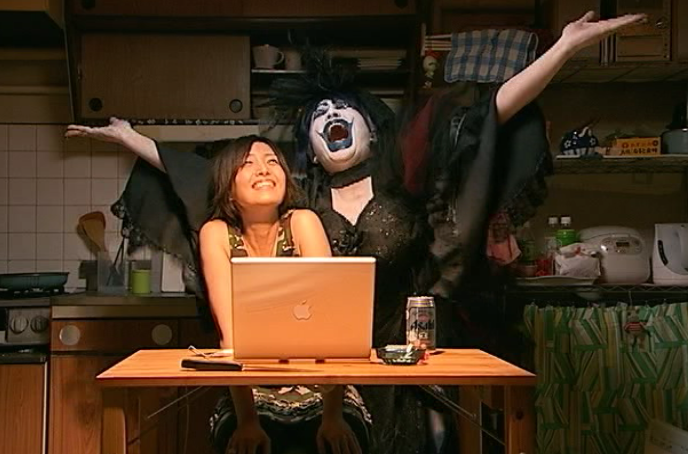
The first time we meet Negiko (Mutsumi Ogiso) she has a noose around her neck. We don't know why. We assume she's unhappy. In her hand she holds her cellphone with the picture of a woman on it. A friend? Her sister? It's unclear. What is clear is that this suicide attempt isn't going to go as planned, especially after the spectre of a woman wearing garish clown make-up appears before her and tells Negiko not to do it. The stool gets kicked out from under Negiko, but she thankfully survives to tell her friend Eiko(Nao Muranaga) (the woman on the cellphone it turns out), about a ghost that showed up in her apartment and told her "Don't do it!" Negiko remains vague on exactly the "it" she was doing at the time. So what was with Negiko grasping Eiko's photo? We get an inkling when Negiko sees her friend meet up with her boyfriend outside the karaoke bar they frequent. This isn't just the jealousy and self-pity of one woman who wants a boyfriend too. Headings back to her apartment she attempts suicide again, this time be slitting her wrists, and once again the ghost appears, and this time it calls Negiko on the exact reason why she wants to end it all - she's in love with Eiko. That and in lust. "She makes me wet!!!" Negiko yells in frustration. If you're reading this and thinking, "Gee, this sounds like a really bleak, depressing film," you'd be wrong. the ghost that comes to Negiko when she is most in need is "Mariko Rose The Spook", the title character in actor/ director Devi Kobayashi's zany and charming lesbian and gay comedy.

Yes Negiko has drama and unrequited love in her life, but when you compare that to living an eternity as a suicide, it's a piece of cake. Mariko Rose should know. She tells Negiko that she's been haunting her apartment for a century, since way back in the Meiji Era and as Mariko Rose says, "The afterlife... is a drag." Negiko doesn't know how true that is until she decides to do a little Google detective work to track down more information on this mysterious Mariko Rose. It turns out she was a he, Jusaburo Araki to be precise, Japan's very first drag queen, proprietress of Tokyo "boy's bar" in Shimbashi, Tokyo and victim of a love gone wrong with an army officer. Mariko didn't have a guardian spirit looking out for her and committed suicide after being dumped by her true love. Mariko doesn't mope about weeping and rattling her chains though. When she manifests herself before Negiko she's decked out in black lace and frills, her elaborate chapeau perched on her head at a jaunty angle and a permanent smile on her face like a cross between a GothLoli and Ronald McDonald. Mariko, not convinced that a boyfriend makes Eiko straight spurs Negiko on with a ridiculously funny and infectiously catchy musical number in which she sings "She could still be bi! She could still be bi!" The plan that Mariko hatches to literally scare Eiko in to Negiko's arm get derailed though when our lovely ghost gets a look at Eiko's amateur paranormal investigator boyfriend though. It turns out he's the reincarnation of Mariko Rose's beloved army officer.

"Mariko Rose The Spook" is an independent production with a capital "I". There's not much of a budget here; and the over-the-top, almost sitcom feel of the film normally wouldn't be something I would latch onto. What changed that for me though was 44-year-old director Devi Kobayashi who also stars as the titular spirit. While Mutsumi Ogiso shows some impressive comic timing with her performance as the lovelorn Negiko it's Kobayashi who steals the entire show and seriously camps it up as Mariko. While there's nothing really menacing or otherworldly about Mariko she would definitely be able send children into seizures of fear with her clown make-up. Mariko, despite being dead 100 years, is all about the joy of life though, not the fear of death; and when I say life I mean luscious and lusty life. Devi rivals the late great Divine with the amount of eyelash-batting and and overall diva presence. She pouts, scolds Negiko, steals her food, turns on household appliances with her "poltergeist power... baby!" and doles out pearls of wisdom like, "Love usually sucks. You're at the other person's mercy regardless of your orientation." She'd also love to just eat cute boys up and shows her trickster side when she uses Negiko's negative energy to take solid form so she can smooch Eiko's none too bright boyfriend and convince him to strip down to his underwear. Let's see Caspar the Friendly Ghost get that friendly...

A few years back Japan produced the wildly popular character named Hard Gay portrayed by pro wrestler-turned-comedian Masaki Sumitani. Hard Gay wore S&M gear and would pelvic thrust in commercials and variety shows all over the country. Hard Gay was also a nasty gay stereotype who's thankfully gone past his sell by date. Some, mostly people who haven't been lucky enough to see "Mariko Rose The Sppok" yet might worry that this drag queen from beyond the grave might be another negative stereotype like Hard Gay, but nothing could be father from the truth. While the character of Mariko is definitely a broad comedic type she's a queen full of good-natured campy humour and cheek and most importantly Kobayashi never whitewashes the same-sex love and desire featured in his film. Love is love whwther woman and woman, man and man, or ghost and reincarnated army officer. If the end of "Mariko Rose The Spook" is any indicator it won't be the last time that we see Mariko, and I sincerely hope it won't be the last time that we see such delightful filmmaking from Devi Kobayashi.

Varied Celluloid's VCinema Podcast features... Chris MaGee?!

by Chris MaGee

Okay, the latest VCinema Podcast hosted by Coffin John over at Varied Celluloid features an interview with some guy named Chris MaGee who seems to think he knows something about Japanese film. I don't know where they get these guys...

If you want to hear this Chris fella go on about the blog he runs and the film festival he helped start up in Toronto... well you can listen right here.

(Seriously, it was an honour to talk to Jon. Hope to do it again very soon. Thanks for the opportunity, Jon!)

Japan Cuts brings even more for New Yorkers to look forward to this summer

by Chris MaGee

It seems like summer in North America is the hot time for Asian, and especially Japanese, film fans. Marc Saint-Cyr already reported this week on the great line-up of films coming to New York City for this year's New York Asian Film Festival, but there are more Japanese films coming to the Big Apple this summer! The folks at The Japan Society are presenting their annual Japan Cuts festival.

Some of the4 films in this year's very impressive line-up are being co-presented as part of NYAFF '10. Highlights of that of course are Toshiaki Toyoda's meditative new film "Blood of Rebirth", Tetsuya Nakashima's turn to the dark side "Confessions", the phenomenally entertaining "Golden Slumber" directed by Yoshihiro Nakamura, Miwa Nishikawa's buzz-worthy drama "Dear Doctor", Momko Ando's same-sex romance "Kakera: A Piece of Our Life", and actor-turned-director Tomorowo Taguchi's sophomore film "Oh, My Buddha!" (above).

Japan Cuts will also be bringing films to New York that their head programmer Samuel Jamier says represent the best of the best releases from Japan that have (for some unkown reason) have not received a North American DVD or theatrical release - and he's right! Yuki Tanada's "Electric Button (Moon and Cherry)", Yoshihiro Nakamura's "The Foreign Duck, The Native Duck and God in a Coin Locker", and Toshiaki Toyoda's "Hanging Garden" to name only a few. All in all Japan Cuts spells a great couple weeks for Japanese film fans.

Japan Cuts 2010 runs from July 1st to July 16th at The Japan Society in Lower Manhattan. Check out their full line-up and get details about the fest here.

Shinya Tsukamoto + Nine Inch Nails = Purely awesome

by Chris MaGee

I'm just going to mention two names and see how they sit with you. Here goes... Shinya Tsukamoto and Nine Inch Nails. How does that strike you? Seems like a match made in heaven, or at least a grimy, bleak purgatory, right? Well the 50-year-old Japanese cyberpunk visionary and 45 year-old industrial mastermind Trent Reznor have teamed up so that NIN can add their aural assault to Tsukamoto's "Testuo The Bullet Man". Check out the track below. It's majestic, haunting... and it'll scare your house pets and set your grandparents teeth on end, which for a "Tetsuo" film is utter perfection.

Thanks to Wildgrounds for pointing the way to this.

REVIEW: Paco and the Magical Picture Book


パコと魔法の絵本 (Pako to Mahō no Ehon)

Released: 2008

Director:
Tetsuya Nakashima

Starring:
Koji Yakusho
Ayaka Wilson
Satoshi Tsumabuki
Anna Tsuchiya

Sadao Abe

Running time: 105 min.

Reviewed by Eric Evans


At some ice cream parlors, there exist special-order sundaes so absurdly huge that management will put your name on the wall if you finish one. These 20-scoop, 20-topping monstrosities blend dozens of flavors which are delicious on their own, but together? The first few bites might taste OK, but as time goes on the whole shebang melts into a rainbow soup of textures and flavors that is none too appetizing, and what should have been a treat becomes something unpleasant. These mega-sundaes epitomize the term "too much of a good thing."

And so goes "Paco and the Magical Picture Book". Co-written and wholly directed by Tetsuya Nakashima, the film employs similar thematic and visual tropes to those in his two previous films, "Kamikaze Girls" and "Memories of Matsuko", but is neither as narratively driven as the former nor as emotionally effective as the latter.

Ostensibly a children's film but too intense and meandering for most kids, "Paco" employs a greater number of fantasy sequences than Nakashima's earlier films, augmented here and there by CG animation. The story within a story (think "Princess Bride" on mushrooms) follows the misadventures of a number of colorful inpatients at a convalescent home, specifically how they endeavor to put on a live-action show based on the favorite storybook of a young girl living there (the titular Paco, played by perky Ayaka Wilson). That an already eccentric group of people (Anna Tsuchiya as a foul-tempered nurse, Jun Kunimora as a transsexual, and Koji Takusho as a mean-as-piss old man) will be acting out the story in homemade costumes should have provided enough visual interest, but Nakashima piles color on top of color, wig on top of wig, until the place looks like an entire world designed for the Johnny Depp version of the Mad Hatter to call home.

That the story and execution are Lewis Carroll-esque isn't the problem; some of the art direction is vibrant and over the top in just the right way. The mortal weakness of the film is that Nakashima doesn't balance these elements with a real world. Every aspect of the film is like one of Matsuko's fantasy sequences—technicolor everything, crazy costumes, sets covered in flowers or debris or both—and the effect is eye candy overload. Even the 'real world' where the story of the story is being told is all crazy sets and goofball characters—there's no respite from the zaniness. The story can't breathe, and you're never sure what's fantasy and what's reality. That doesn't have to be a bad thing, as in, say, Terry Gilliam's "Brazil". But even a filmmaker as occasionally over the top as Gilliam knows that fantasy ceases to be fantasy if there's no reality for comparison. That I would cite Terry Gilliam as a model of tonal restraint should tell you something about "Paco".

The shame is that so much of the film does work, starting with the performance by Yakusho as a sort of rampaging corporate warlord in his winter years. So mean that he hates that people know his name, he's the picture of fairytale villainous excess in an elaborate wig and flowing robes. He stomps and growls and yanks flowers from the ground, and it's only after he learns of Paco's unique problem that he begins to soften. Yakusho plays the part with an almost kabuki theatricality in order to rise above the visual chaos, but remains the emotional core of the film. It's a big performance. The rest of the cast is hit or miss, gnawing on scenery in an attempt to get noticed amid the clutter. Tsuchiya's role allows her to scowl and holler as she did in "Kamikaze", but also offers a surprising twist; a hapless Ryo Kase mugs his way through a thanklessly one-dimensional part as Yakusho's nephew, but seems uncomfortable throughout.

The movie is worth seeing, but only as a curiosity. A shame, because Nakashima's artistic progression from "Kamikaze Girls" to "Memories of Matsuko" was so striking. "Paco" feels weighted down with ideas and creativity, going from bombastic scene to bombastic scene without giving the viewer much to latch on to. By the time Nakashima hits the brakes to lay on the pathos it seems like an afterthought, like someone absentmindedly offering you a cookie after you've eaten a banana split. Quite simply, it's too much.

Studio Ghibli Museum gets two new short films by end of year

by Chris MaGee 

Even though Hayao Miyazaki has said that the chances of it happening are the same as The Beatles reuniting, the dream of all Studio Ghibli fans is that one day the Ghibli Museum short films will one day make it to DVD (Region 1, English-subtitled DVD please!!!). The 69-year-old animation master has directed a seven films that screen at the Mitaka, Tokyo-based Museum's Saturn Theatre, but he has always said that that is the only place that they will screen. So unless you're as lucky as our contributing writer Eric Evans who made a trip to the Museum last year we just have to read about these little marvels.

Now we're giving all of you a chance to read about even more Ghibli Museum shorts. Anime News Network is reporting that Miyazaki's seven shorts will soon be expanded to nine with the addition of "Pan-Dane to Tamago-Hime (Yeast and Princess Egg)" and "Takara-Sagashi (Treasure Hunting)" which will apparently begin screening between November of this year and May of 2011. "Treasure Hunting" sounds like it's easy enough to get our heads around, but "Yeast and Princess Egg"? I don't know if I even want to go there...

More plot details for Sion Sono's "Cold Fish" revealed

by Chris MaGee

In February we reported on the upcoming Sion Sono film "Cold Fish". at that time the details of the plot were a bit sketchy - based on a true story it tells the tale of two tropical fish dealers who slide into madness and serial murder after one of their daughters is held captive by the other. Madness, serial murder, kidnapping? Yup, that sounds like Sion Sono and the addition of tropical fish, well that's perfect as "Cold Fish" will be one of the first releases from Nikkatsu's newly created "extreme" genre wing Sushi Typhoon.

Now AsiaFilm.fr (via Wildgrounds) has brought us a much more detailed plot synopsis of "Cold Fish". A chirashi, or miniature two-sided poster distributed in Japanese movie theatres, was being handed out at the Cannes Film Festival and it spills the beans, or the cold fish, but don't worry there aren't any major spoilers.

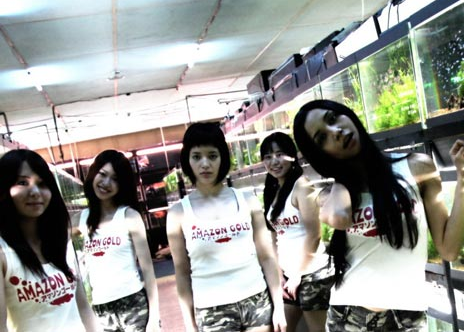
To paraphrase "Cold Fish" is about a tropical fish dealer named Shamato whose home life is less than happy. His second wife, Taeko, doesn't get along with his daughter, Mitsuko, and with reason. Mitsuko has a thing for shoplifting, and one day after lifting some items at a grocery store a mysterious man named Murata to smooth things over between Mitsuko and the store owner. Murata, who is also a tropical fish dealer (talk about coincidence!) is befriended by Shamato and Taeko, but soon they realize that Murata is a compulsive liar as well as being responsible for the grisly murder of nearly 50 people. Not sure how these murders fit in with the babes wearing the wife-beaters in a promo still from "Cold Fish" (above) that has been circulating, but...

Obviously things go down the aforementioned road to madness that is familiar territory for Sono. To get the full synopsis for "Cold Fish" (without spoilers) follow the link to AsiaFilm.fr above. "Cold Fish" is due out in 2011.

Weekly Trailers


Happy Ending - Atsuhiro Yamada (2009)


Momoko isn't your average girl. She's a movie buff, but not for the chick flicks that most of the other girls her age love. Her passion is slasher and horror films. She doesn't need all that girly crap! The only problem is that after meeting a young man at the library where she works she soon finds her horror-loving heart softening and her life begins to resemble the movies she hates so much.


The Mosquito on the 10th Floor - Yochi Sai (1983)

Director Yoichi Sai, the man behind such films as "Doing Time" and "Blood and Bones" tells the story of a police officer who is barely upholding the law and barely holding himself together. can anyone say "Bad Lieutenant"-Japanese style?

REVIEW: Yumeji


夢二 (Yumeji)

Released: 1991

Director:
Seijun Suzuki

Starring:
Kenji Sawada
Tomoko Mariya
Masumi Miyazaki

Tamasaburo Bando
Yoshio Harada

Running time: 128 min.


Reviewed by Bob Turnbull


If the final chapter of Seijun Suzuki's Taisho Trilogy (1991's "Yumeji") is possibly one of the most impenetrable and narrative-free works of his 54 film, 54 year career, it could also be the most stunningly gorgeous. It pretty much has to be, though, since plot and character arc are concepts dispensed with almost completely. As joyfully weird as later projects "Pistol Opera" and "Princess Raccoon" and as radically anti-studio and genre-defying as his late 60s "Branded To Kill" and "Tokyo Drifter" were, "Yumeji" feels like the full distillation of Suzuki's approach to the visual medium of film. It's a compendium of images and movement that can generate infinite layers of meaning individually, but when combined resolve to a coarse whole. It's how a delusional, multiple personality mystery author might dream while under the influence of hallucinogenics.

Each of the trilogy's parts is a standalone film with no further ties to the others except for having been set in Emperor Taisho's reign (1912-1926). Of specific note during this period is the gradual shift towards democratic rule, liberal mores and a broader, less isolationist view of culture. The first entry in the trilogy ("Zigeunerweisen") was based on a novel by Taisho-era writer Hyakken Uchida while this last one is based on poet and artist Takehisa Yumeji. Artwork appears throughout in transitions, as ghostly apparitions, as travel itineraries, sketches and in progress paintings while the scenery they exist within feel just as composed, colourful, detailed and meaningful as any of the art. The camera seems to want to explore the variety of corners and frames within the rooms and locations of the film and that encourages our own eyes to wander and gaze at the bright hues and interesting objects that show up repeatedly (a silver gun, a red and white candy-cane rope, a yellow boat, a red and white dress, etc.). It all lends itself to the surreal dreamscape (one of the other common factors between the trilogy's films) so that when rain is suggested by filming a scene through static streaks of blue, it's hardly surprising. But it sure is beautiful.

A few words about the "story". Yumeji has stopped off at a spa as he awaits his fiancee Hikono to arrive from the clutches of her father. They have plans to elope, but she is not overly healthy at the moment so it's proving difficult for her to get away. While he waits, he slides into the arms of a local prostitute and then decides to visit Hikono directly. Not quite ready to leave with him (or to consumate their relationship), he continues on his travels and meets and becomes infatuated with a woman named Tomoyo. Her husband has apparently been murdered by a roaming killer, but his body has not been found yet, so she searches for it in the lake on a daily basis. Once Yumeji becomes involved with her, a stranger arrives claiming to be Tomoyo's husband (and could very well be the man who shoots Yumeji in his dream that opens the film). To complicate things, one of Yumeji's models shows up as does Hikono. That's really only a rough guide to a variety of events - timelines jump ahead occasionally without warning (even within a scene) and it's rather difficult to recognize which of the many women is actually on screen at a given time due to their similar ways of dressing and hairstyles. It's likely part of Suzuki's plan, though, since Yumeji seems to be fascinated with the female body (with less consideration for the person) and can only sketch a particular one after being intimate with it.

One particular scene gives a good idea of how the film operates...Yumeji wants to sketch Tomoyo and requires her to be naked. He appears to be ready to sketch with all his tools as the camera cuts to a shot of a naked female with her long hair draped over her body and her face in shadow. Yumeji studies her for a few moments. The camera begins to circle her and as it does, a fully clothed Tomoyo comes in out of the shadows in the background and begins to rotate and move closer to the naked woman. The camera stops moving as Tomoyo stops right next to the model and they appear to be two halves of a whole. Cut to a close-up of the fully clothed Tomoyo looking back to Yumeji. He stares, looks down at his tools and prepares to mix a specific yellow pigment. As he looks back up, he pauses and then throws down the pigment in frustration. Cut to Tomoyo consoling him. It's a wonderful way to represent his attempt to picture in his mind her naked body without actually being given access to it. When he can't quite retain that image and the reality of Tomoyo's clothed self comes back to him, he can't continue. Via sharp edits that change the locations of characters, camera movement, non-sequiturs and lots of Dixieland music, Suzuki (who celebrated his 87th birthday earlier this week on May 24th) tries to give you an idea of an artist's internal view of the world and how it leads to his art. Let it wash over you and see what it does to your own dreams.

Read more from Bob Turnbull at his blog.

Iguchi's "RoboGesiha" comes to Dallas in July

by Chris MaGee

It's not just New York, and the East Cost with Fantasia and the Shinsedai Cinema Festival, that will be seeing high profile Japanese films roll into their town this summer. This week the Asian Film Festival of Dallas announced the first films of their annual line-up. Amongst films by Wilson Yip (Ip Man 2), Jing Wong (I Corrupt All Cops) and Arvin Chen (Au Revoir Taipei) the AFFD will be bringing tongue-in-cheek gore master Noboru Iguchi's film "RoboGeisha" to Texas' capital.

The film has a pretty razor-thin plot involving two sisters who are recruited into an army of cybernetic geisha assassins is certainly not Kurosawa (Akira or Kiyoshi), but that's not really the point. It has women with swords attached to their butts, geisha who transform into tanks and a giant kaiju monster masquerading as Osaka Castle. Who needs plot?

This year's Asian Film Festival of Dallas runs from July 23rd to July 29th, and if you haven;t seen the trailer for "RoboGeisha yet here it is to get you Texans motivated. Thanks to Twitch for the heads up.

Maki Sakai and veteran actor Tatsuya Fuji star in "Soup Opera"

by Chris MaGee

Anyone who has followed the J-Film Pow-Wow over the past couple years will know that I'm a huge fan of actor Tatsuya Fuji. The now 68-year-old actor came to fame in such films as Yasuharu Hasebe's "Bloody Territories" and "Stray Cat Rock: Sex Hunter" before becoming infamous with his sexually explicit performance in Nagisa Oshima's 1976 classic "In the Realm of the Senses". Fuji never dropped his pants for a role after that, but he didn't need to. He's an actor with immense screen charisma. Of late he's been starring in more feel good fare like Mitsuhiro Mihara's culinary-themed "Flavour of Happiness" and now it looks like he's following that up with yet another crowd pleaser based in the kitchen.

Tokyograph is reporting that Fuji will be starring opposite actress Maki Sakai (above) as a sauve older man named Tony in the screen adaptation of Sawako Agawa's novel "Soup Opera" Sakai's character, Rui, is a bit of a hot house flower who has been living with her elderly aunt for years. Rui ends up getting kicked out of the nest after her aunt finds love and she's forced to move in with Tony and a shy man named Kosuke (Takahiro Nishijima). The difficult living arrangements are eased by some hot steaming bowls of soup, or so the teaser trailer at Nippon Cinema leads us to believe. Things also get smoothed over by the presence of Kimiko Yo who rounds out the cast and who seems to be making a career of starring in major studio, homey crowd-pleasers like "Departures" and "Dr. Doctor".

"Soup Opera" is due out in Japanese theatres this fall.

Explore the world of Japanese sex films at New People's Viz Cinema

by Chris MaGee

I'm hoping that all of you have read Jasper Sharp's definitive and exhaustively researched book "Behind the Pink Curtain". Most likely due to reading his book many of you will have checked out the many pink films that have been finding their way to North American DVD via distributors like Pink Eiga and Mondo Macabro. Now, if you're in the San Francisco area you can take your investigation of pink films, roman porno and all that's cinematically sexy about Japanese film to the next level. No, not start surfing the net for free Japanese porn... we mean checking out S-E-X: TokyoScope Vol.4 “Hot Tears of Shame”, a talk on the history of Japanese sex films put on by Patrick Macias and Tomohiro Machiyama on Friday, June 11th at 7:00pm at New People's Viz Cinema. You can get more info about the talk here, and thanks to Patrick Macias' blog for getting the word out there.

REVIEW: Samurai I: Musashi Miyamoto


宮本武蔵 (Musashi Miyamoto)

Released: 1954

Director:
Hiroshi Inagaki

Starring:
Toshiro Mifune
Rentaro Mikuni

Kuroemon Onoe
Kaoru Yachigusa
Mariko Okada

Running time: 93 min.


Reviewed by Marc Saint-Cyr


1954 was a big year for Japanese cinema. Included in its bumper crop of notable films was Akira Kurosawa’s “Seven Samurai,” Kenji Mizoguchi’s “Sansho the Bailiff” (both recipients of the Silver Lion at that year’s Venice Film Festival), Keisuke Kinoshita’s “Twenty-Four Eyes” and Ishirô Honda’s “Gojira.” Another significant release was Hiroshi Inagaki’s “Samurai I: Musashi Miyamoto,” which would go on to win the honorary Academy Award for Best Foreign Language Film (before a competitive category was established). Starring Toshirô Mifune and spinning an exciting tale of feudal Japan , it proved to be a substantial and appealing film for Western audiences still in the midst of discovering Japanese cinema for the first time.

Based on Eji Yoshikawa’s novel about the renowned samurai Musashi Miyamoto who penned the strategic text “The Book of Five Rings,” the film begins in the year 1600. When we first meet Mifune’s character, he goes by the name of Takezo. He and his friend Matahachi (Rentaro Mikuni) are restless young men who yearn to achieve glory in battle. While Takezo is practically a free agent, Matahachi is bound by obligation to both his betrothed Otsu (Kaoru Yachigusa) and his mother Osugi (Eiko Miyoshi). Regardless, the two men enlist as foot soldiers and soon enough find themselves in the terrible Battle of Sekigahara – on the losing side. With Matahachi wounded, the two men discover the home of Oko (Mitsuko Mito), a widow, and her daughter Akemi (Mariko Okada). They spend two months there hiding and recovering, during which romantic tensions arise between them and their hosts. It is revealed that Oko and Akemi suffer from extortion at the hands of bullying brigands and strip dead samurai of their valuables in order to come up with the necessary payments. Takezo and Matahachi help fight off the thugs, but become separated when the women flee to safer settings. Matahachi goes with them while Takezo returns to their home village only to find himself a hunted man unjustly accused of deserting his friend.

Inagaki appropriately deploys a whole slew of cinematic techniques to illustrate the enthralling story. Crane shots, pans and tracking shots are all liberally used, giving the film a dynamic charge. The period setting is richly reconstructed through elaborate costumes and buildings (in some cases actual buildings, such as the Himeji Castle ). Another substantial element of its impressive production value is its use of Eastmancolor, wielded with great skill by cinematographer Jun Yasumoto. Like other notable color films from the 1940s and ‘50s (think Powell and Pressburger’s “The Red Shoes” and Renoir’s “The River”), “Samurai I” has a pleasantly vibrant look about it, as exemplified by blue and pink kimonos, swelteringly green underbrush and, in one sequence, a hazy yellow afternoon.

At the center of the film is Mifune, who gives another of his legendary, electrifying performances. While the film is called “Musashi Miyamoto,” it is in fact an origin story revealing how the legendary warrior came to be. Thus, for the majority of “Samurai I,” Mifune is not Miyamoto, but Takezo: an impulsive, reckless and undisciplined man who dreams of achieving fame through combat. Mifune portrays him with raw ferocity and rage that really comes through when the inhabitants of his home village work themselves into a state of near hysteria and launch a frenzied search for him. This effectively forces him to become an animal in the wilderness – a cunning survivor who must rely on his wits and strength in order to stay alive and avoid getting caught by the authorities. While hiding throughout the village, he makes contact with Otsu to tell her that Matahachi is alive, but wisely withholds the reason for his absence. One of the film’s most entertaining characters is the wise, good-humored Buddhist priest Takuan (Kuroemon Onoe), who has many great scenes with Takezo, matching his blunt anger with patience, ingenuity and spunk. Through many cruel yet comical methods, Takuan seeks to redirect Takezo’s brutal nature towards the purpose of doing good in the world, shaping him into the man who will be known as Musashi Miyamoto.

As plainly indicated by its title, “Samurai I: Musashi Miyamoto” is only the first part of a trilogy Inagaki made about Miyamoto. The structure of the film itself only reinforces its introductory status, as it is essentially one big exposition for character and story arcs that will be further explored in the later installments. While very well made and highly enjoyable in and of itself, “Samurai I” nicely fulfills its purpose as a grand setup for a bigger adventure that I am all too eager to continue following.

Read more by Marc Saint-Cyr at his blog.

Tuesday, May 25, 2010

2nd annual Shinsedai Cinema Festival announces first block of films!


by Chris MaGee


Since our inaugural year in 2009 so many great films have come out of Japan. Both Jasper Sharp (Midnight Eye) and myself have spent the past eight months watching as many of films as humanly possible so that they can bring the best independent, and in many cases under-appreciated, Japanese films to movie audiences here in Toronto. From July 22nd to July 25th, 2010 the Japanese Canadian Cultural Centre will be hosting this celebration of Japanese film, and while Sharp and MaGee are still putting the finishing touches on the 2nd annual Shinsedai Cinema Festival line-up we are proud to announce the first block of films that audiences can expect this year at the JCCC.


Live Tape - The Toronto Premiere of Tetsuaki Matsue's award-winning concert documentary featuring indie singer-songwriter Kenta Maeno. Shot on New Year's Day 2009 in one single unbroken take Matsue and Maeno take us on a musical tour of Tokyo's Musashino district. Winner of the top prize in the Japanese Eyes programme at the 2009 Tokyo International Film Festival and the Nippon Digital Award at the 2010 Nippon Connection Japanese Film Festival in Frankfurt.

Kenji Mizoguchi's The Water Magician - The silent 1933 classic by one of Japan's most revered directors is also one of Japanese cinema's very first independently produced films. The love story between a renowned female performer who literally makes water dance across the stage and an impoverished carriage driver will be brought to life with live musical accompaniment by Toronto experimental quartet Vowls. Not to be missed!

Confessions of a Dog - A gritty police epic that exposes the corrupt underbelly of Japanese law enforcement, Gen Takahashi's Confessions of a Dog was too controversial to receive a theatrical release in Japan. The drama that stars Shun Sugata as a police detective who not only bends the rules but breaks them ended up having to be distributed through Hong Kong to festivals world wide. We are proud to premiere the film in Canada and to have Gen Takahashi as our guest.

Island of Dreams - First time feature director Tetsuichiro Tsuta goes against the trend of shooting on hi-def video with his film Island of Dreams, an homage to 1960s films of Akira Kurosawa, Seijun Suzuki and Kinji Fukasaku. Tsuta and his crew not only shot this eco-thriller on 16mm black-and-white film, but also developed and edited the film entirely by hand.

The Dark Harbour - A hilariously downbeat comedy with a heart, Naito Takatsugu's The Dark Harbour will be having its Canadian premiere at Shinsedai. The story of a lonely fisherman who discovers a single mother and her son hiding in his closet The Dark Harbour brings to mind the straight-faced comedy of Finnish master Aki Kaurasmaki.

The Red Spot - Marie Miyayama's Japanese/ German co-produced debut feature is a touching drama about a young Japanese woman who travels to Bavaria to search for the exact spot where a car accident took the life of her parents and younger brother 18 years before. What she discovers in Germany is more than just a red spot on a map though.

Different Cities - Experimental video artist Kazuhiro Goshima uses subtle CGI-animation to clear Tokyo of all but a handful of its inhabitants in Different Cities. We follow five inter-weaving charca ters as they wake up to discover they've become lost in their own city.

Yuki Kawamura Trilogy - Musician, video artist, and now filmmaker Yuki Kawamura has crafted three touching Ozu-esque drama's about the impermamance of life and the magic that can be found in a single moment. Mixing traditional Japanese Noh theatre and modern hi-def technology these three films - Spark, Angel Robe and Grandmother - will be receiving their Toronto premiere at Shinsedai.

Ladybirds' Requiem - Artist and animator Akino Kondoh's first short film The Evening Traveling was a huge hit at Shinsedai last year, so this year we've not only programmed Kondoh's second animated short Ladybirds' Requiem, but we are featuring her 2004 painting Red Fishes as our official poster image. To top it all off Kondoh will be in attendance at this year's festival.

The full line-up and schedule for Shinsedai 2010 will be announced June 17th and ticket and passes will go on sale Jun 23rd, but until then get more details on this year's film festival by...

Visting the official Shinsedai 2010 website

Joining the Shinsedai 2010 Facebook group

Following the Shinsedai Cinema Festival on Twitter.

Subscribing to Shinsedai 2010's YouTube channel

Hope to see you all at the Japanese Canadian Cultural Centre for Shinsedai 2010 this July!

Our Top Ten Favorite Japanese Sci-Fi films


When many of us think of Japanese genre films we think of such tried and true forms as yakuza movies, chanbara films, horror movies and even softcore pink films. When it comes to a genre like science fiction, though, most people believe that Japan's contributions are limited to kaiju monster films and cyberpunk anime adventures. While some of these have definitely paved new ground for science fiction on screen it's a mistake to think that Japanese film has only given us men in rubber suits and dystopian animation. With that in mind we at the J-Film Pow-Wow wanted to present our top ten favorite Japanese sci-fi films. We think more than a few of these will surprise you, if only for their unique twists on this expansive cinematic genre. Enjoy!


10. Returner - Takashi Yamazaki (2002)

2002's "Returner" is by no means original: A determined viewer could chart its influences, scene by scene, from earlier (and better known) films, chief among them "Terminator", "Matrix" and "Independence Day". But what matters here is the execution, primarily in regard to creating world-class special effects in a U.S.-style blockbuster-type of film on a Japan-sized budget. At first blush the use of digital effects is limited to "Transformers"-style shapeshifting spacecraft and alien assault troops, but the DVD extras reveal that much of the film's scope comes from huge sets that don't exist at all other than as pixels generated by animators. This seamless CGI work would serve director Takashi Yamazaki well in his subsequent films, among them "Always: Sunset on Third Street" 1 and 2 and this year's "Space Battleship Yamato." Anne Suzuki is the emotional anchor the film needs as a time-traveler from a future Earth ravaged by war with extraterrestrials. Before you can say "Kyle Reese" she convinces anti-Triad, leather-trenchcoated ace gunman Takeshi Kaneshiro to aid her in her mission to stop this war with aliens before it starts. One of the film's less plausible elements is the villain, a crazed silver-haired Yakuza who wants the alien's weaponry for himself. But no matter. The bullets fly—in "Matrix" bullet time, no less—and our heroes utilize their wits, martial skill and a pinch of future technology to avert disaster. Yamazaki follows James Cameron's advice to young filmmakers: He keeps the camera low and keeps it moving. To his credit, the acting and action are effective, the CG work blends beautifully with the practical effects, and the result is a slick if derivative sci-fi film that succeeds as matinee-style entertainment. EE


9. Goke: Body Snatcher From Hell - Hajima Sato (1968)

"I think we're in for something that will blow our minds" says one of the characters in Hajime Sato's 1968 Horror/Sci-Fi film "Goke: Body Snatcher From Hell". If your mind doesn't quite get blown, I would venture to say that it may at least be a bit warped by the end. The movie opens with a lurid sky of red and orange as the backdrop for a plane in flight (blood red according to the pilot). Within the next few minutes we learn of a recent assassination of a British ambassador in Japan, see a bird have a bloody run in with the window of the plane, learn of a possible suicide bomber on board and see the plane crash after a close call with a UFO. You have to like a film that just dives right into things...The survivors - a politician, his wife, a weapons manufacturer, a psychiatrist, a young blonde American woman, the co-pilot, stewardess, the assassin AND suicide bomber - aren't getting along so well. There's great tension in the air that is exacerbated by the lack of water and made even worse when they find out via the radio that they are left for dead since search and rescue have no idea where they are as the plane has apparently simply disappeared. Of course, that's nothing compared to what happens once the assassin stumbles across the alien craft, has his head split open and then begins attacking the passengers one by one. It's all pretty silly, but scads of fun. Over-the-top acting? Check. Gory effects? You bet. Brightly lit and colourful environment? Oh yeah. Unsubtle political potshots? I'll put it this way, the politician says at one point: "Humanism! Just what we need!". Perfect goofy sci-fi entertainment. BT


8. Time Slip (a.k.a. G.I. Samurai) - Kosei Saito (1979)

At the centre of Kosei Saito's 1979 "Time Slip" (aka "G.I. Samurai") is a great performance by Sonny Chiba and a strong concept about a modern military outfit that travels back in time and meets samurai during the Warring States period. If it also has a bloated storyline, insignificant secondary characters and terribly misguided music, you can forgive it for the many things it does very well. Chiba plays Yoshiaki Iba, commander of a group of soldiers on maneuvers on a beach. Something seems amiss to them one night: Venus seems to be in the wrong spot in the sky and all their watches have stopped at exactly 5:18. Apparently caused by a solar flare of some variety, all the men on the beach and their vehicles and weapons are transported back in time. When they wake up they are back during a time of samurai and tribal warfare and seem to be right in the middle of a battle. They are able to repel the archers with their guns and this captures the attention of Kagetora, the leader of one of the tribes. Very quickly, Iba is drawn to him as well and realizes he has met a kindred spirit. Iba is frustrated by an inability to actually be a soldier as his life in the Showa Era is filled with peace and he can only lead his team through drills and exercises. Now he sees an opportunity to be part of history and participate in real battles. Kagetora invites Iba to help him conquer the country and to rule it with him - not simply because he has modern weaponry, but because he trusts and respects him. This relationship and the terrific half-hour long extended battle sequence are what make the movie work. It loses the opportunity to flesh out the many possibilities of how humans would respond to such a stressful and fantastical situation via its bland secondary characters, but fortunately that doesn't overly weaken the main premise: What would a man who wasn't made for these times do if he was brought back to the times he was made for? BT


7. 20th Century Boys - Yukihiko Tsutsumi (2008-2009)

From its city-stomping, poison-spitting giant robots to its elite police force dressed in Science Patrol-inspired orange jumpsuits and helmets, the near-future of "20th Century Boys" is a 9-year-old nerd's dream—in this case, literally. Summer 1969: Kenji, an elementary school student, passes his days with friends in a homemade grass fort writing the "Book of Prophecy," a science fiction tale of false prophets, doomsday viruses and terrorism on a massive scale. Fast forward three decades and the stories in the book start to come true, seemingly triggered by a masked cult leader known only as Friend. Based on his knowledge of the book, Friend must be one of their childhood chums—but which one? Over the span of three films and about 8 hours, the story of 20-year fight against Friend's tyranny unfolds, reuniting a small childhood gang in an effort to save the world from destruction. Well-documented (and apt) similarities to Stephen King's "It" aside, the three-film cycle of "20th Century Boys" is a vast entertainment, at times creating genuine tension and dread with its vision of a dystopian future. Elements of the story arc will feel familiar or even derivative to seasoned moviegoers, particularly fans of the original "Star Wars" trilogy and the "Lord of the Rings" films. (Ragtag group of friends on a quest to defeat a seemingly invincible foe, who happens to be faceless and represented by a giant eye symbol? Check!) And while very good across the board, the cast provides very few surprises in their roles. In fact, so cast to type are the actors that we had the mystery villain pegged 30 minutes into the first film. But the true star here is the scope of the future Japan depicted across the movies. Film one feels like an episode of "X-Files," all paranoia and conspiracy; film two a live-action anime, with bullet-dodging and virtual-reality time travel; film three—the best realized of the trilogy—runs the gamut from a walled-off Tokyo rebuilt to reflect the city of Friend's youth to flying saucers and a rock concert set against the backdrop of the world expo. None of the three films is a masterpiece, and each would benefit from cutting a half hour. But for fans of Japanese culture and near-future science fiction, there's no more fleshed-out realization of a world on the brink of chaos. EE


6. The Clone Returns Home - Kanji Nakajima (2009)

Surely one of the most impressive science fiction films to come out of Japan (and the East, for that matter) in recent years, Kanji Nakajima’s "The Clone Returns Home" adopts a fascinating approach to the familiar genre element of cloning technology. In the film, a space travel organization resorts to cloning human subjects in the event of fatal accidents – as a sort of life insurance in the most literal sense. The host’s memories are stored in a giant database, then uploaded to his clone(s) when needed. Nakajima mixes this ethically debatable method with the affecting story of Kohei (Mitsuhiro Oikawa), an astronaut who, as a boy, grew up alongside his twin brother Noboru (both youths played by real-life twins Ryô and Shô Tsukamoto) until an incident in a river resulted in the latter’s death. While on a mission, Kohei is killed, prompting his superiors to clone him shortly thereafter. This brings about a series of unforeseen consequences for the multiple Koheis that are created as well as his distressed wife. The film thus makes good use of the ideas surrounding cloning, but is ultimately a meditative study of childhood, sibling relationships, memory and identity. Stylistically, it bears a close resemblance to Andrei Tarkovsky’s own science fiction films – particularly "Solaris" (1972). Indeed, Nakajima, like the Russian master, situates most of the film in settings dominated by nature, enveloping the viewer and characters in rain, mist, wind, trees, rivers and fields overgrown with grass and shrubs. It is this vividly represented country setting that serves as the everlasting, time-conquered site of Kohei’s youth that he must revisit. The overall experience "Clone" offers is very much a spiritual one, its emotional core embodied by the anguished Kohei as memories of his mother and brother resurface and he struggles to find solace from the past. Gorgeously photographed and admirably crafted, "The Clone Returns Home" is an equally smart and stirring work of art. MSC


5. The Face of Another - Horishi Teshigahara (1966)

There are no futuristic cities, no spaceships, no aliens, time travel, clone or dystopian conspiracies - none of what has appeared on our list thus far - in our next pick for our favorite Japanese sci-fi films. What's behind Hiroshi Teshigahara's 1966 film "Face of Another" is a medical procedure so radical that it pushes it into the most profound science fiction territory. As were so many of Teshigahara's films "Face of Another" was based on a novel by absurdist author Kobo Abe and tells the story of Okuyama (Tatsuya Nakadai), an engineer horribly disfigured after an industrial accident. When he's made an offer by surgeon Dr. Hira (Eiji Okada) to become the subject of an experimental new prosthetic, a brand new artificial face, Okuyama can't say no. What, though, are the ramifications of having a face that's not your own, a face of another. It's this basic philosophical question that drives Teshigahara's film. Okuyama soon begins to enjoy the anonymity of wearing a mask and begins to behave not like his old self, but a brand new person, a person without accountability and inhibitions. He even tries to seduce his estranged wife (Machiko Kyo) both as a way to reconnect with her, but as a kinky strategy to test her fidelity to him. Dr. Hira's concerns about his medical innovation begin to come true - what would happen if we could all wear masks, if we could take on personaes that are not our own and subsequently free us from any personal resonsibility? As Dr. Hira observes, "We would all be strangers to one another." Wearing a prosthetic face may seem a little far fetched, but viewed through our internet age the powerful metaphor of technologically granted anonymity takes on a whole new meaning. With so many of us relating to friends, family and often total strangers through faceless chat rooms, message boards and social networking sites like Facebook and Twitter the dilemma that Okuyama finds himself in becomes disturbingly familiar. What other way can we determine the success of science fiction than when it becomes technological and sociological fact? That's exactly what Abe and Teshigahara did with the landmark film. CM


4. Tetsuo the Iron Man - Shinya Tsukamoto (1989)

Great science fiction is able to generate great new ideas, causing the viewer to think about realms of possibility previously uncharted. Shinya Tsukamoto’s stop motion phenomena "Tetsuo" manages to do just that, and in such a stark, gritty and original way. Combining the Kaiju film, avant-garde theatre and horror, Tsukamoto begins his penchant for exploring the realms of the human body; something our native David Cronenberg was much akin too. However Tsukamoto takes it to levels previously unseen. The kinetic style utilized by Tsukamoto may have been influenced by pre-cyberpunk genius Sogo Ishii, but Tsukamoto turned the human body into a thing of terror, mixing cyberpunk aesthetics with horrific visuals. And that’s not all. Through into the mix Tsukamoto’s base in theatre, particularly avant-garde theatre, and we get a film inspired as much by underground dance and stage performance as we do horror and science fiction. The use of the human body to express itself, not only as it fuses itself with metal, but also in its animated, theatrical motions, some of them dance like, becomes part of the vehicle that Tsukamoto uses to express himself. A frenzy of originality both narratively and visually, it also features the pulse pounding score by Chu Ishikawa. His industrial Armageddon styled sounds funnel mounds of anger and hatred onto the screen. You feel the grungy, post apocalyptic environment that actor Tomorowo Taguchi is becoming part of. As he becomes one with the cold, metallic world, so to does Ishikawa’s score become one with the images on screen. It’s a crazed, dirty mélange of sounds and images that create probably one of the most original science fiction films since the 1970’s. Yes, even more so than "Bladerunner". This is the anti-"Bladerunner". No shimmer. No beauty. No romantic notion of universal love between android and human (or android). No splendor with the union between man and machine. It goes against all of that. It pushes the genre into new, darker, realms. Places it should look. Inside of us. MH


3. Ghost in the Shell - Mamoru Oshii (1995)

It was practically a given fact that "Ghost in the Shell" would have a place on this list. One of the best known and most highly celebrated animes ever made, it is a certified classic of the cyberpunk genre and a key influence on "The Matrix." It follows cyborg police officers Batô and Major Motoko Kusanagi as they attempt to halt the sinister schemes of a mysterious criminal known as the Puppet Master. They search for him and his agents (some of whom serving him without even knowing it) through a futuristic Tokyo filled with colossal skyscrapers, colorful advertisements and grimy alleyways. The film has no shortage of action-packed sequences, some highlights including an enemy agent’s flight through a crowded market and the climactic battle between the heroes and a formidable, spider-like armored tank. Yet there are also some nice, quiet moments devoted to character and mood. At one point, the Major spends some of her free time diving to the darkest depths of the ocean. Afterwards, she and Batô drink beer and discuss what it means to be a cyborg in comparison to being human, the city’s lights glowing in the night behind them. There are also the wordless passages that simply focus on various areas of the giant metropolis, their poetic quality (partially created by Kenji Kawai’s dreamy score) certainly evocative of similar moments in "Blade Runner." "Ghost in the Shell" also poses many questions regarding what specifically qualifies as a life form and whether cyborgs and computer programs can possess souls. As the film glides along, it manages to balance all of these fascinating elements perfectly, ensuring that just the right amount of intense shootouts punctuate its clever and, some could say, prophetic depiction of cyberspace and information networks. MSC


2. Godzilla - Ishiro Honda (1954)

Throughout the American post-war occupation General MacArthur's SCAP (Supreme Commander of the Allied Powers) censorship policies forbid such themes and content as feudalism, the samurai code of Bushido, and the presence of the U.S. occupying forces themselves from Japanese movie screens. Besides these references to World War 2 were also forbidden, so the Japanese couldn't address the traumatic impact that the Allied fire bombings of Japan, the nuclear annihilation of Hiroshima and Nagasaki, and the subsequent surrender by Emperor Hirohito had on their national psyche. In 1952 the U.S. occupation ended and so did its strict film censorship policies. Just two years later Keinosuke Kinoshita would finally allow the Japanese to grieve with his defining film "Twenty-Four Eyes" about a school teacher who must see her elementary school class grow up to become fodder for the front lines, but what Kinoshita's film didn't address or allow to be expressed was the monstrousity of warfare, the total destructive power that was unleashed upon Japan in between 1941 and 1945. One film, relased in the same year as Kinoshita's maudlin masterpiece, that took on this horror was Ishiro Honda's genre-defining monster film "Godzilla". Starting out with a thinly-veiled retelling of the Daigo Fukuryū Maru Incident in which a Japanese fishing boat was exposed to lethal levels of radtion from a U.S. nuclear test on Bikini Atoll, a fishing boat is mysteriously sunk. When a resuce ship is also sunk and the survivors speak about a gigantic "thing" that may have caused the two disasters Dr. Kyouhei Yamane (Takashi Shimura) heads to a remote offshore island to get to the bottom of things. He soon discovers that the cuase of the nautical disatsers was a giant reptilian monster dubbed Godzilla by the island's natives. Godzilla has been awakened by U.S. nuclear tests and heads to mainland Japan to unleash its anger. While both Japanese and foreign audiences quickly latched on to the kitsch factor of the ungainly Godzilla suit used in production it would be a mistake to call Honda's original 1954 "Godzilla" anything other than an unrelenting allegory of WW2 and the A-Bomb. When the subject matter is too recent and too painful to address directly then what better way to tell the tale than through science fiction? CM


1. Akira - Katsuhiro Otomo (1988)

In my world, all science fiction begins and ends with "Akira". To an impressionable boy of fourteen, nothing in the science fiction world has obliterated my small feeble mind like Katsuhiro Otomo’s colossal masterpiece. It was the first film that opened my mind to Eastern religions beliefs, and did so in the form of bloody cancerous growth that consumed a large portion of Tokyo. It’s the one piece of science fiction that has been able to cross pollinate to other formats, and still retain its originality and scope (having Otomo do both the manga and the film obviously helps.) It falls in line with other great literary tomes like "Lord of the Rings" and "Dune", in which the worlds are so dense, filled with numerous intertwining tales, lineages that span unspeakable amounts of time, and history so finely detailed that the worlds become their own entity. What "Akira" lacks in literary density, it makes up for visually. Very few films are able to cram so many narrative and visual ideas into one 2 hour film. Each image speaks a thousand words. And that’s the other amazing thing about "Akira". It takes a huge manga, spanning thousands of pages, and condenses it into 2 hours. Not an epic 4 ½ monster like what is so popular now; instead all ideas are distilled into their perfect essence, and we are left with a science fiction film that explores the realms of religion, psychic combat, the origins of life and shifting nature of politics, and still retains its meditative stances on youth, the military and the moral corruption ultimate power brings. It’s frickin’ dense and frickin’ amazing! MH

New York Asian Film Festival Lineup Announced


by Marc Saint-Cyr


The New York Asian Film Festival has just announced its full lineup of films for this year, packing in a diverse selection of Midnight Movie picks and Korean, Hong Kong, mainland Chinese, Thai, Indonesian and, of course, Japanese films. Among the selections from Japan are Tetsuaki Matsue's "Live Tape," Hitoshi Matsumoto's "Symbol," Miwa Nishikawa's "Dear Doctor" and Tomo'o Haraguchi's "Death Kappa," along with many others. You can check out the Subway Cinema blog for the full lineup of films, arranged according to category.

The festival will be held between June 28th and July 8th at the Lincoln Center, with entries from the Japan Society's Japan Cuts: Festival of New Japanese Film series being co-presented from July 1st-4th.

Thanks to Twitch for the background info for this story.

When it rains it rains blood and bullets in "Gothic & Lolita Psycho"


by Chris MaGee

With school girls, ninja, and geisha all getting used as fodder in the gore films of Noboru Iguchi and Yoshihiro Nishimura we all knew that it was only a matter of time before GothLoli girls would get added into the mix. We've already reported on Go Ohara's new film "Gothic & Lolita Pscho", a tongue in cheek revenge tale about a a GothLoli girl named Yuki (Rika Akiyama) who must avenge her mother's murder at the hands of a group of assassins. She does this by dressing up in lace and frills, summoning the power of demons and by wielding a metal umbrella that drills, stabs and shoots. You can see all of what Yuki is capable of in this new trailer for "Gothic & Lolita Psycho".


While many of you know that I'm not the biggest fan of this new batch of gore films that have come out in the past few years I do have to say that this film is pretty clever in terms of marketing. When I've gone to screenings of "The Machine Girl" and "Tokyo Gore Police" here in Toronto the goth contingent in the audience is very high, so what better way to get butts into seats than a Gothic Japanese gore film. Kudos to Ohara on that count.

Thanks to Twitch for pointing the way to this.

"Battle Royale" to jump on the 3D bandwagon???


by Chris MaGee

Okay, yes... we're a little late to the pary with this news item, but it's been a week from hell getting the announcement of the first block of films for the 2nd annual Shinsedai Cinema Festival ready. So, our apologies for our tardiness, but we couldn't just let this story pass unmentioned.

There is an army of "Battle Royale" fans out there. This we know. So many of you came to Japanese cinema through Kinji Fukasaku's last film about a lass of high school students who are forced into a pitched battle for their lives on an abandoned island. Next to the classics of Kurosawa, Mizoguchi and Ozu "Battle Royale" stands as a contemporary classic, so we wnat to know what the studio execs at Toei are thing when the announce that they're going to be converting Fukasaku's 2000 film into a 3D format for a Japanese theatrical re-release happening this November. Okay, we know what they're thinking of - money. That being clear we're still dumbfounded as to the wisdom of messing with such a beloved film.

I guess we can be thankful that this isn't a remake, Hollywood or otherwise, but we here at the Pow-Wow are none to happy. How about you? If you haven't already spilled your bile about this on other comments and message boards then by all means spill away in the comments to let us know what you think about a rehauled "Battle Royale".

Thanks to Slash Film for the bad news.

Wednesday, May 19, 2010

Pow-Wow Off For the Week...But Good Stuff Is On The Way!

by Marc Saint-Cyr

Hello, all. Some of you might have noticed the lack of news updates that usually pop up every Tuesday on the Pow-Wow. That can be easily explained: Chris and the rest of us will be taking a short break so as to do a bit of catching up and, in Chris' case, prep work for the upcoming 2nd annual Shinsedai Cinema Festival (running July 22nd-25th). But have no fear - we'll be back up and running next Tuesday (May 25th), complete with a brand new Monthly Top Ten list and an announcement of the lineup of films for Shinsedai!

Your patience is very much appreciated. Catch y'all next Tuesday!

Friday, May 14, 2010

Kenta Fukasaku joins the rat race with upcoming slasher film "Black Rat"

by Chris MaGee

When you read a story about Kenta Fukasaku, son of legendary filmmaker Kinji Fukasaku and co-director of "Battle Royale II", helming a slasher film about a rat mask wearing female murderer killing her high school classmates in various gruesome ways... well you sit up and take notice. That's what I did when I read this story over at 24 Frames Per Second today. Fukasaku's "X-Cross" follow up tells the tale of six high school kids who are prompted to gather in a classroom at 1o'clock in the morning after getting a note from a female classmate who they thought had committed suicide. She may very well have, but they don't have time to puzzle things out because soon they're being sliced, diced and pummeled to death by the "Black Rat".

"Black Rat" is being released in selected Japanese theatres next month as part of the "Avex New Star Cinema Collection Vol.2" The other films in the series are Tetsuo Shinohara's "Ramune", Hisashi Nagashima's "As an Adult Swimmer" and Rin Tadashi's "Custard Pudding". You can check out the trailer for all four films below, but beware that "Black Rat"! She's vicious!

REVIEW: Yamagata Scream


山形スクリーム (Yamagata Sukurimu)

Released: 2009

Director:
Naoto Takenaka

Starring:
Riko Narumi
Akira
Naoto Takenaka

Maiko
Mirei Kiritani

Running time: 106 min.

Reviewed by Eric Evans


If imitation is the sincerest form of flattery, then somewhere in Hollywood Sam Raimi is blushing so hard he's in danger of rupturing a vessel. "Yamagata Scream" isn't shy about its influences, referencing them in a painfully obvious 'nudge nudge wink wink' way—it's more of a drinking game than a movie. And while films as diverse as "Mr. Vampire" and "Blade Runner" get nods (the former through ghouls that seem to hop everywhere like vintage Hong Kong movie vampires, the latter in a straight-up copy of Roy Batty's head-through-the-wall scare tactic), director Naoto Takenaka clearly has a special place in his heart for Raimi's "Evil Dead 2: Dead By Dawn" and "Army of Darkness", from the film's overall tone down to specific plot contrivances. But the problem is deeper than a monkey see, monkey do approach to direction. Beyond the shot-by-shot homages, the film's plot and characters are completely familiar—there are no surprises to be had, no fun twists or takes on the material, nothing new and exciting. Not only does Takenaka fail to up the ante on Raimi, he doesn't quite scale the giddy heights of the work he's so eager to homage. "Yamagata Scream" is fun but forgettable.

Four high school girls (Riko Narumi, Mirei Kiritani, Saaya Irie and Haru) and their teacher ("My Darling of the Mountains" star Maiko) take a fieldtrip to a small mountain town just in time for the destruction of a local shrine to activate an 800-yr-old curse. A samurai and his loyal men, betrayed and murdered by the townsfolk centuries earlier, rise from their graves with supernatural powers and seek vengeance against their betrayers' descendants. Chases, screaming, mild ooze and confusion all ensue. Add to that Narumi's physical resemblance to the zombie samurai's one true love, Takenaka's shameless mugging, and a ridiculous makeup job on Katsuhisa Namase making him look like Clarabelle the clown, and you can connect the dots.

Takenaka is a versatile and prolific actor, perhaps best known in Japan as the gray-haired Lothario conductor in the hit "Nodame Cantabile" TV show and films. North American fans will know him from "Water Boys", where he was the aquarium dolphin trainer and impromptu synchro-swim coach, or "Shall We Dance?" in which he sported a toupee; He's also done drama, such as "Where the Legend Lives" and a film in the "Perfect Education" series. That he's written and directed a handful of movies was news to me; What wasn't news was his friendship with Japanese horror/comedy crown prince Noboru Iguchi. Takenaka played a villainous koi fish Yokai in Iguchi's TV series "Kodai Shojo Dogu-chan", and Iguchi repays the favor with a comic relief featured role in "Yamagata" as a strangely effeminate tour guide, inappropriately dressed as some sort of scout but in a uniform 4 sizes too small. The link to Iguchi goes deeper, it seems: This film could (and arguably should) have been titled "Zombie Samurai Lover" or something shlockier, and it fits very easily into the current crop of horror comedies that so rankle J-film purists. With slightly more gore it would be a minor hit on the festival circuit where "Machine Girl" and "Vampire Girl Vs. Frankenstein Girl" have found appreciative audiences. As it is, there aren't enough laughs to call it a comedy and not enough sticky stuff to call it a gorefest.

Actress Riko Narumi basically hasn't stopped working for 5 years, but maybe she should take a break now and then. Hot off her tonally similar but superior "Crime Or Punishment??" and just before the one-two punch of "Bushido 16" and dance calligraphy film "Shodo Girls", "Yamagata Scream" represents something of a departure for her in that it asks so little of her unique talent. Narumi seems ill at ease playing cute, but she does do smart, pensive, and intense better than any other J-film star under 25. She doesn't seem to have it in her to play dumb, even when she really tries (as in "Crime"). Truth be told, "Yamagata Scream" would be a much better fit for a more cutesy slapstick actress like Takenaka's "Nodame" costar Ueno Juri. Ueno is much more at home mugging and screaming, and might have been able to milk more laughs out of some of the scenes which Narumi's somber seriousness derails. But hey, all this makes it seem as if Narumi was bad, and that's not the case: she's fine, just miscast. In this role she's probably closest to Neve Campbell in "Scream"—too busy being terrorized to realize that the rest of the film she's in is a comedy. She's better than the material, and deserves scripts which allow her to do what she does.

"Yamagata Scream" isn't exactly slow, but it doesn't crack along at enough of a pace to mask its shortcomings. In a post-"Evil Dead 2" world, if you're going to do horror comedy in the same vein you must bring something new to the table. Iguchi has, "Vampire Girl vs. Frankenstein Girl" director Yoshihiro Nishimura has, but Takenaka hasn't. There are laughs and a couple of gross-out moments, but despite the cast's best efforts there's nothing here to elevate the movie beyond cult fringe status.

A pair of Japanese films for this year's CFC Worldwide Short Film Festival

by Chris MaGee

This past week the CFC Worldwide Short Film Festival, running June 1st to June 6th here in Toronto, announced their full line-up. There's good news and bad news for Japanese film fans. Let's get the bad news out of the way first - This year there are only two films in the line up from Japan. Yes, it might be bad news, but it's a minor gripe compared to the good news. That is that the two films programmed are Eisuke Naito's supernatural serial killer short "Prince of Milk" (above) that screened with the neo-noir thriller Yutaka Koide's "So Dark Nights" at this year's Nippon Connection Japanese Film Festival in Frankfurt, and Tetsuo Suzuka's "Clear Skies in May", an Ukiyo-e print come to life that you can catch a glimpse of in the YouTube video below. Both of these are great looking films and considering that Toronto has got the phenomenal Toronto Japanese Short Film Festival we're lucky to have a feast of short films here in the city.

Many more pros than cons and the CFC Worldwide Short Film Festival has so much more to offer in shorts from around the globe that film lovers won't want to miss it. To check out the full line-up and get ticket info check out the 6-day fest's official website here.

More casting for Shunji Iwai's upcoming vampire film "Vampire" revealed

by Chris MaGee

It was in March that it was announced that "All About Lily Chou-Chou" and "Swallowtail Butterfly" director Shunji Iwai was going to be returning from what seemed like self-imposed artistic exile to helm an English-language vampire film. At that time no title had been announced for the project, but it was revealed that Kevin Zegers (Trans America) would be starring opposite Yu Aoi and Amanda Plummer in the story of a shy young man who trolls the internet chatting up lonely women in an attempt to win them over before he drains their blood.

Now Nippon Cinema has revealed the title and additional casting for Iwai's film. This new vampire film, currently shooting in Vancouver, is simply being called "Vampire". Oooookay... Not the best title on the planet, that's for sure. The good news is that the full cast is looking better and better as time goes on. Keisha Castle-Hughes (above right), famous for her role in "Whale Rider", and Rachael Leigh Cook (above left) have been added to the cast along with Kristin Kreuk, Adelaide Clemens and Trevor Morgan; and it appears that the storyline is a little bit different than we had expected. Zegers will in fact be playing a school teacher... and yes, a vampire, not just a shy young man.

Even though everyone is getting a bit tired of the "Twilight" vampire trend you have to admit that it's a genre that never gets old (bad pun). With a director with the visual flare of Iwai this might work. I say might though. We'll have to reserve judgment until "Vampire" (hate that title!) hits theatres next year.

HOT DOCS '10 REVIEW: Gaea Girls


Gaea Girls

Released: 2000

Director(s):
Kim Longinotto &
Jano Williams

Starring:
Chigusa Nagayo
Meiko Satomura

Saika Takeuchi
Yuka Sugiyama

Running time: 104 min.


Reviewed by Chris MaGee


Wrestling was a sport I grew up with. Before coming to Toronto in the late 50's my father had already done the rounds in Manitoba and Alberta fighting as a semi-pro wrestler and bantam weight boxer. My mother would tell me about how she and my dad had been at Maple Leaf Gardens the night that Gorgeous George Wagner lost to Whipper Billy Watson and had his curly blonde locks buzzed from his scalp in defeat. Most Saturdays and Sundays I sat with my Dad and watched the NWA Wrestling matches broadcast from legion halls across Canada, some of them taking place as close by as the old Downsview Arena a short walk from the house I grew up in. Of course my upbringing ended up dovetailing into the WWF Wrestling boom of the early 80s with Hulk Hogan, Jesse the Body Ventura and Andre the Giant. As I grew up, and in some ways out of wrestling, the sport morphed from an often bloody spectacle into what the WWF's chairman Vince McMahon would call "sports entertainment" - mostly bloodless, glossy, Las Vegas-like spectacle. One aspect of pro-wrestling that drastically changed from when I was young was female wrestling. The ballsy and not particularly beautiful brawlers like The Fabulous Moolah eventually gave way to centerfold fighters like Canadian Trish Stratis, "athletes" more concerned with T&A than T'N'T. When I recently attended the Hot Docs screening of Kim Longinotto's and Jano William's "Gaea Girls" though I was taken right back to the golden days of the wrestling of my childhood.

"Gaea Girls" chronicles the world of wrestler Chigusa Nagayo and her league of female fighters dubbed GAEA Japan (Gaea, or Gaia, being the supreme Greek goddess). Founded in 1995 the league is hugely popular in Japan, popular enough to capture the attention of British documentary filmmaker Longinotto. Having previously shot documentaries in Japan on the all female Takarazuka Revue (Dream Girls) and the onnabe, female hosts living as men (Shinjuku Boys) Nagayo's fighters seemed like the logical next step. The world that Nagayo and her league inhabit is far from the flash and dazzle of American pro-wrestling though. Yes, the footage that opens "Gaea Girls" that has an empty ring filled with strobe lights while a booming announcer's voice declares "We are violent! We are freak out!" is sheer theatre, but the matches put on by GAEA Japan are deadly serious. The crowds (mostly female it seems) eat it up though.

What's even more serious than the squared-circle show though is the grueling training that goes on behind the scenes, the meat of GAEA Japan that Longinotto shoots firsthand, both in the practice ring and throughout the GAEA training gym. Nagayo, her hair cut short to prevent her opponents from pulling on it and died platinum blonde for affect, swaggers amongst her senior fighters like Satomura, a viciously talented fighter, but a bit of a bully, and a series of pledges - Higashiyama, a beautiful young woman who never seems 100% committed to life as a GAEA wrestler, Sato, a pig-tailed youngster whose mother brings her to train with Nagayo, and Takeuchi, a young, mousy woman who burns with a fire to prove to GAEA Japan that she has the stuff to get into the ring with them. It's Takeuchi's story that forms the spine of the film. She not particularly talented as a fighter, she lacks the anger and the flare to be a good wrestler. Through her many sparring matches with the GAEA girls she makes a lot of noise, but seems fearful - fearful to let go, fearful to hurt her opponent, fearful to go the extra inch. yard, mile outside of herself and abandon the polite and pretty young woman she is and to become the warrior she needs to be. Longinotto admitted in interviews and in the Q&A session that followed the Hot Docs screening of "Gaea Girls" that she was shocked and sometimes weot while filming the rabid cruelty that Takeuchi was subjected to during her sparring matches with the senior fighters. One particularly bad match with Satomaru leaves her with clots of blood pouring from her mouth. Shocking for the audience watching the film, but equally as shocking for the pledges and some of the GAEA Japan wrestlers who can't bear to watch what this young woman is being put through and instantly retire from the sport. Takeuchi doesn't let the stitches, the hairline fractures, the bruises and the humiliation stop her though.

"Gaea Girls" is without a doubt a film about wrestling, but in the end Longinotto's and William's documentary is about so much more. First it shows us an avenue for Japanese women eager to do something for themselves, something that doesn't involve taking a job that they'll just give up when they get married and settle into domestic subservience, a reality that persists to this day in Japan. It's also an examination of the senpai/ kohai, or master/ apprentice system of seniority in Japanese society, Nagayo playing the cruel mother... or more like cruel father... who must be respected and deferred to at all times whether it be in the ring or out in the living area where sweeping, daily chores and the punishing exercise regimen seems to be designed just as much to put the young recruits in their place as it is to harden them to fighting. In the end "Gaea Girls" is not an intellectual examination of socio-sexual politics in Japan though. It's compelling human drama mixed with the kind of underdog makes good story that was the key to the success of the "Rocky" films and the story arch of so many pro-wrestlers. The audience at the Hot Docs screening of "Gaea Girls" was on the edge of their seats throughout Takeuchi's multiple backstage qualifying sparring matches. That goes for my girlfriend, Polly Esther, the first fighter in Toronto's own league of women fighters, The Pillow Fight League. Like I said, wrestling has been a part of my upbringing and is still a part of my life. I think the biggest stamp of approval for "Gaea Girls" comes from the fact that Polly, now retired from fighting, left the theatre with many fond memories of the hard but rewarding life of being "Violent!" and "Freak-out!" that GAEA Japan represents. To have someone who lived a story like Takeuchi's and Nagayo's... Well, that's a documentary that comes highly recommended.