Sunday, July 31, 2011

Our Top Ten Favorite Fight Scenes


We at the J-Film pow-Wow run into a lot of our readers at screenings and festivals. It's fun (and quite humbling) to know that there are people on the other side of our keyboards and laptops who love Japanese film as much as we do. One thing that comes up a lot when we chat with you are the films that got you into Japanese film in the first place. A common thread that runs through these first introductions to the cinema of Japan are action movies, and specifically ones that feature some truly amazing knock down, drag 'em out fights. Japanese film-makers have given us scenes of sword fights, martial arts combat and bare knuckle brawling whose violence, energy and skill stick in audiences' minds for days, months, year... and sometimes forever. That's why this month we wanted to share with all of you our top ten favorite fight scenes. We expect a lot of you out there will have varying opinions on our picks, so the only thing to do is put your fists where your mouths are and fight it out with us in the comments!


10. The Final Fight - Samurai Rebellion (Masaki Kobayashi , 1967)

It's almost a full two minutes before Isaburo (played by a seriously intense Toshiro Mifune) and Tatewaki pull their swords out in their final encounter towards the end of Masaki Kobayashi 1967 film "Samurai Rebellion". Once they do, it's less than half that time before their battle is finished. So why does this make the list? First of all, that's only half the story...Once that particular skirmish has finished, Isaburo needs to get back to the little baby he has left waiting for him, but first he has an army of rifle bearing and sword wielding soldiers laying wait for him under the cover of brush in the field. Shots ring out from barrels held by still hidden soldiers while Isaburo dives into the growth. He's hit numerous times, but still hacks away at those soldiers foolish enough to only be armed with a sword. Kobayashi mixes in long shots and closeups to show the progress through the field and the immediate results. Isaburo's riddled body continues forward as he calls out the child's name. It's a hell of an ending, but made even more so due to that first one-on-one showdown. As the two combatants circle each other before even the first glint of sunlight comes from their swords, the winds howl through the open spaces and crops of the field. Isaburo suffers the first slash in their jousting battle - this isn't the standard clang-clang-clang sword fight as it occurs in quick single passing shots - but his determination screams through his silent glare. It's all quite magnificent and gorgeously shot and closes out one of the best films about the courage of a samurai ever made. BT


9. Blood in the boxing ring - Tokyo Fist (Shinya Tsukamoto, 1995)

Many of the scenes on our list deal with the mechanics of fighting, the way someone can master the moves of violence, but one film on our list took it a step further and looked at the motivations of violence. That is "Tokyo Fist" directed by Shinya Tsukamoto. Like his 1989 breakthrough "Tetsuo the Iron Man", "Tokyo Fist" is about the transformation of the body, but unlike its cyberpunk predecessor it doesn't leave the reasons of its characters' metamorphosis a mystery. Like a pitch black take on those old Charles Atlas comic book advertisements showing a 98-pound weakling beefing up to take on a muscled bully, "Tokyo Fist" introduces us to salaryman Tsudo and his fiancée Hizuru. At first they are the standard, polite couple... that is until the arrival of Kojima, a prize fighter who wants nothing more than to pound Tsudo into submission and run off with his bride-to-be. Sure, Tsudo doesn't want this sexual aggressor to steal his woman, but in his heart he also doesn't want to have his pride hurt. So begins his training to turn his sinewy body into a killing machine. Meanwhile Hizuru finds her own method of physical transformation through pain - piercing and body modification. This narrative transformation of that old Charles Atlas ad injected with a healthy dose of the dangerous obsessions of a J.G. Ballard novel climaxes in one of the bloodiest boxing scenes committed to celluloid. Tsudo faces off against Kojima in the ring, but has face beaten into ground beef by his opponent. Meanwhile we see Hizuru engaging in her own blood-bathed ritual involving surgical steel bars inserted under her flesh. Unlike all the other fights on this list, Tsukamoto repels us with violence while enticing us to take a look at our darkest urges and instincts. CM


8. Man battles cattle - Karate Bullfighter (Kazuhiko Yamaguchi, 1977)

Sonny Chiba helped to popularize the Karate oriented fighting style during the 70’s, clearly separating itself from the more graceful and dance-like duels of many of the Shaw brothers films from China. Chiba was a raw and aggressive machine whose form was an afterthought as long as his fists overcame whatever challenge he faced. This is epitomized in "Karate Bullfighter", the first of a trilogy of films detailing a fictional account of the life of Mas Oyama, one of Chiba’s teachers and the creator of Kyokushin Karate, a style that prides itself on full contact sparring. One folktale tells us that Oyama fought bulls to test his strength, knocking them out with a single blow, and so one of these battles is recreated here, with Sonny Chiba battling a real bull. Yes, a real bull. If you thought the shark versus zombie from Lucio Fulci’s "Zombie 2" was the most bizarre fight you’ve ever seen, you haven’t seen anything until you’ve seen Sonny Chiba holding a real bull by the horns and punching it in the head. The shark in "Zombie 2" was drugged, and clearly so as it moves lethargically during the battle. Here, there appears to be no trickery like that. This is a fight that could only have been done in the 70’s, not only for the fact there are laws protecting animals from being punched in the head for our entertainment on screen, but also because I’m sure very few actors today would put themselves in that much danger, nor would studios and insurance companies allow it to happen. Sure the other fights in the film are pretty brutal and breathtaking, but nothing is as incredible as watching Chiba match his strength to a real bull. MH


7. Stripped down combat - Sex & Fury (Norifumi Suzuki, 1973)

A good fight should be a mix of skill and strength with a healthy dose of stripped down animal rage. There are few fights on our list (or anywhere for that matter) that are as stripped down as the one between Ocho (Reiko Ike) and a group of assassins in Norifumi Suzuki's 1973 classic "Sex & Fury". Pickpocket Ocho finds herself in a little more trouble than she's used to when she begins to track down the man who killed her father years before. Vengeance is hard work, so Ocho decides to take a soak in a local bath house; but danger doesn't take time for a woman in in the tub. As Ocho suggestively soaps her ample bosom a group of men wielding katana burst in. Facing death Ocho doesn't have to time to think about propriety, she just grabs her sword and starts fighting... in the nude! Norifumi Suzuki was one of Toei's most called upon directors of its Pinky Violence films, pictures that combined bloodshed with boobs, so the concept of of a nude sword fight makes sense. What makes this scene from "Sex & Fury" stand apart from other Toei titillation, though, is not the level of combat skill, but that of film-making skill. Suzuki and Ike combine amazing fight choreography with the nudity required by Pink Violence films, but it's the editing that is truly masterful. As per Japan's screen censorship laws film-makers could not show pubic hair in their films. Suzuki and editor Osamu Ichida cut together the sequence so that it's not only exciting, but so that we get to see her breasts and behind, but never a whisper of hair between her legs. Not an easy task when you're fighting al fresco... CM


6. Slo-mo extravaganza – Milocrorze: A Love Story (Yoshimasa Ishibashi, 2010)

“Milocrorze: A Love Story,” Yoshimasa Ishibashi’s debut feature, is chock full of cinematic delights. Composed of four stories, it shifts genres with bold abruptness; packs the frame with a dizzying array of colors, effects and gags and keeps a remarkable momentum of fun and energy going. The tour-de-force sequence of the whole film arrives in the third segment, which finds Takayuki Yamada (who plays all of the main male protagonists) as a ronin traveling across a feudal land in search of his true love. His travels bring him to a brothel where a tense confrontation in a gambling den dissolves into a massive, “Kill Bill”-style swordfight. What makes this lengthy sequence so audacious is Ishibashi’s choice to have it play out in extreme slow motion, with fast motion “flashes” sprinkled throughout it. Besides serving a clear comedic purpose (for the many great facial expressions alone), this approach could be seen as bearing an element of generosity as well. So many fight scenes seem to play out too quickly or in too disorienting a fashion, robbing viewers of the chance to properly appreciate them; here, for a change, is one absolutely designed to let one’s eyes drink in all the splendor and detail of the orchestrated mayhem before them. As far as displays of choreographed screen violence goes, this is about as visionary and operatic as it gets. MSC

5. The ultimate cat fight - 2LDK (Yukihiko Tsutsumi, 2002)


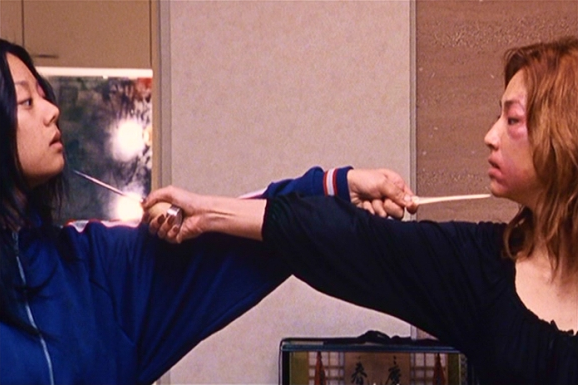
The cat fight. It's a fight that has been fetishized by many men who want nothing more than to see two women use tooth fang and claw to destroy each other. Some guys out there even get off on it. We at the Pow-Wow can't really put ourselves in that group, but it's hard not to be in awe of a cat fight on the scale of that between Nozomi (Eiko Koike) and Rana (Maho Nonami) in Yukihiko Tsutsumi's 2002 film "2LDK". To say that these two aspiring actresses and reluctant roommates dislike each other is a bit of an understatement. Miho is a young woman who will use her acting talents (and other talents...) to get what she wants, while Nozomi is an innocent in the big city of Tokyo. The two women do nothing but rub each other the wrong way, but when they find themselves competing for the same role (and the affections of the same talent agent) their petty annoyances build, build and then explode into a cat fight that nearly takes up the entire 70 minute run time of Tsutsumi's film. "2LDK" (which stands for a two-bedroom apartment with living room, dining room, and kitchen) was filmed as a companion piece to Ryuhei Kitamura's sword fight film "Aragami", but this half of Kitamura's/ Tsutsumi's "Duel Project" dispels with the precision and honour of two samurai clashing. Instead we get two girls who use everything -- from ketchup to power saws -- to vent their hatred for the other. Truly epic. CM


4. Grave vs. Goddess - Death Trance (Yuji Shimomura, 2005)

Tak Sakaguchi and Yuji Shimomura need to be on this list. Whilst most of the films here involve samurai and swordplay (and yes, "Death Trance" is does feature both), it’s their skill with unarmed fight choreography that has changed the way we view Japanese fight scenes today. Shimomura is so talented, he was even recruited by the modern master himself, Hong Kong actor/director/action director Donnie Yen, when he made his modern cop action masterpiece "Flashpoint". Sure "Versus" laid the groundwork, but with the "Death Trance", they take it to a whole other level. Sakaguchi uses gloves that resemble hands so that he can make full contact during the scenes, giving each fight an elevated level of realism. His style is a mix of the old and the modern, the east and the west, which only enhances the bizarre ancient, yet post apocalyptic vibe the film has. There is an almost infinite number of fights to choose from, but it’s the battle between Grave (played by Sakaguchi) and the Goddess of Destruction that’s a real stand out. Shimomura throws the kitchen sink at us, giving us a sword fight that channels Seijun Suzuki through "American Beauty", as blood splatters mix with red flower petals, the two combats floating seamlessly through a void, Sakaguchi wielding his pulsating penis like sword, giving the duel a heightened sexual undertone. In a film that on the surface is an excuse for action, style over substance, Shimomura gives us something very original both narratively and visually. MH

3. The wife's first return - Survive Style 5+ (Gen Sekiguchi, 2004)

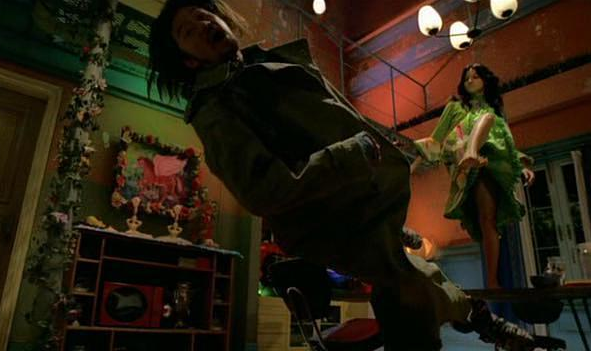
In the first of five overlapping, intersecting, funny and warped stories about how people deal with what is dealt to them (ie. how they survive), Tadanobu Asano plays a man who has just killed and buried his wife. Upon returning home, he encounters her calmly sitting at the table in her bright green dress. Without saying a word, she whips up an enormous feast for him and sits quietly watching while he slowly polishes it all off. Just as he sits back to light up an after dinner smoke (perhaps thinking that he's dodged a bullet), he looks up to see her looming over him poised for attack - which she does with a huge flying kick to his head. As he soars backward in slow motion, the soundtrack kicks in with a driving tune entitled "Go! Go! Go!" and she begins to chase him around their brightly coloured house and connecting all manner of uppercuts and flying kicks (all in slow-mo). It's a massive burst of energy and beautifully sets up the rest of this candy-coloured movie which looks at times like a vat of jelly beans exploded on the set. The fight continues while we jump briefly to the other stories (memorably to the family of the third story singing "Go! Go! Go!" loudly in their car) until it ends suddenly - setting up her second return later in the film (and then third and fourth...). The fight is mostly a one-sided smackdown, but it's no less entertaining than any other brawl you would care to mention. This was where I fell for Asano as an actor - his deadpan straight face morphs into wild eyed disbelieving panic and you can almost feel some sympathy for him. Not quite, but almost. BT
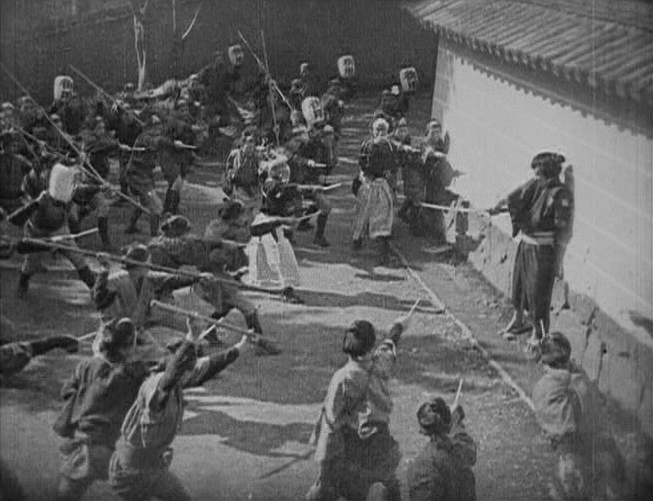

2. The capture of an outlaw - Orochi (Buntaro Futagawa, 1925)

The depiction of violence on the Japanese screen has certainly gone a long way. Just take a look at the silent films of Shozo Makino starring kabuki actor Matsunosuke Onoe in which combat looked more liked a series of static poses, and then compare those with the savage bloodbaths in a film like Takashi Miike's "13 Assassins". The samurai sword fight went through a lot of different evolutionary stages between the 1920's and today, but one gigantic leap occurred in Buntaro Futagawa's 1925 jidai-geki classic "Orochi". Heizaburo Kuritomi (played by the legendary Tsumasaburo Bando) has gone from honoured samurai in the service of his master Eizan to a ronin outlaw after having been provoked into a fight with his disrespectful rival Namioka. Without a master Heizaburo has wandered the land, never giving up his own code of honour and good conduct. The only problem is that the establishment sees him as a hot head and soon he becomes wanted by the law. The final scene of Futagawa's "Orochi" sees Heizaburo take on a mob determined to bring him to justice... and what a scene it is! Instead of the stiff, posed fight scenes that had been filmed before this scene bristles with savage energy. Bando gives it his all in his performance -- slashing and stabbing at the crowd determined to bring this rogue warrior down. They use everything they have including clay roof tiles thrown down on the battered samurai. We won't give away how this scene ends, but we will say that it set a new high watermark that jidai-geki films would aspire to for years and years to come. CM


1. The fury of Ryunosuke Tsukue - Sword of Doom (Kihachi Okamoto, 1966)

This film appears on many of our lists that involve samurai and swords, and rightfully so. This is my penultimate samurai film, one of our most favourite films of all time. Part of that reason is the reason this film is at the top of the list: the final fight scene. As Ryunosuke Tsukue (Tatsuya Nakadai) retreats to the house of pleasure with the group of ronin he’s teamed up with, he finds himself haunted by the spirits of those he’s killed. His growing insanity and guilt climaxes when he realizes the girl serving him is in fact the granddaughter of the old man he killed at the start of the film. Soon Ryunosuke starts battling his poltergeist foes, his sword cutting through the thin wooden and paper walls. Before he knows it, he’s doing battle with his fellow ronin, and any other sword wielding male in the building. Ryunosuke becomes an unstoppable machine, cutting down men and ghost alike, his evil sword slicing wildly. His opponents cut him, stab him, make him bleed, but like a demon he continues, leaving a path of destruction, until he’s barely able to stand. Just when you think he’s making his final charge: freeze frame. The film ends abruptly, leaving us to dwell on the massacre we’ve just witnessed. Does Ryunosuke die or does he continue his bloody rampage (technically none as the film was meant to continue in a trilogy of films based on "Daibosatsu toge")? This film and the final battle must of greatly influenced Miike’s "Izo" which explores the same themes of the samurai’s nihilistic and the fate that draws them into the world of violence they occupy, but it doesn’t elevate itself to the same level of "Sword of Doom". It’s a rare fight scene that can level your draw on the floor from its sheer physical prowess and yet cause you to ponder fate and your control or lack of control of it. Violence has never been so beautiful nor thought provoking. MH

Venice Film Festival line-up to include new films by Tsukamoto, Shimizu and Sono

by Chris MaGee

July is almost over. One more month of summer and then we're into the autumn of 2011. A little sad, but when you're a film fan autumn is a good time... actually a great time because it heralds two of the biggest film festivals in the world - the Toronto International Film Festival and the Venice International Film Festival. The former has just announced key screenings and galas, but no titles from Japan yet. The latter, on the other hand, announced their full line-up on July 28th, so we can get a look at which Japanese films will be on view for audiences.

In terms of features, three of Japan's biggest directors will be featured. Sion Sono will have his adaptation of Minoru Furuya's manga "Himizu" (above) in competition in the Venezia 68 programme, while Shinya Tsukamoto will have his documentary film "Kotoko" starring singer/ songwriter COCCO featured in the Orizzonti programme. As part of the Fuori Concorso programme Takashi Shimizu will have a new film, "Tormented", featured.

It's not just feature films from Japan that will be screening at Venice though. Animator Mirai Mizue and short film-maker Isamu Hirabayashi will have new works featured in the Orizzonti Fuori Formato programme. Also, as we previously reported, director Amir Naderi will be premiering his Iranian/ Japanese co-production "Cut" starring Hidetoshi Nishijima.

Exciting stuff! The 68th annual Venice International Film Festival will run from August 31st toi September 10th. For a look at its full line-up click here.

REVIEW: The Azemichi Road

あぜみちジャンピンッ! (Azemichi Jumping!)

Released: 2009

Director:
Fumie Nishikawa

Starring:
Haruka Oba
Misaki Futenma
Makiko Watanabe
Mayumi Uesugi
Shizuka Umemoto

Running time: 105 min.


Reviewed by Chris MaGee


Like so many teenagers Yuki (Haruka Oba) feels like she lives in a world of her own, one cut off from the larger world around her. When we first see her quietly walking through the streets of Tokyo at the beginning of Fumie Nishikawa's "The Azemichi Road" we wonder what youthful anxiety has made Yuki feel so separate; but when the camera pans in on Yuki's doe-like face and then her ear we see that her isolation is more than usual youthful angst. Yuki, you see, is deaf. A hearing aid helps a little, but her disability has created a wall of silence around her. As a visual counterpoint to Yuki's lonely existence Nishikawa (whose previous credits includes the documentary "Uncut" and the screenplay for Eva Tang's "While You Sleep") introduces us to a group of girls, the same age as Yuki, who have formed an amateur hip hop dance troupe, The Jumping Girls. Their camaraderie, as they practice their routines in front of a community center and eventually a vacant storage space, is palpable and makes us feel all the more sympathy for Yuki. Little do we (or Yuki, or The Jumping Girls) know that the liberating power of dance will very soon transform Yuki's marginalized life.

Pop music, and in this case J-Pop, is full of infectious beats, teen starlets and precise dance moves. Both The Jumping Girls and Yuki have become obsessed with one group, the Rip Girls. The Jumping Girls practice ceaselessly for a dance competition to be judged by these dance-pop idols, while Yuki has discovered that she can keep up with their moves by cranking up her stereo speakers so she can feel the music pounding in the floor and in her body. On her walk home from school one afternoon Yuki encounters Rena (Misaki Futenma), one of The Jumping Girls, near their rehearsal space. Surprisingly Rena knows some sign language and encourages Yuki to come in and check out their practice session. At first Yuki hesitates, but she knows this is one of those moments in life that can't be allowed to slip by. Soon she is in the midst of these talented and "cool" girls, but with the volume on their ghetto blaster turned up Yuki proves that she has the stuff to join their ranks. The spark has occurred and now Yuki, Rena and the rest of The Jumping Girls share the single purpose of taking home the top prize at the upcoming dance competition.

Yes, "The Azemichi Road" takes the classic underdog-makes-good formula and plays it to the nth degree, but let's consider "formula" for a second. Stories told by rote formula are much maligned amongst film lovers, and rightly so in many cases. It's easier to tell a story in a prescribed way than it is to embark on a totally original narrative. But, and this is a big but, there is the occasional film-maker who comes along and takes a formula, or some would say "genre", and creates something nearing formal perfection. Fumie Nishikawa does this with "The Azemichi Road". This isn't an easy task though. "The Azemichi Road" is geared to children and young adults, a market that often struggles with subtlety, but Nishikawa not only gives us a genuine story of acceptance and fulfilled potential, but she does it with truly beautiful film-making craft. Yuki's journey builds slowly, deliberately and again and again we see it through the crisp, colourful and lush cinematography of Osamu Maruike. There are echoes of the work of anime master Hayao Miyazaki in the green hills of Yuki's idyllic rural home, and like Miyazaki's classic "My Neighbor Totoro", Nishikawa's film gives just as much to its teen and pre-teen audiences as it does to the parents who are bringing their families to the theatre. Like "Totoro" the world of "Azemichi Road" is one that we want to inhabit.

One thing that I felt truly sets "The Azemichi Road" apart from other kids movies being produced right now, specifically in North America, is its faithful depiction of the lives of its young cast. You can only imagine that if a Hollywood studio got their hands on the script of "The Azemichi Road" they would cast pretty, buxom 18 and 19-year-old actresses as "teens" and inject a creepy sexuality into it. There would also be one example after another of song placement by the latest pop groups that the big record labels want to push on consumers. Nishikawa does none of this with "The Azemichi Road". The girls in the dance troupe are the same age as their characters, between 13 and 16, and instead of polished dance moves delivered with a suggestive bump and grind their performances are what we could expect from girls that age -- awkward, full of knees and elbows, but in the end sincere and bursting with enthusiasm. Yuki's waitress mother, portrayed by actress Makiko Watanabe (Love Exposure, The Lost Girl) also stands out for her honest performance of an overworked parent who musters the energy to support her daughter in a new adventure in her life.

It's true that "The Azemichi Road" may sometimes prove to be a little bit too slow for some of its young audience, and that a change in the song that the girls practice to would be nice (you'll have the tune stuck in your head for days); but in the end Fumie Nishikawa has given us a film that both kids and their parents will love now and hopefully for many years to come.

"Death Note" director Shunsuke Kaneko returns with new manga adaptation "Messiah"

by Chris MaGee

One of the most successful, creatively and financially, manga-to-movie adaptations in recent memory has to be 2006's "Death Note". That film, which told Tsugumi Ohba and Takeshi Obata's story of a high school boy who wields a book that kills whoever has their name written in it, not only was a huge winner at the Japanese box office, but it has since become a cult favorite for Japanese film fans worldwide. "Death Note" was helmed by director Shunsuke Kaneko, and now Tokyograph is reporting on Kaneko taking another crack at adapting a popular manga to the screen.

Kaneko is currently putting the finishing touches on "Messiah", the film adaptation of Akira Hiyoshimaru's spy manga currently published in Kadokawa Shoten’s Gekkan Asuka Magazine. The manga tells the story of an elite group of spies within Japan's public security bureau called Sakura. The Sakura erase their original identities and go deep under cover on top secret missions. In Kaneko's film version actor and pop star Atsushi Arai stars as Eiri Kaido, a new recruit to the Sakura who must go under cover at a high school to monitor a dangerous student. The rest of the cast of "Messiah" is being rounded out by Masahiro Inoue, Minehiro Kinemoto and Sho Jinnai, amongst many others.

Will "Messiah" capture the imaginations and hearts of young moviegoers in Japan and abroad like "Death Note" did? We'll have to wait until October 15th to find out. That's when "Messiah" is scheduled to open in Japanese theatres. Thanks to Cinema Today for the above promo image from the film.

Life of "Barefoot Gen" creator Keiji Nakazawa becomes subject of new documentary

by Chris MaGee

There have been many powerful films made and books written about the bombing of Hiroshima on August 6th, 1945, but few can match the work of Keiji Nakazawa. You see, Nakazawa was actually there on that horrendous day. Six-years-old at the time, he would see his city demolished in seconds by the first atomic bomb attack in human history. He would take these memories of Hiroshima's destruction and eventual reconstruction and commit them to the page in his manga "Barefoot Gen". Nakazawa's is a truly remarkable story and now a new documentary will give us a unique look at this 72-year-old manga artist and tireless peace activist.

Opening at Auditorium Shibuya on August 6th will be "Hadashi no Gen ga Mita Hiroshima", the directing debut of documentary film-maker Yuko Ishida. The film combines illustrations drawn by Nakazawa with his own personal accounts of that August morning that not only changed his life, but that of the entire world. Anime News Network posted this trailer for "Hadashi no Gen ga Mita Hiroshima", so if you live in Tokyo check it out and then make it down to Auditorium Shibuya next month. If you don't live in Tokyo then do yourself a favour and get the manga "Barefoot Gen" and give it a read.

REVIEW: The Catcher on the Shore

やぎの冒険 (Yagi no Boken)

Released: 2010

Director:
Ryugo Nakamura

Starring:
Munekazu Uehara
Seima Gima
Susumu Taira
Taeko Yoshida
Yayoi Shiroma

Running time: 80 min.


Reviewed by Marc Saint-Cyr


Often, a filmmaker’s traits or back story will provide just as much incentive to see a film as details about the film itself, if not more. That is most likely to be the case for most viewers regarding Ryugo Nakamura’s debut feature film, "The Catcher on the Shore." At the age of fifteen, Nakamura is already a highly accomplished filmmaker, having made "Catcher" when he was fourteen and thirty shorts since embarking upon his career at eight. The opportunity to take the plunge into features came in 2009 when the Okinawa Convention and Visitors Bureau launched a contest for story ideas for a production in the region. Nakamura, of course, ended up winning, and has since proven himself worthy of the chance given to him with quite a remarkable coming-of-age story.

"The Catcher on the Shore" stars Munekazu Uehara as sixth grader Hiroto, who catches a bus to Okinawa where he is to spend the winter with his grandparents and father. Life in the warm rural village unfolds at a relaxed pace and Hiroto’s days are filled by taking leisurely excursions to a stream in the woods, tending to the pair of goats owned by his grandparents and blowing up firecrackers to scare a comical election candidate. Yet Hiroto’s contentment is disrupted after one of the beloved goats is killed in preparation for a communal meal of goat soup. When a prime opportunity arrives, he tries to help the other animal escape before a similar fate befalls it. His efforts bring about teasing and conflict, highlighting his outsider status as a naïve (or just soft-hearted) city boy. When night arrives, Hiroto camps out in the jungle wilderness, testing his bravery against the forces of nature and helping further his acceptance of the at-times uneasy relationship between humans, animals, life and death that permeates the world.

For me, "The Catcher on the Shore" was one of the standout films that screened at Toronto's 3rd annual Shinsedai Cinema Festival, where it received its international premiere. Within the first few scenes, it became clear that the film would reflect an especially disciplined and visionary creative spirit behind its production. The camera movements and shot compositions by Nakamura and cinematographer Akihiko Nitta are executed with visible confidence, lingering on the Okinawan vegetation and giving an added eloquence to Hiroto’s experiences. Some sequences come across as especially inspired, such as one long take in which Hiroto’s father has a lengthy conversation with a friend about how to properly kill a goat. It isn’t until the slowly panning camera has covered most of its trajectory that the boy is shown listening close by – as he pets the remaining goat, no less. Little later on, the film momentarily picks up its pace in a lengthy, comedic chase after the runaway animal taken up by Hiroto and several of the town’s inhabitants.

However, not all of the pursuer’s intentions are as noble as Hiroto’s, which is just one of the ways in which a near-anecdotal narrative about a young boy’s bond with a bleating goat is amplified into a more universal story of maturity and the pain that can accompany it. During the chase, a local boy goes from being a close friend to Hiroto to something of a bully, leading to a tense struggle in a field of tall grass. From this point onwards, the film becomes noticeably more steeped in elemental imagery and the action loses its light, carefree quality in favor of a tone more befitting an age-old rite of passage. When night falls, the two boys build a large fire, setting the stage for a striking sequence in which they respond to crying wild dogs with their own howls as a storm rages around them. Afterwards comes the calm of the morning and perhaps the film’s finest shot, which lingers on Hiroto as he walks away from the gently rising camera into a sublime, still realm of trees and floating mist.

Having been made by a fourteen year-old director, it is of course totally acceptable that "The Catcher on the Shore" has its flaws. If there is one worth mentioning, it is the slightly stunted quality of the film’s dramatic weight and thematic exploration, as the story and subject matter certainly provide fertile potential for a more fully developed work. But that is not to downplay the existing film’s genuine sense of poignancy, mainly offered up by its consideration of the necessary harshness of life and its natural clashes with innocence. Enhancing this deep concept with assured technical skill, an insightful approach and naturalistic performances, Nakamura fully manages to make a strong impression in his first venture as a feature filmmaker. As he continues to accumulate more experience and sharpen his artistic instincts, he is all but bound to rise to even more impressive heights as he continues to follow his passions.

Read more by Marc Saint-Cyr at his blog

Yoji Yamada's "The Yellow Handkerchief" goes from the big screen to the small screen

by Chris MaGee

Some stories just get told again and again... and again. The latest example of life of the remake mill is an upcoming TV adaptation of Yoji Yamada's Japanese Academy Award-winning drama "The Yellow Handkerchief". The original (above left) starred Ken Takakura as an ex-con who leaves prison to travel through Hokkaido to reunite with his estranged wife. This new TV version, that will be broadcast on NTV in the fall, will star Hiroshi Abe (Still Walking) in Takakura's role. Abe will be joined by Gaku Hamada and Maki Horikita as the two strangers that join the ex-con on his journey.

This isn't the first time that "The Yellow Handkerchief" has been remade. In 2008 Indian film-maker Udayan Prasad shot his own version of "The Yellow Handkerchief" starring William Hurt, Maria Bello, Kristen Stewart and John Gregory Willard. What sets this new NTV remake apart from Prasad's is that Yoji Yamada himself is responsible for writing the script, apparently the first time in 21 years that the veteran director has written for television.

Thanks to Tokyograph for this news.

Weekly Trailers


Smuggler - Katsuhito Ishii (2011)


Finally a full trailer for Katsuhito Ishii's adaptation of Shohei Manabe's manga "Smuggler". Satoshi Tsumabuki stars as an actor who takes a job helping the yakuza dispose of the bodies of their enemies. "Smuggler" is set to open in Japanese theatres on October 22nd


Kids Return - Takeshi Kitano (1996)

Ken Kaneko and Masanobu Ando star as two high school punks whose friendship is transformed when one becomes a yakuza gangster and the other a boxer. This was the first film Takeshi Kitano made after his near fatal 1994 motorbike accident.

REVIEW: Chikamatsu Monogatari

近松物語 (Chikamatsu Monogatari)

Released: 1954

Director:
Kenji Mizoguchi

Starring:
Kazuo Hasegawa
Kyoko Kagawa
Yōko Minamida
Eitaro Shindo
Chieko Naniwa

Running time: 102 min.


Reviewed by Bob Turnbull


The story is that Kenji Mizoguchi was not wholly engaged during the filming of his 1954 film "Chikamatsu Monogatari" (sometimes known as "The Crucified Lovers"). He was coming off 3 consecutive Venice wins and had just broken off his professional and personal relationship with actress Tanaka Kinuyo, so the thought is that he was taking a "breather". Though the film's tale was taken partially from an old Bunraku play by Chikamatsu Monzaemon (as well as Ihara Saikaku's collection of stories "Five Women Who Loved Love" which had also been used for the adaptation of "The Life Of Oharu"), one could easily feel that Mizoguchi was indeed simply going through the paces when confronted by a plot that uses a somewhat conventional set of misunderstandings, stupid decisions and coincidences to force its central protagonists through to their certain tragic ends. However, that would be too simple a reading of the film - even though it may use many of those aspects, it provides a sharp attack on those who would put their respect and honour above all else. It also manages the feat of being extremely cynical about putting your trust into just about anyone while also giving one some hope at the end that the truly evil can still get their comeuppance and the realization of true love is worth any consequences that may befall you.

It all begins during one of the busiest times of the year for Ishun's print house (he is known as a Great Printer) as specialized calendars are being prepared for their numerous customers (including the Imperial Palace). The most trusted of the printers is Mohei and though he is laid up with a bad cold, he still rises to the occasion to finish up a particularly important job while being doted on by the pretty young servant Otama. Mohei has a good friendship with Osan (the Madam of the house) and, after noting that both her mother and brother have stopped by the premises, asks her if everything is OK. Osan very politely lies to him that things are fine when in reality her brother's foolish decisions have put the family house at risk. Osan needs to borrow more money from her husband Ishun - a task she dreads. A few minutes with Ishun explains her feelings - he tries to use his power and influence to force Otama to be his mistress, he won't part with his money to even help his blood relations and he has mastered the art of hypocrisy. While mentioning that the "nobles" will only drink with him when he is paying, he walks through his house and barely even acknowledges a single one of his staff who welcome him home and show him deference. He is at the root of the chain of events that push the story forward as his continued advances on Otama force her into telling a lie that she is engaged to Mohei. Her hope that it will quell his visits are dashed when he overreacts to Mohei's admission that he borrowed some money from the house accounts for personal use (in reality to help Osan's brother pay their family house's mortgage). Through several machinations and bad timing, Mohei's escape from house arrest stumbles upon Osan's plan to catch Ishun in the act of visiting Otama - the result is an assumption that Mohei and Osan are lovers and what could possibly be a worse crime for a woman to commit and a worse way for a man to have his honour besmirched? Ishun demands that Osan kill herself by laying his sword at her feet and yelling "you know what someone of your rank must do now!" Apparently a man of his rank does not have the same restrictions...

Since the entire neighbourhood has recently just witnessed an adulterous couple being paraded through the streets before being crucified for their acts, Mohei and Osan run away together knowing that they can't easily explain away the circumstances. It's a safe bet at this stage to think that "this just can't end well", but the plot begins to fill in some of the wider thematic details as well. We see Ishun's desperate attempts to preserve his respect by making Mohei out to be a thief and a request to bring back Osan separately to avoid any further rumours. Meanwhile we also encounter the scheming of Sukeyemon (another printer in the house) and Isan (Ishun's next in line) as they plan to ensure the scandal receives wide attention. Osan's mother is concerned primarily for the embarrassment she might receive as well as her proximity to Ishun's money (we also learn that she forced Osan to marry him in order to help the family's finances). She even states out loud that Osan should have committed suicide even though she doesn't really believe the stories that the two are lovers. Osan's brother proves to be wrapped up in his own hedonistic lifestyle and the noble elders have only thoughts about their own standing. No one seems to be above getting pleasure out of seeing others fall or free of the concern about what others think of them.

Though a few of the coincidences and pieces of exposition that are required to keep the characters making their bad choices get a bit tiring, Mizoguchi manages to keep you wrapped up in the outcome of the two runaways and does so with a sense of mounting tension. A particularly disturbing moment happens as Mohei calmly ties Osan's legs together while they sit in a rowboat in the middle of the lake and you suddenly realize that they are planning a double suicide by drowning. It's also one of the more gorgeously lit scenes in the film with an ominous feel to everything that surrounds them. Almost the entirety of their journey happens in darkness and shadow and combined with the sharp percussive score, you truly feel there is no way out for them. It's all a bit weighty, but Mizoguchi's deft skill at incorporating his themes into an otherwise straightforward tale show that he was still the consumate filmmaker.

Read more from Bob Turnbull at his blog.

Wednesday, July 27, 2011

A double bill of Koji Wakamatsu films come to Toronto's Projection Booth

by Chris MaGee

There are some Japanese film-makers who get a lot of play here in North America -- Takashi Miike, Seijun Suzuki, Akira Kurosawa, etc. Then there are film-makers who never seem to get the due they deserve here despite amazing talent and a significant body of work . In this camp one could easily put Shuji Terayama, Mikio Naruse and Koji Wakamatsu. A recent announcement here in our hometown of Toronto may be changing that situation for the latter film-maker though.

Recently the former Gerrard Cinema (1035 Gerrard Street East) has risen from the ashes and has been redubbed The Projection Booth. With the mandate of screening "Art - Schlock - Indie - Foreign" films the theatre has already posted an impressive August line-up at their official website. Included as part of it are the two latest films by pink film/ indie veteran Koji Wakamatsu. Starting on August 19th The Projection Booth will begin an exclusive run of both Wakamatsu's 2008 historical drama "United Red Army" and his 2010 Edogawa Rampo adaptation "Caterpillar". Both of these are award-winners and the latter features a revelatory performance by actress Shinobu Terajima.

Here's hoping that the screening of these two films will perk up Toronto film audiences' attention to the work of Koji Wakamatsu. To check out showtimes for both films just head here and download the PDF of The Projection Booth's August schedule.

Omnibus film "Quirky Guys and Gals" comes to DVD by way of Third Window Films

by Chris MaGee

You know a DVD label is truly successful when people begin to get excited about its releases months in advance and buy up every DVD that rolls out on to store shelves (or online as the case may be). For the longest time this level of recognition was something only enjoyed by the venerable Criterion Collection, but one indie label is fast becoming the go to company to get great new films from Japan. That company is of course Third Window Films. Company president Adam Torel has done an amazing job amassing a catalogue of well known contemporary classics (Kamikaze Girls, Love Exposure) as well as the work of up-and-coming film-makers (Kakera, Lala Pipo). It was during this past week that Third Window announced their latest acquisition -- a film that brings together some veteran talent with some of the best new film-makers from Japan.

Coming soon from Third Window will be the omnibus comedy "Quirky Guys and Gals", and that title pretty much sums up the four stories brought to the screen by the makers of "Fine, Totally Fine", "Happy Darts", "Okan no yomeiri" and "Survive Style 5+". The segments in the films range from Yosuke Fujita's “Cheer Girls” in which a trio of girls create cheering routines for individuals instead of sport teams to Gen Sekiguchi's “The House Full of ‘Abandoned’ Businessmen” in which a woman takes pity on out of work salarymen and begins to collect them in their own club.bringing all these stories to life is a cast that includes the likes of YosiYosi Arakawa, Aoi Nakamura, Tenkyu Fukuda, Misako Renbutsu, Kyoko Koizumi, Tomochika and Tetsuji Tanaka.

UK DVD buyers, as well as us lucky folks with region free DVD players, can look forward to picking up "Quirky Guys and Gals" from Third Window on October 3rd (get more info on the film here. To get yourself ready for the release check out the film's trailer below.

Rare Japanese animation comes to Toronto care of LIFT and Tomonari Nishikawa

by Chris MaGee

It was a couple weeks back that we reported on how experimental film-maker Tomonari Nishikawa was here in Toronto as a film-maker-in-residence at LIFT, The Liaison of Independent Filmmakers of Toronto. Since arriving here in the city earlier this month Nishikawa has been teaching classes at LIFT, working on film projects and has been running a series of screenings. On July 18th Nishikawa presented a programme of hand-processed 16mm films at The Gladstone Hotel’s Art Bar, and now there is news from LIFT of yet another do-not-miss event for those with a love for the cinematic avant-garde.

On August 5th at CineCycle (alley behind 129 Spadina Avenue) Tomonari Nishikawa and LIFT will be presenting "Tension vs. Mediation: Contemporary Japanese Animation". This programme will bring together works by art animators/ film-makers Shiho Kano, Kazuhiro Goshima, Aki Nakazawa, Yuta Takehiro, Hirotoshi Iwasaki, Yusuke Nakajima, Chikara Matsumoto (above) and Kotaro Tanaka. Like the july 18th programme, this is a collection of films that rarely if ever get shown in North America, let alone Canada so get out to CineCycle and feast your eyes.

For more information on "Tension vs. Mediation: Contemporary Japanese Animation" curated by Tomonari Nishikawa and presented by LIFT just click here.

Japanese Weekend Box Office, July 23rd to July 24th


1. Harry Potter and the Deathly Hallows: Part II (Warner)
2. Pikachu The Movie 2011* (Toho)
3. From Up On Poppy Hill* (Toho)
4. Ninja Kids!* (Warner)
5. Wanko - The Story Of Me, My Family And Rock* (Toho)
6. Andalusia* (Toho)
7. Super 8 (Paramount)
8. Pirates of the Caribbean: On Stranger Tides (Disney)
9. Someday* (Toei)
10. Soreike! Anpanman Save Cocolin And A Miracle Star* (Tokyo Theatres/
Media Box)

* Japanese film

Courtesy of Box Office Japan.

Tuesday, July 26, 2011

The 3rd Shinsedai Cinema Festival: Overview


by Marc Saint-Cyr

For the third time, the annual Shinsedai Cinema Festival (co-programmed by Midnight Eye co-founder Jasper Sharp and the Pow-Wow's own Chris MaGee) arrived in Toronto and brought an eclectic mix of independent feature films from Japan, offering not only several refreshing alternatives to standard summer movie fare, but also the rare chance to see little-known works that are quite difficult for North American audiences to access. While the festival's weekend (July 21st-24th) was stricken with sweltering temperatures, viewers were able to find relief at Toronto's Japanese Canadian Cultural Centre in the form of cool temperatures and entertaining films that ably demonstrated the artistic talents of emerging Japanese filmmakers.

The film that resonated with the most people during the festival was the crowd-pleasing "The Azemichi Road," which won the first Kobayashi Audience Choice Award. Directed by Fumie Nishikawa, who won a prize of $1000 Canadian in addition to the honor of having made the festival's most beloved film, it depicts Yuki (Haruka Oba), a young hearing-impaired girl who turns to hip-hop dancing as a means of finding friends, passion and hope. A Special Mention Award was given to visiting guest Devi Kobayashi for his double bill of comedic films "Mariko Rose the Spook" and "Hikari." An accomplished director and performer, Kobayashi accepted the honor in full costume as his zesty, cross-dressing spirit Mariko Rose, adding a memorable spirit of fun to the ceremony.

Devi Kobayashi dressed as his hilarious character Mariko Rose from "Mariko Rose the Spook"

Other esteemed guests were also present throughout the course of the weekend, including Kiki Sugino, lead actress and producer of the opening night film "Hospitalité" from Koji Fukada; Ryugo Nakamura, the talented director of "The Catcher on the Shore," which he made when he was only fourteen (he is currently fifteen); his producer Yuichi Ide; and Gen Takahashi, who was present for last year's Shinsedai Cinema Festival to present his epic exposé of the Japanese police force, "Confessions of a Dog."

Along with the above-mentioned films were several additional highlights for viewers to experience. Among them were "Shirome," a hilarious faux documentary on J-Pop group Momoiro Clover's spooky tour of a haunted house; a presentation of Torajiro Saito's 1935 silent film "Kid Commotion" with live foley sound effects; "Wandering Home," in which Tadanobu Asano delivers a powerful performance as real-life alcoholic photojournalist Yasuyuki Tsukahahra; the hand-drawn marvel "Midori-ko," which took animator Keita Kurosaka over ten years to make and "KanZeOn," a unique documentary from Neil Cantwell and Tim Grabham providing an insightful exploration into Buddhism, Noh Theatre, music and nature.

With all of these films and more featured during its four days, it can certainly be said that the 3rd Shinsedai Cinema Festival was a great cultural event. Since its inauguration, it has greatly succeeded in its aim to bring fresh works to audiences eager to see what Japanese cinema's latest waves are bringing from overseas, and will no doubt continue to enlighten, inspire and entertain eager viewers in the coming years.

Scroll below to view more pictures from the 3rd Shinsedai Cinema Festival:

From left to right: director Gen Takahashi, actress and producer Kiki Sugino, JCCC Executive Director James Heron, director Ryugo Nakamura, producer Yuichi Ide, director and comedian Dev Kobayashi

The nearly-packed Kobayashi Hall before the opening night film "Hospitalité"

Shinsedai Cinema Festival co-programmer Chris MaGee introducing "Hospitalité"

Kiki Sugino introduces "Hospitalité"

One of the festival posters autographed by the visiting guests

 The foley set-up for "Kid Commotion"

The foley team who performed the sound effects for "Kid Commotion," led by foley artist Goro Koyama (second from left)

Chris MaGee and Devi Kobayashi cool off from Toronto's heat wave

Wednesday, July 20, 2011

Actor Yoshio Harada, 1940 - 2011

by Chris MaGee

Very, very sad news from the world of Japanese film. Actor Yoshio Harada, most recently seen and best known to North American audiences as the patriarch of the Yokoyama family in Hirokazu Koreeda's 2008 drama "Still Walking", passed away Tuesday, July 19th in a Tokyo hospital after a bout of pneumonia. He was 71.

Harada was born in the Adachi Ward of Tokyo in 1940. Even as a young man Harada was fascinated by the world of acting and after graduating from high school he would study the craft at Tokyo's venerable Haiyuza Theatre Company. Harada would make the transition from stage to screen in 1967 when he appeared on the Fuji TV series "Youth of the World". The following year he would make the further transition to the big screen in Shochiku's "Hear the Song of Venegeance" co-directed by Masahisa Sadanaga and Shigeyuki Yamane. In the following years Harada would make a name for himself portraying brooding and shaggy-haired villains and anti-heroes in the films of Toshiya Fujita (Stray Cat Rock: Crazy Rider '71, Wet Sand in August, Lady Snowblood 2) and Kazuo Ikehiro (The Fearless Avenger, Trail of Blood), but Tokyo's theatrical community still beckoned. Besides these mainstream action and jidai-geki adventures Harada would star in many of the films of famed playwright and poet Shuji Terayama, including 1974's "Pastoral: Hide and Seek" and 1984's "Farewell to the Ark". It was in the mid-70's that he gained critical praise, winning the the Best Supporting Actor Prize from Kinema Junpo for his role in Kazuo Kuroki 1975 film "Preparation for the Festival".

It wasn't just the critics who made Harada one of the biggest stars on the Japanese screen though. His acting peers and the Japanese public would turn him into a superstar. It is widely discussed how actor Yusaku Matsuda was so impressed by Harada's talents that he would study his performances again and again. Harada's charismatic screen presence would also play a part in the rebirth of one of Japan's most famous maverick directors. In 1980 Harada starred alongside Toshiya Fujita and actress Naoko Otani in the triumphant return of Seijun Suzuki. As many know Suzuki had been fired from Nikkatsu Studios after the release of his 1967 avant-garde action film "Branded to Kill" and had been away from the spotlight for over a decade. Harada had already worked with Suzuki on his failed 1979 comeback "A Story of Sorrow and Sadness", but the following year Suzuki's independently produced feature "Zigeunerweisen" became a cult hit and would go on to win the Best Film Award from Kinema Junpo that year.

Harada's career would continue to grow. He would work with some of the biggest names in Japanese film including Yoichi Sai (Let Him Rest in Peace), Yojiro Takita (No More Comics), Toshio Masuda (This Story of Love), and Junji Sakamoto (Knockout). It was through Sakamoto and "Knockout" that Harada would gain a whole new set of younger fans, including director Toshiaki Toyoda. Harada would star in Toyoda's 2003 film "9 Souls" as the leader of a gang of escaped convicts. It was this role, as well as those in such films as Kazuo Kuroki's "Ronin Gai", Rokuro Mochizuki's "Onibi: The Fire Within" and Kenji Sonoda's "Madness in Bloom" that would lead to one of Harada's greatest career triumphs. In 2003 he was awarded the Medal with Purple Ribbon, Japan's medal of honour for his contribution to theatre and cinema.

The past decade had seen Harada shift from hot-headed anti-hero roles to those of grumpy but wise grandfather figures. Throughout the '00's he would pick up awards for Best Supporting Actor from the Hochi Film Awards for his role in Kazuo Kuroki's "Face of Jizo", as well as a Best Actor Award from Kinemu Junpo for Jun Ichikawa's "Zawa-zawa Shimo-Kitazawa". Most recently Harada had battled back from a 2008 surgery for bowel cancer to star alongside Jo Odagiri in the latest film from Hirokazu Koreeda, "Kiseki". Harada also put on his screenwriting cap, coming up with the story idea for Junji Sakamoto's upcoming film "Oshikamura Sodo-Ki (Records of Turmoil at Oshika Village)", in which Harada starred as an elderly man named Zen who runs a restaurant in Oshika, Nagano who helps an old love (Michiyo Okusu) cope with dementia by staging a kabuki play. According to a post at The Shinano Mainichi Shimbun advisors on "Oshikamura Sodo-Ki " said that Harada looked well at an advance screening of the film in May, and that news of his passing came as a "big surprise".

Friends of the J-Film Pow-Wow attending the current offering of the Puchon International Fantastic Film Festival said that all the Japanese guests were discussing this terrible loss. One of the most poignant tributes to Harada has come from his "9 Souls" director Toshiaki Toyoda via Toyoda's Facebook account. Toyoda stated, "I am sorry... how many times can [one] come across a person too good for the world? I count the number of times, and there is no knowing the shortness of the life of [this kind of] person."

Yoshio Harada is survived by his wife, his son, musician and actor Kenta Harada, and his daughter, Mayu Harada. Our deepest condolences go out to them and to all of Harada-san's family, friends and colleagues during this time of mourning. We leave you with the trailer for Seijun Suzuki's "Zigeunerweisen".

Sunday, July 17, 2011

Six Questions for... Toshiaki Toyoda


Of the wave of new film-makers that came out of Japan in the late 90's and early 00's one stands head and shoulders above the rest -- Toshiaki Toyoda. While the work of the 42-year-old director may superficially reflect the violence and cool of so many of his film-making peers of the last decade a closer viewing reveals layers of humour, dark beauty and keen human insight. And then there's his masterful use of music. It was actually a desire to pursue music that brought Toyoda, a former chess prodigy, from Osaka to Tokyo but it was an encounter with director Junji Sakamoto that turned his attention to film-making. Toyoda quickly made his mark with films like 1998's "Pornostar", a.k.a. "Tokyo Rampage", the boxing documentary "Unchain", and an adaptation of Taiyo Matsumoto's manga "Blue Spring". 2003's prison break saga "9 Souls" and 2005's grim domestic drama "Hanging Garden" revealed a more mature Toyoda, one ready to stand alongside the likes of such major film-making talent as Kiyoshi Kurosawa and Hirokazu Koreeda; but a 2005 drug conviction nearly derailed his promising career. Thankfully Toyoda returned to directing with 2009's "Blood of Rebirth", a resurrection both on screen and off. CM


1. What movie inspired you to become a film-maker? What was it about the movie that was inspiring?

“Dotsuitarunen (Knockout)” by Junji Sakamoto. It's his passion.


2. Is there someone you always wanted to work with on a project, but have never had the chance?

Ken Takakura and Edward Norton (He is good at Japanese).


3. Please finish this statement: If I had not become a film-maker I would probably be a ________.

Super rich guy.


4. Which three people (besides film-makers) have had the biggest influence on you?

The Unabomber, Jiddu Krishnamurti, and Prince.


5. What is your favorite book? Why is it your favorite?

In Japanese literature, “Dokurohai” by Mitsuharu Kaneko. I read it recently and felt like it’s about me. In English, “Franny and Zooey” by JD Salinger. It is very beautiful.


6. What moment in your career has made you most proud so far?

When I catch that special moment during filming, you know?


Translation by Chikako Evans

Follow Toshiaki Toyoda on Twitter here.

REVIEW: The Noisy Requiem

追悼のざわめき (Tsuitō no Zawameki)

Released: 1988

Director:
Yoshihiko Matsui

Starring:
Kazuhiro Sano
Toshihiko Hino
Simon Kumai
Yukiko Murata
Isamu Ohsuga

Running time: 150 min.


Reviewed by Chris MaGee


Somewhere around the late 90's the image of Japanese film began to change. For years before that the term "Japanese film" would bring to mind the top-knotted samurai of Kurosawa and the serene, sad interiors of Ozu. The farthest into darker and more existential territory most mainstream European and North American audiences would venture might be the critically-lauded films of Hiroshi Teshigahara, typified by his 1964 film "Woman in the Dunes". Then come the 90's a whole new batch of films and film-makers began to emerge from Japan's independent and V-cinema scene that would drastically change the perception of Japanese film and the people who seek it out. People like Shinya Tsukamoto and Takashi Miike, and to a lesser extent Shozin Fukui, Kazuyoshi Kumakiri and Hisayasu Sato, began gifting us with shocking, abrasive and irreverent visions where bodies morphed, blood flowed and nary a ray of brightness would reach. In a few years North American and UK distributors were releasing films like Tsukamoto's "Tetsuo the Iron Man", Miike's "Audition", Fukui's "Rubber's Lover", Kumakiri's "Kichiku: Banquet of the Beasts" and Sato's "Splatter: Naked Blood" in stores. These films formed the dark side of the J-Horror boom, something dubbed "extreme cinema", and for young cult movie fans these pitch black visions eclipsed much of what came before from film-makers in Japan. What many didn't know is that there was a director who was working a decade before who had not only released a film that would anticipate this dramatic shift, but also drew direct inspiration from earlier classic cinema. That director was Yoshihiko Matsui and his film was "The Noisy Requiem".

At its narrative core the gritty black-and-white "The Noisy Requiem" is a serial killer film, although one that follows none of the previous or subsequent genre trappings. In the heart of Osaka's run down Shinsekai, or New World" district a killer is hiding in plain sight amongst the bums and the beggars. We first meet Makoto Iwashita (Kazuhiro Sano) as he is strangling and wrenching the head of a pigeon. It's only seconds later that we see that his cruelty is in no way limited to animals. What follows is a montage sequence in which we see Iwashita at work, killing women in back alleys by bashing them over the head with a small crowbar and then carving out their reproductive organs. What he does with these is shove them into a cavity he has hollowed out between the legs of a wooden mannequin which he has lovingly laid out on a bed on his rooftop hideaway. Stomach-churning indeed, but somehow Matsui, who also wrote the screenplay for "The Noisy Requiem", begins to make us somehow empathize with this most anti of anti-heroes. One way he does this is to introduce us to a series of other Shinsekai natives equally as repulsive as Iwashita.

There are a pair of street musician/ beggars, both injured and shell-shocked WW2 veterans who howl and contort on a street corner. Iwashita isn't even convinced these two are Japanese and he brutally beats them, but still they return to their street corner. There is a homeless man portrayed by butoh dancer Isamu Ohsuga who is caked with dirt and feces and drags around a log with an instant resemblance to a woman's buttocks and groin. There are the midget siblings, bother and sister, whom Iwashita gets a job from. The sister was burnt as a child and bares horrible scars on her torso. When she isn't spending time masturbating with an electric dildo she is having relations with her own brother, something that was apparently dictated in their mother's will so that her daughter would know what being with a man was like. Iwashita lays beside his terrifying bride each night pondering the people, horrible like "jellyfish" who are "shoved into his eyes" each day. Navigating amongst this knot of grotesque creatures are a silent couple -- a young man and a little girl. Their presence is a calming one often accompanied by melancholic piano music. If looking for an easy interpretation then these other homicidal, homeless and incestuous denizens of Osaka's underworld might be demons while the young man and the girl are possible angels in the scenario. Even they dramatically fall from grace in the final third of the film though, giving us some of the most shocking images and ideas in "The Noisy Requiem".

As we first watch "The Noisy Requiem" we wonder two thing. First, we wonder if the debased characters that inhabit the film aren't just everyday folk as seen through Iwashita's lens of hatred and violence. This would give us as an audience an easy way to interpret Matsui's film, or maybe escape or distance ourselves from some of its more nauseating imagery. We soon learn, though, that Iwashita is just one of many damaged and deranged individuals that crawl through the muck of Shinsekai. It's a realization that both gives "The Noisy Requiem" its power, as well as making it a film that many have had problems sitting through. If Iwashita is just another human whose darkest fantasies have erupted into his conscious life then what does that say about us as audience members and fellow human beings?

That brings us to the second thing we wonder, why? Why the violence, why the depravity heaped up by Matsui and "shoved into our eyes" in the same way Iwashita is assaulted by his own world? That brings us to Matsui's important place in Japanese film history. One of Matsui's self-confessed creative heroes was avant-garde poet, playwright and film-maker Shuji Terayama. This is the same Terayama whose remarkable films have yet to catch on in North America due to his debut feature, also a gritty black-and-white film called "Emperor Tomato Ketchup". It, like "The Noisy Requiem", is set in a decaying and surreal world, but it also features simulated sexual encounters involving minors. This has made Terayama, a major intellectual figure in Japan, verboten in the U.S. and Canada. Matsui doesn't take his power to shock though just from Terayama. One only needs to look at the 1960's films of New Wave pioneer Shohei Imamura to see the tradition from which Matsui has come. From 1961's "Pigs and Battleships" straight through to 1968's "Profound Desire of the Gods" the world of Imamura was one steeped in murder, obsession, lust, pornography, incest and black humour. As Imamura was often quoted as saying, "I am interested in the relationship of the lower part of the human body and the lower part of the social structure." Yes, the characters in "The Noisy Requiem" are extreme, but they would not look out of place in the Imamura universe. Instead of being connected to the waist down "lower part of the human body" though Matsui's characters inhabit the creases in our flesh, between our legs, under our armpits, in places we never see, can't reach, the places that breed disease, but are still necessary to our being. Maybe it's this that today's "extreme" film-makers draw from when looking at a film like "The Noisy Requiem".

The work of Yoshihiko Matsui is a wonderful, if often uncomfortable, bridge between the likes of Imamura and Terayama and contemporary violent and confrontational films that pack theatres at genre film festivals worldwide. Impossible to find legally in North America and very expensive to purchase in Japan, "The Noisy Requiem" is a revolting masterpiece, revolting in the true dual meaning of being both at times disgusting, but always revolutionary. A difficult dose of film, but one that is well worth the effort.

Courtroom set revealed for Takashi Miike's live-action "Gyakuten Saiban (Ace Attorney)"

by Chris MaGee

With all of the projects that Takashi Miike gets his name attached to it is often hard to get a handle on exactly which one is in fact going before the cameras next. For example, in the last couple months Miike has been connected with a live-action film based on Capcom's video game "Gyakuten Saiban (Ace Attorney)", and also a live-action film of Ikki Kajiwara romantic manga "Ai to Makoto". Well, it turns out the former is moving along before the latter.

The folks at Anime News Network have shared the above photo which was apparently leaked by a Toho publicity rep and shows the courtroom set for Miike's adaptation of "Gyakuten Saiban (Ace Attorney)". As we reported back in May, this new Miike project will take place in an alternate Japan that is struggling with a major crime wave. Like the original Capcom game, it is the job of Ace Attorney Phoenix Wright (being portrayed by Hiroki Narimiya) to investigate charges against accused criminals and to prove the guilt or innocence of the defendant before each whirlwind three day trial is completed.

With the sets built it looks like "Gyakuten Saiban (Ace Attorney)" will be on schedule to be released in Japanese theatres next spring.

Amir Naderi's "Cut" to open the Orizzonti section at Venice International Film Festival

by Chris MaGee

Since September of last year we have been following the production of Iranian film-maker Amir Naderi's Japan produced film "Cut" starring actor Hidetoshi Nishijima. (You can read our full coverage here.) The film centers around Nishijima's character, an independent film-maker and film professor who, in order to pay down debts owed to the yakuza, takes a job as a human punching bag for underground fights. The film had originally been slated for completion in the spring with a hoped for premiere at the Cannes Film Festival, but some post-production delays curtailed those plans. Now there is good news from the "Cut" camp though. The film will now be receiving its world premiere at the 68th annual Venice International Film Festival. This year Venice Film Fest runs from August 31st to September 10th, and "Cut" will open the festival's Orizzonti section. Congratulations to Naderi and the "Cut" crew!

For more information on the world premiere of "Cut" at the 68th annual Venice International Film Festival click here.

Weekly Trailers


Postcard - Kaneto Shindo (2011)


At the end of the Second World War Sadazo (Naomasa Musaka) is sent to fight in the Philippines. As he waits to ship out he receives a postcard from his wife Tomoko (Shinobu Otake). He then writes a response and gives it to a fellow soldier with the instruction to deliver it to his wife by hand. 98-year-old Kaneto Shindo (Onibaba, The Naked Island, Kuroneko) directs.


Incident at Blood Pass - Hiroshi Inagaki (1970)


Toshiro Mifune reprises his role as the Yojimbo, "bodyguard", a masterless samurai who is ordered to head to a mountain pass to wait for an unspecified mission to unfold... and one does, involving yakuza, an abused woman on the run from her husband, a stuttering law enforcer and a gold heist.

REVIEW: Dersu Uzala

デルス·ウザーラ (Deruzu uzara)

Released: 1975

Director:
Akira Kurosawa

Starring:
Maksim Munzuk
Yuri Solomin
Svetlana Danilchenko
Dmitri Korshikov
Suimenkul Chokmorov

Running time: 144 min.


Reviewed by Marc Saint-Cyr


"Dersu Uzala" occupies a central place in one of the most eventful chapters of Akira Kurosawa’s life. Following the lengthy production of 1965’s "Red Beard" and an ill-fated collaboration with Twentieth Century Fox that ended with him getting fired from "Tora! Tora! Tora!," he sought to venture into more artistically challenging territory and ended up making 1970’s "Dodes’ka-den," his first color film. A compassionate portrayal of downtrodden dreamers living in a slum outside of Tokyo, it was, sadly, a critical and commercial failure upon its release, adding to the depression that led to Kurosawa’s attempt on his own life in late 1971. But luckily, he did not succeed, and after properly recovering, he went about going back to work. With help from Yoichi Matsue, who served as an assistant director on "The Hidden Fortress" and producer on "Dodes’ka-den," Kurosawa was able to set up a co-production with the Soviet Union’s Mosfilm. The final result was "Dersu Uzala," an adaptation of Russian surveyor Vladimir Arsenyev’s autobiographical book detailing his experiences exploring and mapping the Usurii region of Eastern Siberia and friendship with the titular Goldi hunter he met there. The film marked a great rejuvenation for Kurosawa and won, among other awards, the Oscar for Best Foreign Language Film.

After a short prologue in 1910, "Dersu Uzala" jumps back to the autumn of 1902, when Arsenyev (Yuri Solomin) first sets out with a band of soldiers on his topographical survey. Before long, the group has its first encounter with Dersu (Maksim Munzuk), who is initially mistaken for a bear when he emerges from the dark forest. An expert at hunting and surviving in the wilderness on his own, he joins the men and lends them his valuable skills. Arsenyev begins to form a close bond with Dersu, learning about how he lost his wife and two children to smallpox. The stumpy little Goldi imparts valuable lessons to the soldiers, like how it is proper to leave a stock of rice, salt, matches and dry firewood in an abandoned shelter for the next weary traveler to find. On one occasion, Arsenyev and Dersu become lost in a frozen wasteland and, following the hunter’s instructions, the two desperately work together to build a shelter before the freezing night claims them. After parting ways, they meet again years later in 1907, only to eventually realize that Dersu’s once-sharp eyesight is deteriorating. Yet despite the potential hazards this condition brings, he nonetheless ultimately decides that his right place is amongst nature.

With "Dersu Uzala," Kurosawa returned to the grand, large-scale type of filmmaking he is so renowned for. After the constructed sets and artificial look of Dodes’ka-den, the director essentially did an about-face and supervised a lengthy location shoot in wild Siberia. Thus, the film’s visual splendor stems directly from the incredible imagery of the natural phenomena that reduce the humans who pass through it to miniscule figures. At several points, Kurosawa’s mastery of composition (here enhanced for the only time in his career by 70mm film stock) emerges in full force. One stunning shot shows the moon occupying the upper left corner of the frame, the sun the upper right, between them a tripod, Arsenyev and Dersu, all dwarfed by the vast sky and celestial bodies above them. Another strong image portrays the smoldering sun’s red rays reflected on the icy landscape. But Kurosawa is also at his very best as a storyteller here, and keeps the touching relationship between the two very different men at the forefront of the film’s priorities and, consequently, the audience’s awareness. The human element is never entirely overwhelmed by the imagery.

On top of these traits, there is the simple fact that "Dersu Uzala" is a highly entertaining adventure story. The survey team and Dersu must face all kinds of dangers, including Chinese bandits, tigers that pose both physical and spiritual threats and, of course, the various forces of nature that assail them. The men’s tremendous efforts to survive are made all the more vivid by Kurosawa’s gift for depicting the forces of wind and rain, water and earth. Admirers of the master’s previous work are likely to be reminded of similarly sensual imagery from such films as "Seven Samurai" and "Rashomon."

One could see Dersu as a tragic mirror image of Kurosawa himself – especially in the film’s later half in which the hunter must accept the cruel effects of age (tellingly, Kurosawa himself became increasingly blind as he grew older). But on the other hand, "Dersu Uzala" represents a great triumph for the filmmaker, both on its own terms and in the context of his career. Even though Kurosawa still required outside assistance – from George Lucas and Francis Ford Coppola, no less – to get his next project, "Kagemusha" (1980), off the ground, that film went on to win the Palme d’Or at Cannes and cleared the way for the magnificent "Ran" (1985). Indeed, "Dersu Uzala" is the central ingredient of a great comeback story and certainly does the trick in reaffirming the incredible talents of Akira Kurosawa.

Read more by Marc Saint-Cyr at his blog