Saturday, August 28, 2010

Puppet animator Kihachiro Kawamoto, 1925-2010

by Chris MaGee

This past week has already seen the death of one of the most promising animators in Japan, Satoshi Kon, so it was with an equal amount of shock and sadness that we read of the passing of yet another famed Japanese animator this same week. Anime News Network reported that world-renowned puppet animator Kihachiro Kawamoto died after a bout of pneumonia on Monday, August 23rd. He was 85.

Born in 1925 in Tokyo Kihachiro Kawamoto originally wanted to pursue a career in architecture while taking up doll-making as a hobby. In 1950 he teamed up with publisher Tadasu Iizawa to create a series of doll storybooks. It was at about this same time Kawamoto discovered the works of the pioneering Czech stop-motion animator Jiri Trnka. Inspired by Trnka Kawamoto began studying under stop-motion animator Tadahito Mochinaga and by the 1970s he was making elaborate films based on traditional Japanese folk tales and Western fairy tales. Kawamoto worked his entire craeer as an independent artist while gaining great fame at home and abroad. Not only did he have 200 of his intricate handmade puppets housed in his own museum in Iida City, Nagano Prefecture, but he also spent several years sitting as the President of the Japan Animation Association, a post previously held by Japan’s "god of Manga and Anime" Osamu Tezuka.

On a personal note, I was very honoured to feature a programme of Kawamoto's animation at the most recent Shinsedai Cienma Festival here in Toronto. My partner on the festival, Japser Sharp, put together the programme of Kawamoto shorts specifically for the festival and the feedback from audiences was universally glowing. To see how quickly and how deeply people were affected by Kawamoto's films is a testament to his brilliance as an animator and a storyteller. Kihachiro Kawamoto will be sorely missed. Our deepest condolences go out to his family and colleagues.

REVIEW: The Dark Harbour


不灯港 (Futouko)

Released: 2009

Director:
Naito Takatsugu

Starring:
Shinya Kote
Yuko Miyamoto
Kazuki HirookaAkaji Maro
Diamond Yukai

Running time: 101 min.


Reviewed by Bob Turnbull


Early in Takatsugu Naito's "The Dark Harbour", we get a simple closeup of Manzo the fisherman's hands - they are rough, worn and have obviously done a great deal of labour in their days. His life, as shown in the virtually wordless opening segment of the film, is a simple one. Since he lives alone, runs his own fishing boat by himself and doesn't have the best social skills in the world, it's also a very solitary existence. It's not that he wants it that way, but that's just how things are. His attempts to meet a woman aren't very successful, but he's convinced that he would make a fine and tender husband if given the chance. It's tough, though, since the local women get snapped up and the city women can't see through his awkward exterior. So when an opportunity presents itself, Manzo dives right in.

If the film's title doesn't properly set your expectations for the sweet and gentle story about one man's wish to share his life, it does still show some of the darker elements of humanity. Jealousy, selfishness and cold detachment all rear their ugly heads at certain points, but Manzo's good heartedness is always at the centre (even if he may also engage in some of those behaviours). The catalyst for the events of the film stem from the announcement of a party arranged to introduce the town's working men (mostly fishermen) to a group of "city women" who are brought in by boat. As preparation, all the men must record a short video describing themselves. The evening of the mixer doesn't go well for Manzo, but when his film is projected on screen he is shocked to notice a woman and small boy watching him intently from inside his closet. The crowd thinks they are ghosts, but in fact they had just sneaked in to eat some of his food and rest while he was out and had to hide when he came home unexpectedly. They both seem to be genuinely moved by his thoughtful words about having the capacity to be a tender husband even though his outward physical appearance has been beaten down by years of hard work. After an initial "get out of my house" reaction, Manzo reconsiders, finds them and asks them to stay with him.

In the context of the film, the sudden nature of him asking these homeless people to move in with him makes perfect sense. He tells them that he never wants to eat alone ever again and that his life is suffocating him. What follows are lovely moments of pure cinema - he makes a scarf for her from some discarded material he had found earlier in the water, he creates a treasure hunt for the little boy Masao (who isn't actually Mitsuko's son - her previous boyfriend was the father but abandoned them both) and takes them on a slightly surreal picnic. Combined with some of the very mannered dialogue and wonderful bouncy musical score, the film paints an odd dreamlike feel to these moments - quite appropriate since Manzo obviously has a specific idea in mind as to what a family relationship should be like. Even though you can't help but smile through this section of the film, you know that there is something amiss. Does he really love Mitsuko or is he in love with the idea of loving someone? Does she in turn really care about him or is she just using him as a temporary port while she refuels?

The pace of the film is a marvel. Though it is wordless for its opening 9 minutes, without dialogue for a full 15 minutes and mostly depends on characters' actions, reactions and characteristics to drive the story, its 102 minute runtime absolutely flies by. It still finds time to linger on the activities of the people in the harbour or amble through their picnic, but it's never without reason and always seems to add more texture to the story. It contains some very funny moments as well, in particular Manzo's clothes shopping expedition before the party with the city women. As it turns out, purple suit jackets and fringed cowboy coats aren't as trendy as he was led to believe. Manzo (played in a perfectly suited understated manner by Shinya Kote) couldn't really be described as a great catch, but he engenders not only the audience's sympathy but their good will too. Until meeting this pair of drifters who happened to dock at his house, he says that he never had the motivation to change his life. But now, maybe his ship has finally come in.

Read more from Bob Turnbull at his blog.

Fantastic Fest bring Austin, Texas "Outrage", Redline" and "Golden Slumbers"

by Chris MaGee

September is almost here, so North American genre film fans that can mean only one thing - Fantastic Fest! The fest, founded by Alamo Drafthouse owner and operator Tim League and Ain't It Cool News webmaster Harry Knowles, has been going strong since 2005 and for this, its 5th offering, Fantastic Fest will continue to bring the best in genre filmmaking to Texas. Of course that includes some amazing content for fans of Japanese film. This year festival attendees will get a chance to catch three very high profile new releases.

First up is the North American debut of the Takeshi Koike (Ninja Scroll) directed and Katsuhito Ishii (Funky First: First Contact) scripted high speed animated raciong film "Redline" (above) that includes such big name voice talent as Tadanobu Asano and Yu Aoi. Then there's Yoshihiro Nakamura's phenomenal ( and I do mean phenomenal) thriller "Golden Slumbers" starring Masato Saki as a man wrongfully accused of assassinating the Japanese Prime Minister. To round things off Fantastic Fest will be bringing "Outrage" (trailer below), Takeshi Kitano's return to the yakuza genre, to North America. Critical reception for this one has been split right down the middle, so it'll be interesting to see how a genre-loving audience will receive it.

The 5th annual Fatantic Fest will run in Austin from September 23rd to September 30th. To check out all they have lined up for audiences this year check out their official website here.

London's Zipangu Fest gets a fun, trashy Halloween double-bill!

by Chris MaGee

It was just at the beginning of this month that we reported on how Midnight Eye co-founder, author, film historian and curator Jasper Sharp was starting up his own Japanese film fest in London under the moniker of Zipangu Fest ("Japanarchy in the UK!"). The official dates for Zipangu's inaugural year have already been announed - November 23rd and November 28th - but now Sharp has brought us news of an advance Zipangu screening event to kick things off with a scare... and a laugh.

According to Jasper Sharp's official website Zipangu will be presenting a Halloween double-bill of Takao Nakano's trash-tastic "Big Tits Zombie 3D" (above) and Noboru Iguchi's gore comedy "Robo Geisha" on 29th October at London's Barbican Centre. Along with these two films there will also be a screening of director Keiichi Matsuda's short film "Augmented City".

To get just a taste of the lunacy that will be one display on the 28th of October check out the trailer for "Big Tits Zombie 3D" below. Can't think of a better way to get in the mood for Halloween or for London's first Zipangu Fest! Keep checking the fest's official website for more details and line-up announcements.

REVIEW: Charon


CHARON(カロン)

Released: 2004

Director:
Gen Takahashi

Starring:
Megumi Morisaki
Ryushi Mizukami
Jun'ichi Kawamoto
Ikki FunakiKen Iwainofu

Running time: 89 min.


Reviewed by Chris MaGee


There are many people in all of us. Whether we like to acknowledge it or not we all act differently in different situations. With one group of friends we may act one way, with our bosses and colleagues at work another and with our family members yet another. Maybe only our closest friends and spouses get to the real person inside of each of us... maybe not. One thing for sure is that despite the gaps, the fissures and sometimes that chasms that separate these various aspects of our personality it is highly doubtful that any of us lead as schizophrenic a life as the protagonist in Gen Takahashi's 2004 film "Charon".

It is difficult to say "Leads as schizophrenic a life as Hideko..." when talking about "Charon". It's true that we first meet the main character in this drama (played by actress Megumi Morisaki) she is known as Hideko, the ultra-proper, kimono-clad wife of the author Dai Katsuki (Ryushi Mizukami). Despite her strict rule of never having sex with Katsuki he dotes on him and when he's not home she dotes on the customers of a bookstore where she works part-time. Everything changes about Hideko after a trip to the train station where she literally picks up a whole new wardrobe and persona kept in one of the station's coin lockers. A change into expensive designer clothes and Hideko is now Yuto, a high class prostitute who charges ¥100,000 (roughly $10,000) for two intimate hours with her. Yuto is... well, to say in love would be too strong... she is involved with her pimp (or as he puts is "coordinator and consultant") Michio (Jun'ichi Kawamoto). It's when Yuto goes on her calls that we meet Charon, Yuto's professional name, a woman not unlike Hideko in her genteel manner and willinginess to please. Of course the way in which she pleases as Charon is entirely opposite to Hideko.

Charon, the name of Hideoko/ Yuto's professional persona, and the title of veteran independent writer director Gen Takahashi's film, is a very apt choice. Charon, as it's mentioned in the film, is the moon of Pluto, a celestial body so far away from us here on Earth that despite the fact that it orbits the exact same sun as us the moon wasn't discovered until a short 38-years ago. Charon keeps up an unpredictable elliptical orbit and when telescopes can get a glimpse of it it is only as a vague shadow in the blackness. Vague, unpredictable, mysterious - this all fits Megumi Morisaki's character in "Charon" to a T. So deep are the chasms between her personaes, so entrenched are the barriers between one woman and another that when Michio encounters Hideko working at the bookstore she looks at him as if he's a total stranger. The same treatment is given to her husband Katsuki when after he discovers her call-girl persona he hires her for the kind of intimate contact that he can never have with his wife Hideko. It's when the men in Hideko/ Yuto/ Charon's various lives begin to stumble past the boundary lines she's created that Charon disappears into the blackness of space. Hideko/ Yuto/ Charon jumps town and goes missing and it's up to the unlikely duo of bookish Katsuki and streetwise Michio to find her and in the process find out who exactly the woman they loved was.

While Charon the woman is an utterly inscrutible mystery "Charon" the film is an absolutely engrossing experience. While our sense of narrative vertigo is particularly acute at the start, with Takahashi throwing us right into the deep end we soon find ourselves eagerly following the various threads of this mysterious woman's existence. Megumi Morisaki's performance isn't showy as the line between easch of her personaes isn't that dramatic. Her personality is drawn in subtle shadings as opposed to clear cut facets, but the most revealing moments in "Charon" come when Morisaki is alone in front of the camera, either browsing through a store, navigating a train station, or walking down a hotel hallway to one of her johns. She is no one at all, a blank, almost ghost-like; and its at those moments that we're convonced that she herself doesn't quite know who she is. That uncertainty plagues both Katsuki and Michio, who once they go in search of the woman they both love (and form a charming onscreen friendship at the same time) begin to wonder what falling for such a ghost of a woman says about them. Who are they that they could get so easily duped?

Gen Takahashi, who brought us the astounding "Confessions of a Dog" proves with "Charon" that he is an expert storyteller, both within the pages of the script, but also behind the camera. He continually utilizes shaky handheld camera work with flashback and ellitical editing to put the audience in the same position as Katsuki and Michio. It takes us a while to get our footing in Hideko/ Yuto/ Charon's world, and just when we think we may know who she is Takahashi takes us further and further away from our original expectations. It's a narrative strategy that works. "Charon" won the audience award at the 2005 Yubari International Fantastic Film Festival, and here's hoping that with the recent intertest in the Weest for "Confessions of a Dog" and Takahashi's manga adpation "Goth" that "Charon" will fascinate and puzle a whole new group of film lovers.

Weekly Trailers


Flower and Snake 3 - Yusuke Narita (2010)


We've already been treated to screen adaptations of erotic author Oniroku Dan's novel "Flower and Snake" in 1974 with Masaru Konuma's take on the S&M tale of the submission training of an upper crust wife , and then in 2004 with Takashi Ishii's "Flower and Snake 2". Now we get treated to more bondage and suspension fantasies with Yusuke Narita's "Flower and Snake 3" being released in Japanese theatres this weekend.


Under the Blossoming Cherry Trees - Masahiro Shinoda (1975)


Japanese New Wave master Masahiro Shinoda teamed up with "Lone Wolf and Cub" star Tomisaburo Wakayama to bring a skewed love story to the screen with 1975's "Under the Blossoming Cherry Trees". Wakayama stars as a bandit who falls in love with a nobleman's wife. He kills the nobleman in order to have her for himself, but doesn't bargain on the dark turns this new relationship will take.

REVIEW: Daido Moriyama: Stray Dog of Tokyo


Daido Moriyama: Stray Dog of Tokyo

Released: 2001

Director:
Kenjiro Fujii

Starring:
Daido Moriyama
Nobuyoshi Araki
Kazuo Nishii
Sandra Phillips

Running time: 84 min.

Reviewed by Marc Saint-Cyr


The subject of documentary filmmaker Kenjiro Fujii’s debut work is quite the intriguing character. Clad in black clothing and initially coming across as a cool, enigmatic loner of-sorts, photographer Daido Moriyama certainly snagged my curiosity from the first moment he appeared onscreen. His career began in the late 1960s and since then has consisted of a highly diverse and unique journey through the medium of still photography. Fujii’s film compellingly examines that journey, shedding light on both Moriyama and the nature of art.

Throughout his film, Fujii interviews a handful of figures in the Japanese photography and art communities, including Michiko Kasahara, the curator of the Tokyo Metropolitan Museum of Photography; photographer Nobuyoshi Araki and Kazuo Nishii, the former editor-in-chief of the magazine “Camera Mainichi” who sadly passed away in 2001 (the film is dedicated to him). However, the documentary’s most prominent figure is Moriyama himself, who talks about his life, ever-changing relationship with photography and philosophies regarding art and creativity. As a youth, he had many different ambitions, harboring interest in becoming a sailor, a painter and a comedian. Yet he drifted towards photography, and has been taking pictures of his surroundings since childhood. Moriyama doesn’t place too much importance on the specific makes of cameras he uses, and his only significant preference is towards small, light devices so as to not attract too much attention when taking pictures. Many sequences follow him as he walks around Shinjuku putting his various strategies to work – holding up the camera with one hand, taking pictures without looking through the viewfinder, walking at a steady, fairly quick pace between shots and, perhaps most cunningly, pretending to look in a different direction while aiming and shooting his camera at a nearby, unsuspecting subject. Such passages count among the best ones of the film, capturing Moriyama in his element as he navigates through a nocturnal Tokyo , operating like a true guerilla artist.

In-between the intimate, conversational segments with Moriyama, Fujii highlights the main accomplishments of his career, which include the photo books “ Japan : A Photo Theater” (1968), “Farewell Photography” (1972) and “A Hunter” (1972) and the series “Light and Shadow” (1982) and “Daido Hysteric” (1993-97). Of these works, “Farewell Photography” is chosen by many of the interview subjects as the epitome of Moriyama’s art, which in turn is recognized as unique through its utilization of, in Nishii’s words, the characteristics “are” (rough), “bure” (shake) and “boke” (no focus). Indeed, Moriyama’s work, which is extensively sampled throughout the film, focuses on glimpses and fragments of everyday life that are sometimes quite clear, sometimes abstract and surreal, always beautiful. Moriyama discusses how photography is an art form that involves “copying” certain portions of the world, and in which direct, deliberate intent or a desire to create meaning is not always necessary. Such personal views and insights alone give viewers plenty to think about in comparison to their own preconceived ideas of photography.

As the film moves along, Moriyama seems to grow more comfortable and open. He certainly has no qualms about discussing more offbeat subjects such as a seven year hiatus from photography mostly spent indulging in drugs; his distaste for executives, PR people and commercial work and his habit of giving in to laziness. Yet he primarily gives the impression of a friendly, positive personality, particularly when he candidly interacts with Fujii and divided his attention to filling his camera with pictures. One great passage towards the end shows Moriyama steadily discovering a digital camera that Fujii lends him. As he learns how to operate it, he soon reveals unmistakable joy and excitement as he captures a whole new set of pictures on the marvelous device. It is a particularly well-chosen note to end “Daido Moriyama: Stray Dog of Tokyo” on, as it solidly articulates the entire film’s thoughtful exploration of art, originality and the liberating qualities of creation.

Read more by Marc Saint-Cyr at his blog

Yochi Sai's 1995 film "Marks" gets turned into drama series starring Kengo Kora

by Chris MaGee

We all love a good mystery, don't we? Sure we do! What better way to keep people glued to the screen than to leave them guessing, right? That's what veteran filmmaker Yoichi Sai did with his 1995 screen adaptation of Naoki Prize-winning author Kaoru Takamura's novel "Marks no Yama". Sai's film told the overlapping story of a young man named "Marks" Mizusawa who had survived the suicide of his entrire family and consequently suffered abuse in a mental hospital where he was incarcerated, and that of a series of linked murders that are being investigated by hard-bitten detective, Yuichiro Aida.

Now according to Tokyograph Sai's film and Takamura's book will be brought to the small screen as a WOWOW produced drama series. "Snakes and Earrings" and "Fish Story" star Kengo Kora has been cast as Mizusawa while TV actor extraordinaire Takaya Kamikawa will be taking on the role of detective Aida. Japanese TV audiences can expect to catch "Marks no Yama" once it premieres on Japanese TV this coming October.

REVIEW: It's Tough Being a Man


男はつらいよ (Otoko wa tsurai yo)

Released: 1969

Director:
Yoji Yamada

Starring:
Kiyoshi Atsumi
Chieko Baisho
Sachiko Mitsumoto
Chieko Misaki
Chishu Ryu

Running time: 91 min.


Reviewed by Eric Evans


The artful economy of Yoji Yamada's late-career triumphs "Twilight Samurai", "The Hidden Blade", "Kabei: Our Mother", and this year's "Ototo" is the result of decades in commercial filmmaking. The majority of his career was spent directing the adventures of traveling salesman and low-rent Yakuza Torajiro Kuruma, better known to generations of Japanese filmgoers as Tora-san. Of the 48 Tora-san films Yamada directed 46 (skipping episodes 3 & 4), and each is as formulaic as the last. That's not an insult: Some of the greatest film series have been formulaic in the extreme, yet also compellingly watchable. That ability—the talent to craft a tale both new yet familiar—separates commercial filmmakers from mere hacks. And while some Tora-san films may be slightly more compelling than others owing to a particular performance by a supporting actor, Yamada ensured that all the episodes were snappy and clean and entertaining.

Much like Zatoichi films, the appeal of the Tora-san movies is in their formula. Tora-san enters a town, falls in love with someone fated to be with someone else, and somehow causes trouble with his jovial but uncouth manner. His behavior often starts as mannered and respectful but with the encouragement of a bit of laughter or a few too many swigs of alcohol it veers wildly into the inappropriate, and he's stuck trying to make the situation right. Which he does, but through misadventure and often despite himself. This formula has proven so winning with Japanese audiences that a museum to the character draws a steady flow of visitors, and his trademark mole and hat are instantly recognizable visuals.

The destination doesn't matter nearly as much as the journey in Tora-san films. "Otoko wa tsurai yo" opens with Tora-san explaining in voice over that he's been away from home for 20 years as he journeys back to Shibamata to see his sister, family, and neighborhood. Not without charm, he gets back and shocks everyone with his gentle and polite manner. This act soon dissolves, leaving Tora the loudmouthed drunkard responsible for spoiling his sister's proposed marriage (among other things). At the family meeting—a vital pre-proposal meal at which every formality matters—Tora gets tipsy and begins explaining why Chinese characters are fun, loudly explaining "'Corpse' and 'water' make urine!" as a mortified Sakura lowers her head. When the only other woman present excuses herself to escape Tora's off-color comments, he hollers after her "Hey mother, you going to the toilet? Where is it, I need to go too—but don't worry, I'm fast!" He's oblivious to his effect on others and seemingly unaware of proper manners. The film meanders a bit, but communicates both Tora's pathological inability to avoid rocking the boat and his good-natured desire to make things right for those around him. You can't stay mad at him any more than you could a misbehaving family pet.

This first in the series boasts an appropriately emotional performance from Chieko Baisho as Tora's long-suffering sister Sakura and a brief yet impactful cameo by J-film legend Takashi Shimusa, but it's the central performance from former Asakusa comic Kiyoshi Atsumi that made this, and all these films, work. It's a tricky thing to be charming and maddening, boorish and childlike, yet Atsumi managed to maintain that balance for 48 films spanning 4 decades. He has a grin so infectious that you smile along with him even as he's committing social blunders. It's said that there are actors and then there are movie stars—people who, for whatever reason, convey charisma onscreen mores than others. Atsumi is made of the stuff.

I'm no sociologist, but I think there's something reassuring about seeing someone break, then work to restore, cultural mores. Tora-san speaks his mind in a way few well-mannered Japanese would; He's brash and blunt and sometimes directly confrontational. He's nomadic, drifting here and there and paying little mind to traditional notions of responsibility to his family or community. "Otoko wa tsurai yo" establishes Tora-san's patterns of behavior without missing a beat. What few wrinkles the concept had were apparently ironed out during the character's year as a TV drama, and the films feel more like extended episodes of a series than stand-alone films. Does the movie work? It's absurdly successful on it's own level. It makes the viewer nostalgic for a Tokyo that hasn't existed since the 1960s, and is never at all disagreeable. It's the cinematic equivalent of a comfortable sweatshirt. If that seems appealing to you, dozo.

Tuesday, August 24, 2010

Anime Master Satoshi Kon, 1963 - 2010

by Chris MaGee

In the past few months we have seen the deaths of some of the most influential, both in front of the camera and behind - actor Kei Sato, director Katsumi Nishikawa, and art directors Takeo Kimura and Kimihiko Nakamura - all men who shaped the history of Japanese film in their unique ways. Their losses were sad, but all of them lived long and eventful lives, passing away in their 80's and 90's. Today, though, the news broke of the passing of a man who has shaped not only Japanese animation, but also film around the world, and the worst part is that he left us so tragically early. Satoshi Kon, the creator of such well known animated films as "Perfect Blue", "Millennium Actress", "Tokyo Grandfathers" and "Paprika passed away. Although details are still sketchy as to the cause of death Cinematical is reporting that Kon died after a battle with cancer. He was only 47.

Born in 1963 in Kushiro, Hokkaido Kon initially studied painting at Tokyo's Musashino College of the Arts. Instead of jumping from school into Japan's art scene, though, Kon worked as the screenwriter on "Akira" creator Katsuhiro Otomo's 1991 live-action film "World Apartment Horror", the story of a yakuza trying to evict a group of illegal immigrants from a haunted tenement building. Kon wouyld continue to work alongside Otomo, first as the set designer on Hiroyuki Kitakubo's 1991 animated science fiction film "Roujin Z", which Otomo worked as a screenwriter, and then as one of the contributing directors to Otomo's seminal 1995 anime omnibus film "Memories". Kon would write the segment "Magnetic Rose" that followed the crew of a space cruiser who respond to an emergency signal emanating from an abandoned space station. The surreal adventure that follows would set the tone for what would become Kon's signature narrative style.

Starting with his 1997 directorial debut, "Perfect Blue", a tale of an idol singer and actress suffering from a mind-altering schizophrenic split that Kon based on a novel by Yoshikazu Takeuchi, Kon would bring audiences stories in which the lines between reality, fantasy and memory blurred beyond recognition. 2001's award-winning "Millennium Actress" would tell the story of a Setsuko Hara-esque heroine whose life history is presented by fusing present-day interviews with documentary filmmakers and scenes from the protagonist's filmography. 2006's "Paprika" would explore the world of dreams through an ingenious technology that would allow a female psychologist to enter into her patients' nocturnal fanatasies. Kon wouldn't always tread the paths of Fantasy though. His 2003 animated feature "Tokyo Godfathers" told the story of a trio of homeless Tokyoites who find and care for an abandoned infant.

Most recently Kon was at work on a feature film that would carry on in his established surreal tradition. In November stills leaked online from an upcoming animated feature titled "The Dreaming Machine" which Kon was describing as a “future folklore story”. There is no word now as to the fate of this production, as the anime world is still reeling from the news of Kon's passing. Rumours first started to circulate via Madhouse, the animation studio Kon had called home, and their Twitter account that indicated that one of their best known directors had passed away. WIt was then confirmed and reported on Anime News Network that the deceased director was in fact Satoshi Kon. Kon's passing comes at a time when his influence is being felt strongly in mainstream Hollywood features such as Christopher Nolan's blockbust "Inception" and Darren Aronofsky's upcoming psychologial thriller "The Black Swan". All fans of Japanese film, anime, animation worldwide and science fiction at large will now be left with only speculation as to the legacy that Kon might have left had he lived into old age.

Our thanks go to Otaku U.S.A. for being the one to bring this very sad news to our attention. Our very deepest condolences go out to Kon's family and friends in this very trying time. We leave you all with the trailer for Satoshi Kon's final feature film, "Paprika".

Top Ten Sexiest Scenes in Japanese Film


While August in Japan tends to be the time when studios release horror films to help "chill" the country's over-heated movie audiences here in Canada summer is all about sun and sex. Well, maybe that's a bit of a stretch, but when all five of us Pow-Wow members chatted recently about what this month's Top Ten List would be our minds went straight to all things sexy. This this month we offer you our choices for our Top Ten Sexiest Scenes in japanese Film. Now, to make things "sexy" as opposed to "smutty" we decided to limit our choice to scenes from mainstream films as opposed to, say, pink films. We wanted to keep things work safe (at least in terms of images), plus we wanted to give you all a tour of the sexier side of films you may have already seen, or might seek out because of this list. So light some candles and out some Barry White music on and get ready to get sexy...


10. Trading One Secret for Another - from Rokuro Mochizuki's "Pandora: Hong Kong Leg" from "Jam Films"

Takami Yoshimoto has a secret: she suffers from terribly itchy athlete's foot. Desperate for a cure she heads to Chinatown, where she meets what could kindly be described as a manic caricature of a wise old Chinese herb dealer (Butoh/theater actor Akaji Maro). He guesses her secret and says he has a cure, leading her through alleyways and into a seemingly abandoned theater. There the stage is set with a regal red velvet throne set atop a large box. At the foot of the chair, there's a hole in the box. "Put your feet in there," the old Chinese man says, and when she does she discovers something surprising about herself. "Pandora" is maybe the least judgmental and most expressive film ever made about sexual fetishes. In a mere 15 minutes, director Rokuro Mochizuki presents us with three unnamed characters who are foot fetishist/subordinate/body worshiper, closet voluptuary, and voyeur. None is depicted as depraved or in need of help; by all accounts they each lead healthy, productive lives. It just so happens that those lives intersect onstage in a quiet fulfillment of sexual obsession. Yoshimoto plays her nameless protagonist with verve. As she writhes onstage fully clothed but for her bare feet, there's no questioning her ecstasy. It's one of the most erotically charged non-sex sex scenes I've ever seen. Further, try watching the first 2 minutes of the film with your eyes closed. In a clever bit of juxtaposition that hints at what's to come, the soundtrack's panting, moaning and rhythmic thumping is crafted to sound pinku but set over visuals that don't jibe… yet. EE


9. "Act Like a Samurai!" - from Akira Kurosawa's "Seven Samurai"

A minor yet intriguing subplot of Akira Kurosawa’s classic masterpiece “Seven Samurai” involves Katsushiro (Isao Kimura), the youngest of the titular heroes, and Shino (Keiko Tsushima), one of the peasants they must protect. Her father, the overprotective Manzo (Kamatari Fujiwara), attempts to disguise her as a boy so as to keep her from being seduced by the samurai. Yet that plan fails when Katsushiro discovers her true identity and soon after falls in love with her. Their story not only adds another moral dilemma to the film through their different classes, but also provides some romantic tension which noticeably increases as the village’s crucial battle draws closer and closer. Of the two of them, it is Shino who makes the advances while Katsushiro, who is otherwise quite eager to prove his worth as a man, comically reacts with hesitation and flat-out fear. The scene that most effectively highlights the nature of their relationship drops in on them as they relax and talk together in a flowery clearing. At the exact point when their conversation turns to more sensitive matters, Kurosawa masterfully cuts to an overwhelming close-up that has Shino’s face occupying the whole of the screen like a giant planet – perhaps the perfect depiction of Katsushiro’s terror-rattled, out-of-proportion perception of her. She then falls back on the ground and cries, “Coward! Act like a samurai!” as he looks on, trembling and unsure how to proceed. Though their romance grows more fiery later on in the film (quite literally, when they embrace in a hut as shadows of flames dance over their bodies), this scene perfectly articulates the supremely intimidating force that sex appears as through adolescent eyes. MSC


8. A Naked Embrace - from Yasuzo Masumura's "Manji"

Bored housewife Sonoko (played by Kyoko Kishida from "Woman In The Dunes") meets and pursues the younger beautiful Mitsuko. Director Yasuzo Masumura pushes boundaries in this 1964 film that, through an episodic look at their growing relationship, documents one woman's total and complete obsession. Even when Mitsuko is shown to be pulling many of the strings to create tense and awkward situations (she manages to involve not only Sonoko's husband, but her own fiancee as well), Sonoko is not deterred. There's plenty of lacivious behaviour in the film, but the sexiest scene is likely a mutual hug by the two ladies after they have disrobed. Mitsuko's body is peeking out of the wrapped sheet she has around her and after Sonoko devours the glimpse of her posterior with her eyes, she tears the sheet off her in strips with a ferociousness that she's never really known. As she sees Mitsuko's fully naked body, she slowly falls to her knees in front of her, just as she would were she about to pay tribute to some idol or statue of a God. Sonoko removes her clothing as well and approaches Mitsuko looking much more comfortable and with a much more confident air about her - even on a par with the sexual being in front of her. She gives her a fairly wicked smile as she moves in for the embrace and they begin to caress each other's bodies with zeal. BT


7. The Big Reveal - from Keisuke Kinoshita's "Carmen Comes Home"

Whoever said sex had to be serious? Certainly not Keisuke Kinoshita. Although Kinoshita is probably best known for his 1954 meldodramatic classic "Twenty-Four Eyes" one of the directors real claims to fame came three years prior when the execs at Shochiku managed to get their hands on a supply of Eastman Kodak 35mm colour film and decided that they wanted to dazzle movie audiences with sweeping vistas, natural wonders... and scantily clad ladies. The result was the musical comedy "Carmen Comes Home", which centered around the clash of cultures and morals betyween rural Japan and big city Tokyo. Pretty country girl Kin (Hideko Takamine) has spent the past couple of years living in Japan's capital and one day she returns to her parents meager homestead a totally changed woman. Decked out in colourful Western-style dresses and wearing garish make-up Kin, now calling herself Carmen after the seductive protagonist of Bizet's opera, has recreated herself as a cosmopolitan "artiste". In tow is Carmen's best friend Maya (Toshiko Kobayashi), an equally modern and equally sexy young woman who Carmen met during her time on the stage in Tokyo. The two indulge in much singing and dancing in the rolling green hills of Carmen's hometown. The local school prinicpal and mayor decide that they should allow Carmen and Maya to inject a bit of big city culture into their small town lives. The only problem is that as the two young women take the stage wearing very revealing outfits it quickly becomes obvious to the stunned audience of townsfolk that Carmen and Maya aren't ballerinas - they're burtlesque dancers! Kinoshita plays up the scene for laughs with the band on stage trying desperately to keep up with Carmen and Maya's bump and grind while the men in the audience can't keep their mouths from dropping open and their eyes from bugging out of their heads. While Takemine has gone down in Japanese film history as one of its screen actresses it's hard not to notice how good she looks in a bikini top and sarong, and once she and Toshiko Kobayashi finally strip down to nothing but their birthday suits the male viewers (and some female viewers as well) of "Carmen Comes Home" surely wish they could see what the audience members standing dumbfounded in the front row are getting a peek at. CM


6. Rainy Day Seduction - from Takeshi Kitano's "Sonatine"

I’m willing to bet that those who scan their mental catalogues of the sexiest moments in Japanese cinema won’t come up with Takeshi Kitano’s “Sonatine” right away. Like most, if not all, of the director’s work, the 1993 yakuza film has a very careful sense of pacing about it, emphasized by still, quiet moments, deadpan humor and shocking bursts of violence and bloodshed – not exactly the stuff wet dreams are made of. On top of that, the film is mainly male-dominated, focusing on a bunch of yakuza who escape to a deserted beach to lay low during a clan dispute. The crooks, led by Kitano’s Murakawa, make the most of their impromptu vacation by building sand traps, sumo wrestling, staging Roman candle battles and finding other ways to clown around. One night, Murakawa spots a pretty young woman struggling with a man who he swiftly neutralizes with his gun. So enters Miyuki (Aya Kokumai), who soon enough begins meeting with the thugs on a daily basis and joining in their fun and games. Being as attractive as she is, she definitely adds a refreshing dynamic of sexuality to the film through her presence alone. But it isn’t until she and Murakawa get caught in a rain shower while walking together that she really starts to heat things up. They both take shelter under a tree and simply look at each other for a few seconds. Then, without saying anything or revealing any sense of shyness or hesitation, she removes her top. Thus, in one swift move, she adds so much more to her nature and relationship with the tired gangster – while simultaneously dropping a veritable h-bomb of sex appeal. Later on, when she mournfully wanders the beach alone and spends a few final moments with Murakawa, she comes to embody most poignantly the familiar feelings of nostalgia and sadness that accompany the end of summer just as the yakuza’s holiday closes. But for hotness alone, even though she looks great throughout all of Kitano’s film, she never again quite reaches the ridiculously high level achieved in just a handful of smoldering frames in that rain shower sequence. MSC


5. Horny Little Devil - from Eiichi Yamamoto's "Belladonna of Sadness"

Most people don't think of sex when they think of Osamu Tezuka. The "God of Manga" created such iconic characters as Astro Boy, Kimba the White Lion and Black Jack, but he also founded the animation studio Mushi Productions in the early 1960's to make animated versions of his manga creations. By the early 1970's though Mushi Pro was suffering finacially and Tezuka lefthe company which ended up carrying on without him. In a doomed attempt to ease its financial woes Mushi Pro began making erotic animated films such as "Cleopatra", an X-rated feature-length animated film about the Egyptian queen. That was followed up by director Eiichi Yamamoto's even more daring (both artistically and sexually) 1973 animated film titled "Belladonna of Sadness". This psychedelic passion play took its inspiration from French writer Jules Michelet's 1862 book "La Sorcière" which chronicled the history of wichcraft in Europe. Yamamoto and his screenwriting partner Yoshiyuki Fukuda took Michelet's endless examples of sexually-related magic rituals and wrapped them around the story of a girl named Jeanne (voiced by actress Aiko Nagayama) who is raped on her wedding night by the local lord. This terrible crime breaks up her marriage even before it can start and sets Jeanne down the road of sexual damnation. While Jeanne's rape is based in reality its the fantastic scene in which she first meets the Devil (voiced by screen legend Tatsuya Nakadai) that puts it firmly in the middle of our sexiest moments list. The Devil first appears to Jeanne as a tiny cowled figure, only a few inches tall with a bald dome of a head. Let me repeat that... a few inches tall (or long) with a domed head. Yes, we quickly see the visual similarity between the Devil and a flaccid penis, but this horny little devil doesn't stay flaccid for long. The scene has the Devil simulating a handjob in Jeanne's palm before growing in size, sliding down her breasts and ultimately hiding himself away under her skirt. The expected moans and groans from Jeanne follow as the Devil goes entirely from demon to genitalia. Daring in 1973 and still daring today this scene doesn't just get Jeanne's juices flowing, it gets ours flowing as well. CM


4. Monsoon Masturbation - from Shinya Tsukamoto's "A Snake of June"

When I first read about "A Snake of June", I was a tad unsure of what to expect. I mean this is the guy who gave us assaultive, sensory overload marvels such as "Tetsuo" and "Tokyo Fist". Are his body horror thematic elements able to cross over into the world of sexuality? The answer, hell yes! Shigehiko and his wife Rinko have a physically loveless relationship. That is until Iguchi steps in, bursting open Rinko’s doors of repressed sexuality. But breaking her obsessive-compulsive husband out of his prison won’t be as easy, so Rinko, with the help of Iguchi, a vibrator, a sexy black dress and some stalking photography comes up with a plan. Luring her husband into following her, she ends her catwalk in a dark alley where a car awaits. She then takes said vibrator and puts it to use, moaning and groaning in the pouring rain as Iguchi sits in his car, snapping photo after photo. She rips off her clothes, but continues with her self-stimulated pleasure, until her husband, spying from behind a corner, can take it no more and begins to pleasure himself. Soon, we are witness to a ménage a trois of sexual stimulus as all three climax in a collage of monsoon imagery. Narratively, the setup for this scene is amazing, and whilst full of masturbation, nudity and voyeurism, manages to remain completely non-exploitation, believe it or not. You’ve got a naked woman pleasuring herself with a vibrator in the rain, a man spying on her and masturbating and a voyeur in a car snapping photo after photo of this woman in ecstasy, and its incredibly sexy and incredibly beautiful. Hand it to Tsukamoto to be able to create this astounding montage of flashing bulbs, pouring rain, and moans of pleasure. If the imagery isn’t enough to astound you, the frenetic but completely intentional way in which is it’s edited surely will. This is sexy, sexy stuff, chiefly because it focuses on the sexual liberation these people are partaking in. MH


3. A Feast for the Senses - from Juzo Itami's "Tampopo"

Sexy isn't just about sex and it's certainly not just about whatever plumbing is going on between someone's legs. For something to be truly sexy all the senses need to be engaged - sight, hearing, smell, of course touch and also taste. The taste of a lover's kiss is often the appetizer to a whole feast of pleasures; but in Juzo Itami's worldwide 1985 comedy hiot "Tampopo" a kiss is combined with food and taste in a sensual display never before seen in film history and one still unrivaled today. While the main plot of "Tampopo" revolves around a woman, Itami's wife and frequent collaborator Nobuko Miyamoto, who is schooled by a cowboy truck driver (Tsutomu Yamazaki) in the art of making a perfect bowl of ramen Itami includes a variety of unrelated scenes and recurring sub-plots that explore Japan's love affair with food. One of these sub-plots involves a sauve gangster played by a young Koji Yakusho and his girlfriend played by Fukumi Kuroda. The two spend most of the film confined to a hotel room where they order a smorgasbord of delicacies from room service. These gourmet delights aren't just gobbled down though, they're used in scene after scene of exquisite and and endlessly inventive lovemaking. Yes, the scenes of the two, including a frequently nude Kuroda are definitely titilating, but Itami goes from just titilating to outrageously sexy by using one simple prop - an egg yolk. Just after it seems like our gangster and his moll have finally brought their passionate marathon to an end Yakusho comes up behind Kuroda, wraps his arms around her and takes an egg from the table. He cracks it and delicately seperates the yolk from the uncooked white. He then takes sips the raw yolk into his mouth and carefully lets it drop in between Kuroda's lips. Their bodies pressed together the two shift the yolk between each other's mouths again and again until it finally break and dribbles down Kuroda's chin as she moans in pleasure. It's a scene that defines sexy. (Is it getting hot in here our is it just me...?) CM


2. Indoor shower - from Shohei Imamura's "Warm Water Under A Red Bridge"

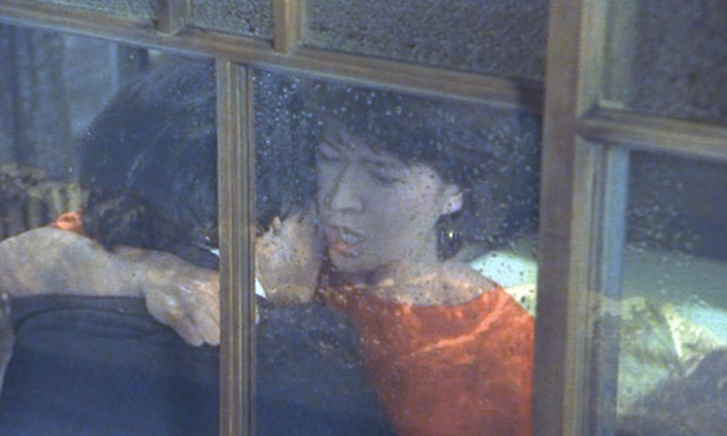
Trust Shohei Imamura to craft a gentle, adult, magical realism-tinged romance about love and projectile female ejaculate. Played in every conceivable way as a straight drama (yet tellingly cross-categorized as drama, romance and comedy by IMDB), "Warm Water Under A Red Bridge" follows out-of-work salaryman Yosuke (Koji Yakusho) on a trip to fulfill a dying friend's wish: Go to a certain house by the river in a small town and retrieve the treasure left there decades earlier. What Yosuke finds is Saeko (Misa Shimizu), a woman of impulse with a somewhat unique physical attribute. Note the moisture on the window pictured above. That's not rain. When Yosuke sees her shoplift but says nothing, Saeko recognizes in him-—what? Kindred spirit? Kind soul? Whatever it is, she takes to him in a direct, uncomplicated seduction that depicts her as both wanton and vulnerable. The film's few sex scenes are frank and speak to the power of pure chemistry: These two damaged people are right for one another from the moment they share a gaze, and their bodies won't let them deny it. Imamura's film is part fable and Saeko is a Snow White awaiting her shabby prince. Her bright red blouse echoes the bright red of the family parrot, an exotic bird in an otherwise drab fishing village. When Yosuke crosses that red bridge to find his princess, he leaves his old life behind and steps into a storybook of passion. EE

1. Dirty Sweaty Sex - from Hiroshi Teshigahara's "Woman in the Dunes"

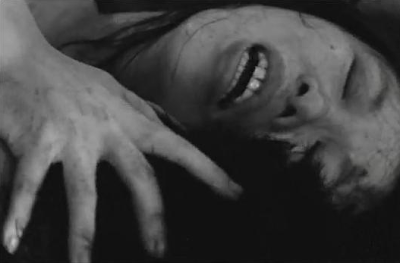
Leave it to Hiroshi Teshigahara to top our countdown. Also of note, Kyoko Kishida makes another appearance on the list (with both the films being released in 1964) as the titular woman in the dunes. Is it surprising that with all that sand around the place, that this is one of the dirtiest and sweatiest sex scenes one can bring to mind? Kishida plays a woman determined to save her house from the slowly encroaching sand dunes. A travelling scientist is encouraged by the local townsfolk to stay in her abode for the night, but finds that he is unable to leave the following morning due to the flowing sand all around him. Initially he tries to escape, but finally ends up becoming accustomed to his new life and the woman with whom he will share it. At one point she asks him whether all women in cities are beautiful. He dismisses her comment and begins to clean her by wiping down her sweat with a cloth. His simple touches and strokes on her back begin to make her shudder and she starts to breathe heavily. As the camera winds its way around her ever tensing body, it captures little details like her toes curling, her hand reaching back to caress him and the caked on dirt on their bodies. Even the soundtrack itself begins to bristle with anticipation as the couple drop any pretense of cleansing themselves and fall to the ground to make love in the sandy ground. It's a rousing scene... BT

Toronto IFF comes through by adding Miike, Nakashima and Sono to their 35th annual line-up

by Chris MaGee

It was only last week that we at the J-Film Pow-Wow were bemoaning the fact that the number of films from Japan was a bit lacking at this year's Toronto International Film Festival. Call it impatience or just plain misplaced wish-fullfilment, but we should have had a bit more faith that the folks at TIFF would come through for all us Japanese film fans. Today the last of this year's 35th annual Toronto International Film Festival line-up was announced and lo and behold there amongst the films from around the globe were some of the biggest films that have come out of Japan and will be coming out of Japan this year.

Joining Japanese and Japan related titles such as Tran Anh Hung's "Norwegian Wood", Naomi Kawase's "Genpin", Linda Hoaglund's "ANPO" and experimental films by Tomonari Nishikawa and Eriko Sonoda are these very high profile films:

Thirteen Assassins - Former cult film badboy turned blockbuster helmer Takashi Miike takes on the task of remaking Eiichi Kudo's 1963 jidai-geki adventure about a group of smaurai assissins bent on seeking revenge on a despotic lord. Koji Yakusho and Yusuke Iseya head up the all-star cast. (check out the trailer below.)

Cold Fish - Current cinematic bad boy Sion Sono follows up his 4-hour epic love story/ religious expose "Love Exposure" with the Based-on-a-true story take of two exotic fish salesmen whose realtionship spirals down into serial murder and madness.

Confessions - "Kamikaze Girls" and "Memories of Matsuko" director Tetsuya Nakashima takes a decidely drak turn in this story which stars actress Takako Matsu (above) as a middle-school teacher whose daughter has been brutally murdered. When she suspects two of her students of committing this heinous crime she sets out to avenge the death of her child.

So it's with a huge of relief and now quite a bit of anticipation that we look forward to yet another Japanese film-packed Toronto IFF next month. To see all the films that will be screened here in Toronto between September 9th and 19th check out TIFF's official website here.

Noboru Iguchi assembles a new group of Ancient Dogoo Girls for "Dogoo 5"

by Chris MaGee

It was a year ago that news came out about a new TV series created by "Machine Girl" direcor Noboru Iguchi. Titled "The Ancient Dogoo Girl" the series, which premiered in October and ran for two months on Mainichi Broadcasting System, told the story of a 10,000-year-old girl, played by busty 18-year-old actress and member of pop group Idoling!!! Erika Yazawa, who is brought back to live to fight ancient bad guys who are unleashing their evil on present day Japan. It looks like folks couldn't get enough of Yazawa and her magical breasts/ ceramic brassiere (check out the trailer for the series below to see what I mean) because the series was followed up by a full-length feature and now Tokyograph is reporting that MBS and Iguhi are prepping a new series with not one, but five buxom Ancient Dogoo Girls!

Titled "Dogoon 5" the series will feature more more tongue-in-cheek supernatural adventures with a healthy dose of T&A courtesy of the returning Yazawa and her four new co-stars - Misaki Momose, Rina Takeda, Manami Nomoto, Maria Yoshikawa and Haruka Dan. Each Dogoo Girl will posess special powers such as super strength, nursing skills, power dreaming and master fighting skills. The girls will be going into action this October with Iguchi and creative partner Yoshihiro Nishimura in tow to provide some of the over-the-top special effects.

Thanks to Oricon for the above promotional still.

Japanese Weekend Box Office, August 21st to August 22nd


1. Hanamizuki -May Your Love Bloom For A Hnudred Years* (Toho)
2. Karigurashi No Arrietty* (Toho)
3. Toy Story 3 (Disney)
4. The A-Team (Fox)
5. Metal Fight Beyblade The Movie/Duel Masters The Movie 2010* (Toho)
6. The Karate Kid (SPE)
7. Kamen Rider the Movie W/Goseiger* (Toei)
8. Inception (Warner)
9. Pikachu The Movie 2010* (Toho)
10. Bayside Shakedown 3 Set The Guys Loose!* ( Toho)

* Japanese film

Courtesy of Box Office Japan.

Sunday, August 22, 2010

AFTER DARK '10 REVIEW: Alien vs. Ninja


Alien vs. Ninja

Released: 2010

Director: Seiji Chiba

Starring:
Mika Hijii
Ben Hiura
Shuuji KashiwabaraMasanori Mimoto
Yuki Ogoe

Running time: 81 min.


Reviewed by Matthew Hardstaff


Yamata (Masanori Mimoto) leads his small Iga ninja team through the forests of ancient Japan , decimating his Koga ninja enemies. With him travels his two right hand men; Shuji Kashiwabara plays his equally kick ass and confident counterpart while Donpei Tsuchihira plays the older, and far less wise ninja. While investigating a fireball in the sky, they run into another group of Iga ninja also investigated the same aerial disturbance, this one containing the sole female ninja of the crew, Rin (Mika Hijii, who starred alongside Scott Adkins in Ninja, the far superior ninja film). Before they can say ‘let’s trade shuriken’, they’re attacked by a bloodthirsty alien that tears most of their team limb from limb (literally). Yamata, the over achieving ninja leader, desperately wants revenge and yerns for a good throw down, so with his remaining ninja friends they seek to hunt down and destroy those damn aliens!

"Alien vs. Ninja" is a ‘versus’ film, so I figured I should write it up as ‘the good versus the bad’, because really, with this amount of gore and camp, this type of film walks the fine line between the two, like Ogami Itto walking the path of meifumado. So we’ll start with the good! Yuji Shimomura performed duty as action co-coordinator alongside Kensuke Sonomura. Sonomura does have some good low budget credits behind his name ("Hard Revenge Milly" and "Machine Girl"), but Shimomura is on a completely different level. This guy made the amazing "Death Trance". This guy worked on "Flashpoint", arguably the best martial arts film of the new millennium with the reigning martial arts king Donnie Yen. Yeck, there’s even a nod to "Flashpoint" in one of the "Alien vs. Ninja" fights, complete with ground and pound, Yamata arm barring an alien and doing the Donnie Yen spinning arm windup punch. The fights in this film are pretty fantastic, and the ninja vs. ninja battle in the later part of the film borders on genius. This film promises aliens vs. ninjas, and to that it does deliver, however in small doses. But when it does give it to you, it’s pretty great. The aliens, men bound to rubber suits, are both hilarious and amazing, and the special effects and fight scenes with them are highly inventive, hilarious and at times strangely sexual. Writer/director/producer Seiji Chiba obviously knows his references, and fills the film with musical cues and narrative setups from "Predator" as well as cinematic framings of the reveal of the alien straight out of "Alien". Unfortunately, he has trouble filling out the script with more than just fights.

So here’s the bad. The film runs 81 minutes, and maybe half of that is aliens vs. ninja’s. The other half struggles with the comic relief of Donpei Tsuchihira, who’s only obvious purpose is to make this film feature length. Yes, the idea of having an old, chubby ninja who’s only survived because he’s remained in the shadows, never to strike, is pretty funny. And I agree that comedy is a huge part of this film, however, many of the jokes drag on, some aren’t funny, and it really slows down the pace. And I mean really slows down the pace. Anyone who tells you this film is aliens vs. ninja’s from start to finish is either lying to you, or they were blinding by the small amounts of mad ninja greatness that dot the film. It does have some great sight gags, but this isn’t elderly ninja from "Red Shadow" that is actually funny, this turns into often annoying, and rarely funny slapstick comedy.

So here’s my problem. This is one of the first films made by Sushi Typhoon. This is Nikkatsu, who specialized in making some of the more fringe genre bending films from action to pink films. This is Takashi Miike, Sion Sono, Yujji Shimomura, Yoshihiro Nishimura, Noboru Iguchi and Tak Sakaguchi teaming up to make the kind of genre films I demand. And when they make a film called Alien vs. Ninja, I expected something they definitely didn’t give me. This is Sushi Typhoon, not Sushi Breeze, this film should be soaked in alien blood, the screen should abound with alien vs. ninja battles, but instead it’s filled with a few splatters. If this is Nikkatsu’s plan, to spoon feed people really, really low budget films that don’t quite live up to the expectations they deserve, I think this experiment will fail.

On a side note, I demand that they change the aspect ratio from that HD 16:9 crap they use, compulsively shooting everything digitally, abiding by its dull straight to video aspect ratio. I demand Nikkatsu bring back the aspect ratio this kind of film was meant to be seen in, 2.35:1! This demands the wide scope of its sixties and seventies counterparts. You can’t have a decent showdown when the opponents are that close together!!! They need an expanse of land, wide and glorious. But now I’m rambling. Next time Sushi Typhoon, make a Typhoon.

Read more by Matthew Hardstaff at his blog.

Hayao Miyazaki takes to the air again with "Porco Rosso: The Last Sortie"?

by Chris MaGee

Hayao Miyazaki is a director who we nromally associate with whimsical and wonder-filled tales about children (or young adults), but in 1992 the master animator created a story not aimed at children but at middle-aged men. That film was "Porco Rosso", a downbeat adventure about a former WW1 Italian fighter ace whose misanthropic ways have transformed him into a pig... literally. Porco flies over the Adriatic Sea battling it out with his rival Curtis and trying to win the heart of his true love Gina. For me "Porco Rosso" definitely had its charms, but not nearly the same amount of charm as Miyazaki's tales aimed at kids, so I was a bit taken aback at the news posted by Todd Brown over at Twitch that Miyazaki is planning a sequel to "Porco Rosso" titled "Porco Rosso: The Last Sortie". Well, I was taken aback at first...

While this is low on my list of favorite Miyazaki films it makes sense that this would be one that MIyazaki would be revisiting now. Longtime fans of Miyazaki will know that if the man has one obession other than animation its aviation. Fanciful flying ships and aerial adventures are featured again and again in his early films - "Nausicaa of the Valley of the Wind", "Castle in the Sky", "Kiki's Delivery Service" and of course "Porco Rosso". Miyazaki came by his obsession honestly. His father was the owner of a factory that manufactured rudders for Mitsubishi A6M Zero fighter planes used during the war. Miyazaki's most recent films though such as "Princess Mononoke", "Spirited Away", "Howl's Moving Castle" and "Ponyo" haven't gotten as airborne as his previous films, so maybe the 69-year-old Miyazaki wants to return to a subject that is so very near and dear to him. Also Japanese manga readers have recently seen pigs flying again in Miyazaki's manga "Kaze Tachinu (The Wind Rises)", the story of Dr. Jiro Horikoshi, the chief engineer and designer of the Zero, in which Miyazaki depicts his pilots as pigs. (Read our full report here.)

No word yet on when we'll see "Porco Rosso: The Last Sortie" fly into Japanese theatres, but we'll keep an ear to the ground on this story.

AFTER DARK '10 REVIEW: RoboGeisha


ロボゲイシャ (RoboGeisha)

Released: 2009

Director:
Noboru Iguchi

Starring:
Cay Izumi
AsamiSuzuki Matsuo
Kentaro Shimazu
Naoto Takenaka

Running time: 102 min.


Reviewed by Bob Turnbull


Considering the lineage of "Robogeisha" (the filmmakers were responsible at least in part for "Machine Girl", "Tokyo Gore Police" and "Vampire Girl vs Frankenstein Girl"), one wonders what went wrong. It's not that I loved the team's previous efforts - I had problems with the last two listed - but at least each had moments of truly unique creativity and even beauty amongst all the strange and grotesque gore. "Robogeisha", however, contains only concepts, weird ideas and a few moments of self-reflexive humour. Otherwise it was mostly a pretty big bore.

I suppose that's an odd reaction to a Japanese splatter-gore, sexual-organs-as-weapons, nothing-is-out-of-bounds film seemingly tailor-made for genre festivals. And yet that was my reaction. It's not that there isn't anything of interest here, it's just that it isn't handled with any deft, is bogged down with a pretty uninteresting story and uses CGI effects that sometimes feel 20 years late. It's only saving grace is through some humour that plays against and acknowledges some of the silliness at play here and in previous films. Well, that and the huge robot that makes buildings bleed.

To give the film some credit, it does contain more of a story than its predecessors (which really only contained rough templates) - two sisters become geishas in an anti-government group that trains them to assassinate corrupt politicians. On top of this, and the strange continued mechanization of the women as they become more weaponized, the sisters are at odds with each other and a strong love/hate relationship builds as they drift to opposite sides of the battle. I was actually surprised at the increased effort to bring about more characterization and even, dare I say it, emotion to the film, but it just never engages the viewer in any of those story-related scenes nor does it build any kind of investment in either of the women. They are truly simply vessels through which the imagined weapons (circular saw blades in mouths, swords protruding from rear ends, etc.) manifest themselves. It's all there in the trailer - as a matter of fact, if you watch the trailer'>http://torontoafterdark.com/2010/index.php/feature-films/robogeisha/">trailer, you've mostly seen the movie.

True, you would miss some funny moments such as the three women battling each other with their "ass swords" and mumbling "this is really embarrassing" as they waddle at each other. Or the politician faced with the spinning circular saw cringing and whining "I think this is going to hurt!". There's just far too few moments like this and far too many special effects that are rendered in rather dull fashion. There's a strong feeling that perhaps the filmmakers intended to make a "bad" film, but all they succeeded in doing was making a bad film. For all the flaws their previous films have, the physical special effects with real oozing liquids and protuberances a-plenty were highly creative and somewhat entertaining. Cheap looking computerized graphics (it's possible the film is a test run using different technology for their creations) leave everything flat and lose the sense of absurdity and wonder. Not to mention the fun.

Read more from Bob Turnbull at his blog.

Award-winning director Yoichi Higashi makes pink films for the disabled

by Chris MaGee

It was only back in April that we reported on how the director of the nostalgic 1996 fantasy film "Village of Dreams", Yoichi Higashi, was returning with a new film starring Tadanobu Asano as an alchoholic author and Aoi Miyazaki as his long suffering wife. The Japanese Academy Award-nominated and Venice Silver Bear-winning director isn't content with just delivering this new drama to Japanese audiences though. Higashi has also written and directed his own pink film titled "Nasu Natsuko no Atsui Natsu (Nurse Natsuko's Hot Summer)". The film tells the story of a white collar worker whose wife is injured in a bike accident. While she recovers in the hospital her husband becomes infatuated with her nurse, Natsuko, and the two embark on a torrid and destructive affair.

"Nasu Natsuko no Atsui Natsu" is part of a series of films dubbed "Bali Erotics" that have been made with disabled audiences in mind. Yes, the producers are aiming the films at people with physical disabilities and to make this erotica entirely available Higashi's film and the other in the series will be screened at the Pole Pole Higashinakano Theatre which is entirely wheelchair accesible. I mean, everyone has urges regardless of sex, race, age or physical ability...

Check out the trailer for "Nasu Natsuko no Atsui Natsu"below and thanks to CinemaToday.jp for this news item.

"Vermilion Pleasure Night" creator Yoshimasa Ishibashi exhibits new video work in Kanagawa

by Chris MaGee

Not many of you out there will instantly twig when you hear the name Yoshimasa Ishibashi, but many of you will know his work. Ishibashi was the man behind the late-night TV Tokyo comedy show "Vermilion Pleasure Night". The show only aired for five months in 2000, but its popularity has grown thanks to YouTube where many of its skits, such as the mannequin family The Fuccons, the disturbing Midnight Cooking/ How to Eat a Girl and the X-rated One Point English Lesson, have become viral hits. Yoshimasa didn't get his start in comedy though. He got his start as a video artist and he's returning to his roots with a new exhibition taking place at Marugame Genichiro-Inokuma Museum of Contemporary Art in Hamamachi Marugame City, Kagawa Prefecture. Titled "SickeTel: Ishibashi Yoshimasa and KyupiKyupi" the exhibition not only brings together videos from "Vermilion Pleasure Night" but it also includes a claymation workshop and two new video works by Ishibashi - "Black Rina" (above left) and "White Snake" (above right).

"SickeTel: Ishibashi Yoshimasa and KyupiKyupi" runs at MIMOCA from July 18th to November 3rd. For more details and more images from the exhibit click here and here.