Saturday, April 30, 2011

Nippon Connection Update: Day 3

by Chris MaGee

Well, yesterday hit the mid-waqy mark for the 11th annual Nippon Connection Film Festival, and despite the recent tragedies in Japan this year appears to be one of the most successful yet. In fact with Japan making headlines day after day here in Germany the profile of the showcase o9f Japanese film and culture may have been raised. IK was speaking with Nippon Connection head Marion Klomfass and while she was a bit concerned that people here in Frankfurt might have reached the saturation point with all things Japan since the March 11th earthquake and tsunami it turns out the exact opposite has proven true. It also helps that for day three the Nippon Connection programmers managed snag some very high profile films.

Day three started off with the German premiere of "The Borrower Arriety", the latest animated flight of fancy by Studio Ghibli. The main Nippon Cinema theatre was sold out, but with an audience that I haven't been used to seeing at screening here -- a nice mix of teens, goth loli young adults, Japanese women some young, but many middle-ged, and a healthy representation of the otaku set (not including us of course...) While this directorial debut for Hiromasa Yonebayashi may not be the strongest Ghibli film out of the gate in recent memory it still has all the hallmarks of one of their cherished productions -- top quality animation, wonderful attention to detail and a strong main heroine. Check back in coming weeks for our full review.

There were a couple other sell out screenings of note for day three, one being an unlikely festival buzz film, the other a straight up crowd p[leaser. The former is Koji Shiraishi's horror mockumentary "Shirome". The film features J-pop girl band Momoiro Clover as they get taken into a haunted house where all may not be what it seems. You can check out the trailer below, and while you may say "Isn't this just another late-in-coming low budget J-horror flick?" this is a film that has gotten a lot of people talking here at the fest. The second of the unlikely sell out screenings was Renpei Tsukamoto's "Wig". It follows a mid-30's salaryman with thinning hair as he rewrites his destiny with the help of a hair piece. The film doesn't break any new cinematic or comedic territory with it's mix of absurdity and slapstick at all, but the crowd couldn't get enough. Could be a contender for this year's audience award??? Maybe....

Of special note on Friday was a lecture given by University of Leeds PHD student Julian Ross titled "Shinjuku Thieves". It charted the cross-pollinations and collaborations between the worlds of fine arts, literature and performing arts in the avant-garde milieux of Tokyo in the 1960's and early 70's. Fascniating stuff, much enjoyed by the full lecture room.

Besides the bread and butter of Nippon Connection -- the films -- Marc and I continue to make the party scene at night, belting out classic tunes in the karaoke lounge with the folks from Midnight Eye and the festival crew. Let's hope and pray that these drunken performances don't find their way onto YouTube, thank you very much. More tomorrow on day four and the very late night we're anticipating with the big Saturday night party with the very appropriate theme of Help Japan.

NIPPON CONNECTION '11 REVIEW: Milocrorze: A Love Story


ミロクローゼ (Milocrorze)

Released: 2011

Director:
Yoshimasa Ishibashi

Starring:
Takayuki Yamada

Maiko
Ann Ishibashi
Seijun Suzuki
Eiji Okuda

Running time: 90 mins.


Reviewed by Chris MaGee


27-year-old actor Takayuki Yamada has had quite the career at a very young age. He started out as a TV actor until, at the age of 22, he burst onto the big screen, and the international scene, as the lead character in Shosuke Murakami's "Densha Otoko (Train Man)". That film, which told the story of an Akihabara otaku who saves a beautiful woman on the subway from a drunk and subsequently falls in love with her, was a decidedly quirky, but still straight ahead romance. Still it demanded that Yamada use whatever comedic chops he had to leaven his character's doe-eyed innocence. He did a wonderful job, but in the end it was Yamada the heartthrob, and not Yamada the comedian, that would eventually win him more big screen roles in films such as "Crows Zero", "Ikigami: The Ultimate Limit" and "MW". Sure Yamada managed to work in a few laughs into his roles in these films, as well as show off his considerable screen charisma, but he has never really been able to grow into what I have always felt has been his full comedic potential... that is until now and Yoshimasa Ishibashi's feature film "Milocrorze: A Love Story".

It's in this film, that could be described as an omnibus film if it wasn't being helmed by a single director, that Yamada is given the task of playing not two but three different roles, all of them tied together by the consistent thread of love and relationships. First there is a little bob-haired boy who meets the beautiful Great Milocrorze (played by model-turned-actress Maiko). At first this boy is in fact played by a boy, but as their relationship grows and eventually sours he comes to be portrayed by Yamada, now with a pot lid covering the hole in his chest where his heart used to be. Next up is a manic and often downright surly relationship counselor who spits, growls, and rages at his poorly socialized clients about how to play macho and win the girl everytime. Finally Yamada gets to play a samurai, one in search of a beautiful woman who is captured by bandits and sold into a house of prostitution. Throughout these various incarnations we in the audience try our best to maintain our vertigo amongst a collection of zany backdrops and effects, as well as one laugh piled on another.

The laughs and craziness come from another artist who, with "Milocrorze" I feel is just coming into his full potential. That would be director and video artist Yoshimasa Ishibashi. Not heard of Ishibashi? Maybe you haven't, but if you've wandered the back alleys of YouTube and seen clips from the TV Tokyo series "Vermilion Pleasure Nights", especially the mannequin family "The Fuccons" then you already know Ishibashi's work. originally the Kyoto native got his start as the video/ film-maker and production designer for avant-pop arts collective Kyupi Kyupi. In 1997 he strayed from the Kyupi Kyupi fold to make his directorial debut with the surreal comedy "I Wanna Drive You Insane" which eventually led him to create and direct "Vermilion Pleasure Night". Zombie families, mannequin families, cannibalistic cooking shows and dirty English lessons -- "Vermilion Pleasure Night" revelled in the absurd and the taboo. That same sense of obtuse humour and hallucinatory visual aesthetic has finally been boiled down to a potent brew in "Milocrorze". From the wild TV set ups for Yamada's relationship counselor to the breathtaking slow motion swordfight that forms the film's climax, Ishibashi has created a magical and maverick piece of work. It helps that he enlisted the acting talent of 86-year-old film-making maverick Seijun Suzuki who makes a cameo appearance as a senile tattoo artist.

Still despite the combination of Yamada's perfect comic timing and Ishibashi's wild imagination "Milocrorze" may not be for everyone. I only mention this as I've talked to a couple colleagues and read a couple of reviews that stress the narrative weakness of the film. Fair enough, but when we see the outpouring of love showered on the early films of Katsuhito Ishii and Gen Sakaguchi's "Survive Style 5+" very few people tend to mention a lack of narrative cohesion. What fans of these films remember and continually reference are the ingenious vidual gags and pathological glee that Ishii and Sakaguchi took with their comedic set-ups. It's kind of like saying that Monty Python could have used a little more time to smooth out and narratively connect the dead parrot sketch with the Ministry of Funny Walks sketch. For those of you who miss the punch line of "Milocrorze: A Love Story"... well, I doubt you'll ever get it; but for those of you, like me, who think that Takayuki Yamada and Yoshimasa Ishibashi have come into their own by working on this film, well I applaud you. In the end this is a film that fans will give life to as a cult classic. It's critic proof.

Friday, April 29, 2011

Nippon Connection Update: Day 2

by Marc Saint-Cyr

The second day of 2011's Nippon Connection for many (including myself) marked the proper start of the festival - meaning serious movie watching. I jumped into my full viewing schedule with a particularly delightful treat: Keita Kurosaka's "Midori-ko," a marvel of animation that took ten years to complete. It focuses on a young woman who owns a little vegetable stand in a strange world populated with talking creatures and machines. She discovers a mutant vegetable that bears human features and characteristics as it grows and matures and pulls her into a series of unexpected encounters. Part of what makes "Midori-ko" such a delight is its uniqueness - the animation style is a far cry from what you'd expect from conventional anime. Instead, the images are rough, hand-drawn and monochromatic with subtle shades of color, all conjuring a detailed realm of shadows, textures and shapes - essentially, a place that feels as though it has existed and spawned numerous other tales beyond the one told in this film. This style is a perfect fit for the vast wealth of surprises that lie in waiting for viewers, indicating an exceedingly rare degree of vision and imagination that is marvelous to discover.


Next, I caught Takashi Ishii's "A Night in Nude - Salvation," which is a follow-up to his 1993 film "A Night in Nude" and features the return of amateur detective Jiro (Naoto Takenaka). It is laden quite heavily with gore, violence and nudity, but what makes it much more intriguing is the twisty (and twisted) story of abuse and revenge that Jiro gradually discovers. A strange venture into neo-noir, "Salvation" certainly intensifies as it continues, eventually delivering a rather satisfying payoff. The same can't really be said of Lewis Rapkin's documentary "Live in Tokyo," which concentrates on city's diverse underground music scene. This topic has no shortage of interesting subjects, and indeed, if nothing else, the film serves as a convenient introduction to many smaller bands and the system in which they try to establish themselves. However, those looking for a more in-depth examination of how these musicians actually work and survive on a day-to-day basis or react to the massive game-changing element that is the internet will likely be let down, as the film only presents a handful of interview segments that are noticeably broad and repetitive and dwarfed by much longer musical segments played over footage of live performances, time-lapse heavy "city symphony" sequences and, bafflingly, armadas of floating sushi.


The day ended with a quite satisfying one-two punch: a screening of Yoshimasa Ishibashi's decadently stylish, gleefully nutty debut film "Milocrorze - A Love Story," followed by a discussion between Ishibashi-san, "Dumbeast" director Hideaki Hosono and our very own Chris MaGee (pictured above). Discussion topics ranged from the dividing line between commercial work and film work, sources of artistic inspiration, Youtube and favorite movies. The stimulating talk and the slew of unique works that I viewed before it all helped remind me of the bounty of opportunities that Nippon Connection bestows to eager explorers of Japanese culture year after year. In light of the recent troubling events in Japan, this year is a particularly important one for the festival - but, judging from the outflow of solidarity and support represented by the visitors, guests and volunteers present as well as the hugely impressive quality and quantity of films and other activities to choose from, it is also very much showing (and delivering on) the promise of a successful one.

NIPPON CONNECTION '11 REVIEW: Doman Seman

 
堀川中立売 (Horikawa Nakatachiuri)

Released: 2010

Director:
Go Shibata

Starring:
Koji Hata
Takeshi Yamamoto
Naozo Hotta
Kirara Inori
Sae Shimizu

Running time: 124 mins.

Reviewed by Marc Saint-Cyr

Thus far in his career, Go Shibata has proven himself to be a most interesting, highly idiosyncratic filmmaker. In 1999, he made his feature film debut with "NN-891102," a boldly experimental exploration of the lasting cultural and psychological effects of the Nagasaki bombing. Then in 2004 came what is still his best-known film to date: the compelling "Late Bloomer," which stars cerebral palsy-afflicted Masakiyo Sumida as a serial killer in the making. Since then, it seems Shibata has set his sights on more ambitious goals to test his filmmaking abilities on, resulting in the large cast of characters, proliferation of lofty ideas and all-out zaniness contained within his latest work, "Doman Seman." While it is reassuring to see him attempting to challenge himself, there will likely be more perplexed than awed viewers left in the wake of his most recent efforts.

"Doman Seman" is set in a strange alternate reality version of Kyoto in which a strange, impossibly tall tower looms over the city. The building houses the Kato the Catwalk Doman Seman Broadcasting Company, which airs nutty TV shows like the Kyoto Hot Boy Map Show, in which attractive young men are asked questions and shown beating up homeless people – a widely popular activity embraced by the public. In this world, which is trapped in a deteriorating, capitalism-fuelled state of ruin and chaos, slacker Shinsuke (Motako Ishii) lives with his unbalanced girlfriend Sae (Sae Shimizu), to whom he owes quite a lot of money. He is rescued from his financial predicament by the mysterious, bald-headed Abe (Naozo Horita), who pairs him with the easy-going bum Tsutomu (Takeshi Yamamoto) for an assignment to keep track of a young man named Terada (Yusuke Noguchi). Terada was involved in an incident fifteen years previous in which he murdered the staff of a personal loans company – an event that weighs heavily upon him once more as a copycat campaign to kill moneylenders is put into action. As Terada struggles to escape from the ever-invasive public eye, Abe enlists the help of a group of power-wielding children to combat the evil, rubber-faced, hearse-riding Kato the Catwalk Doman Seman (Koji Hata).


Initially, one gets the sense that "Doman Seman" is going to be one hell of a fun time at the movies. In the opening scenes, the film launches the viewer into its bizarre world with a dizzying barrage of off-kilter news reports and goofy antics. Scenes like the frequent squabbles between Shinsuke and Sae; strange occult rituals performed by Abe’s gang of youngsters; hallucinatory trip experienced by Shinsuke and Tsutomu after they consume psychedelic, brightly colored Imperial mushrooms and hyperactive fights between the two unlikely spies and the Hot Boys all bear the hilarious, anything-goes insanity and energetic inventiveness perhaps best exemplified by Takashi Miike in "Visitor Q" and "The Happiness of the Katakuris" mode. Additionally, Shibata squeezes in several strong statements and ideas that essentially damn the suffocating forces of money and capitalism and paint the media as a soulless, amoral machine fuelled by vapid sensationalism. But despite these appealing ingredients, the film unfortunately feels too scattered and directionless to make the kind of impact it is aiming for. Tellingly, it is at its strongest when it follows the quiet, troubled Terada and his plight as the events of the past reemerge and take their toll on his life – mainly in the form of prying, camera-wielding members of the public who greedily tail him. In his scenes, the weird factor is dialed down just enough to give him a proper sense of depth and resonance, which is helped along considerably by Noguchi’s commendable performance. But this character-driven sense of gravity is never maintained for long, instead giving way to a barrage of strange goings-on and nonsense humor that ultimately doesn’t really stick together as a whole, thus creating a viewing experience more bewildering than satisfying.

There are still many things to like in "Doman Seman" – it is frequently funny, the camaraderie between Shinsuke and Tsutomu works fairly well and one can readily appreciate the relevant social commentary that Shibata provides. Yet the final result ends up being unnecessarily muddled, making one hope that, for his next project, he will have a more refined sense of focus and structure in mind.

Read more by Marc Saint-Cyr at his blog

Thursday, April 28, 2011

Nippon Connection Update: Day 1

by Chris MaGee

We've been anticipating it for a while, but finally we're in the midst of the 11th annual Nippon Connection Japanese Film Festival in Frankfurt am Main, Germany. In the fallout of the March 11th earthquake and tsunami in Japan and the subsequent crisis at the Fukushima Dai-ichi nuclear plant there was a question as to whether this year's festival would happen at all, but thankfully the Nippon Connection team made the decision that this year it is even more important highlight Japanese film and culture. We here at the J-Film Pow-Wow applaud this show of solidarity.

While the presence of origami cranes, traditionally folded in Japan as a type of physical prayer, scattered around the main festival site is a reminder of the "Help Japan" message of this year's event the opening night of Nippon Connection was still as much of a celebration as ever. The night was kicked off with a reception that was opened by the Gamushara-Oendan, a troupe of male cheerleaders. Don't think short skirts, cleavage and pom-poms here. These guys are all business. Stomping and shouting, dressed in black high-collared school uniforms (called gaku-ran) the job of these cheerleaders is to drive team spirit into you... or else! They also got the assembled crowd of guests and media laughing and clapping along. While past years' opening have featured exquisite example of traditional dance and taiko drumming the boys of Gamushara-Oendan have to be our favorite openers of the fest to date. You can check out more about the troupe at their Japanese language website here.

Once the cheering was done a huge line queued up to see the opening night film, Hitoshi Yazaki's "Sweet Little Lies", a portrait of a disintegrating marriage starring Miki Nakatani and Nao Omori (you can read our full review below). It was a packed house in the theatre, and meanwhile out in the festival lounge Adam Torel, the president of Third Window Films, uncrated his collection of rare northern soul and 70's and 80's J-Pop to DJ the opening party. While the music built the beer flowed and it was time to catch up with this year's festival guests Jasper Sharp and Tom Mes (Midnight Eye), Julian Ross, and Cathy Munroe Hotes (Nishikata Film Review), as well as the Nippon Connection crew -- Marion, Petra, Dennis, Erin, Lukas, Gary, Martin, Antje... and the list goes on and on. Without these folks this year's fest wouldn't have happened, so a big thank you to them. Every year Nippon Connection feels like a home for Japanese film fans like us.

Keep checking back in the coming days and we'll be posting reviews and updates from here in Frankfurt!

NIPPON CONNECTION '11 REVIEW: Sweet Little Lies


スイートリトルライズ (Sweet Little Lies)

Released: 2010

Director:
Hitoshi Yazaki

Starring:

Miki Nakatani
Nao Omori
Chizuru Ikewaki
Juichi Kobayashi
Sakura Ando

Running time: 117 mins.

Reviewed by Chris MaGee


Satoshi and Ruriko Iwamoto are a typical married couple... or are they? Satoshi slips on a suit each day and heads to a large office where he administers his company's I.T. department, while Ruriko works from home, creating one of a kind, handmade teddy bears. Each morning Ruriko sends her husband off to work by whipping up a daily variation of cooked eggs - scrambled, poached, etc. Each night she greet hims with a smiling "Okaeri nasai", or "Welcome home". It's obvious that the two love each other, but as Hitoshi Yazaki's "Sweet Little Lies" progresses we observe that they often have very strange ways of navigating their affections. More often than not when Satoshi (Nao Omori) gets home in the evening he heads to his own little man cave, a room at the rear of the Iwamoto's apartment that consists of a floor cushion, a boom box, a stack of video games, a gaming console and a wide screen TV. To allow for ultimate concentration, or isolation, Satoshi is in the habit of locking the door of his little hermitage. The only way that Ruriko can access him when she has dinner ready, or his younger sister comes to visit is by calling him on his cell phone. Meanwhile Ruriko goes about creating soft and cuddly bears which she shows and sells at a local craft gallery. The only thing is that the one person we would expect to see at her gallery openings, Satoshi, is never in attendance. It seems after three years of marriage that the Iwamotos have become the face of Japan's work-a-day society and sharply declining birth rate. They're loving and dependent on each other, but emotionally removed and, as we learn from Ruriko, celibate for just over two years. Any spark of passion is vacant between them and Ruriko, the active anima to Satoshi's painfully passive animus, observes that maybe this passion is absent because it's not necessary. They and we learn otherwise as "Sweet Little Lies" progresses.

Director Hitoshi Yazaki, who last brought his film-making talents to bear on the lives of 20-something Tokyo couples in 2006's "Strawberry Shortcakes", has returned to show us the emotional innards of the lives of a 30-something married couple and how the gnawing loneliness that exists in both of them cause them to find solace outside their relationship. For Satoshi this comes in the form of Shiho (Chizuru Ikewaki), a young, very cute and very bubbly, member of his scuba diving club who, from the minute she appears on screen, goes about seducing her "sempai", as she calls Satoshi. For Ruriko, her ticket out of loneliness is Haruo (Juichi Kobayashi), a handsome client who begs Ruriko to give him one of her special teddy bears as a gift for his girlfriend Miyako (Sakura Ando). He gets the bear, but then quickly shifts his passions from his girlfriend to Ruriko. Yazaki paints each frame of "Sweet Little Lies" with faded blues, browns and off-whites, moving Satoshi and Ruriko into the proverbial moral grey area that makes their subsequent affairs possible. The only thing is do we in the audience buy that the arrival of Shiho and Haruo has really made the lives the Iwamotos any less lonely?

Japanese film has trod the territory of unhappy couples and adulterous relationships a fair bit in the past 15 years or so, and while watching "Sweet Little Lies" two films kept popping into my head, both as examples of how their directors got the territory right while Yazaki almost but never quite hit the mark. The first was Ryosuke Hashiguchi's "All Around Us" which featured the sublime performances of Tae Kimura and Lily Franky as a married couple whose lives go through some serious ups and downs over a decade. The other was the romance "Shitsurakuen (Lost Paradise)" directed by Yoshimitsu Morita, a film that tried to make up for its over-wrought storyline of adultery with major doses of onscreen sex and nudity. These two films had what I think "Sweet Little Lies" lacks: a believable couple at its center and delicious carnality that tempts them out of the marital bed and into someone else's. I have to admit that my mixed reaction to "Sweet Little Lies" may have to do with my mixed feelings about Miki Nakatani. I can say that besides her turn in Hideo Nakata's hugely underapprecaited mystery "Chaos" she's never struck me as anything but a servicable actress. Her Ruriko wanders through her life with sad eyes and a bemused smile, neither of which spark to life upon the arrival of Haruo. Nao Omori as Satoshi fares a bit better as her man/ child husband. The scenes where Ruriko asks him to hold her and his attempt looks like that of a seventh grader as a junior high dance is motivation enough for her to run out the door and into Haruo's bed. Instead of giving us an onscreen couple with some kind of chemistry (even enough to make us believe that they once felt some spark or lust for each other) Yazaki gives us running symbolism instead. Ruriko's musing early on in the film that every couple needs a red rose and a white rose to function, red for passion and white for truth, is repeated again and again. Shiho offers Satoshi a glass of red wine or white and he chooses the passionate red. Later on Satoshi stands staring at a pure white beluga whale at an aquarium, the white whale of truth that he can't touch because of the glass that seperates him from it. Glass is another recurring theme. Ruriko polishes the windows of their apartment each morning and later confesses to Haruo that Satoshi is her window, a barrier between the dark of night and the warmth, light and safety of their home.

I can't say that I disliked "Sweet Little Lies". The cinematography by Isao Ishii is wistful and gauzy, and the sadness that it evokes is very affecting. Still I wanted to like this film a lot more than I did. It's absolutely true that you don't have to go the route of Morita's "Lost Paradise" and fill the screen with bare flesh to make a convincing film about adultery, but what that film had was what the Iwamotos' marriage severely lacks: passion. Yazaki only hints at the stakes of straying in his story -- maybe heartbreak, maybe even double suicide, but when Ruriko and Satoshi find themselves in the arms of their lovers they seem no more happy, not even less lonely then when they are together. Maybe that's the end point of the film, but it would have been nice to see their hearts quicken and a little blush of colour come to their cheeks at the thought of forbidden fruit. The same thing holds true for films as it does about a good marriage: they need both passion and truth. Without the former the latter is not enough.

Saturday, April 23, 2011

Chris and Marc head to Nippon Connection this week! Keep checking back for updates!

by Chris MaGee

As our regular readers will know both Marc Saint-Cyr and I will be heading to Frankfurt on Monday to attend and participate in the 11th annual Nippon Connection Japanese Film Festival. Yes, we're excited, and yes we're honoured. This post is just a heads up to all of you to make sure to check in daily starting on Tuesday to get news and reviews from the biggest Japanese film festival outside of Japan. We'll try and get as much content up on the blog during the festival run of April 27th to May 1st, plus we'll be doing it with the help of Nippon Connection's blogging and I.T. guru Gary Siemund.

So keep an eye on the site and look for the "Toronto J-Film Pow-Wow @ Nippon Connection" banner above, but until the fest starts on Wednesday here's the trailer for this year's Nippon Connection. Enjoy!

Christopher Doyle talks "Underwater Love" and "Rabbit Horror" at TIFF Bell Lightbox

by Matthew Hardstaff

Folks who attended the TIFF Bell Lightbox this evening in lovely downtown Toronto were treated to a 2 hour talk with uber cinematographer extraordinaire Christopher Doyle, presenting not only "Chungking Express" which plays in a limited run this week, but also earlier in the day opening a photo exhibition at INDEXG of his own work. Doyle is one of my favorite image makers the world over, so this was a special evening, but you may be asking yourself, what does this have to do with Japanese cinema?

Well, last night at the Tribeca Film Festival, "Underwater Love", Christopher Doyle’s collaboration with sentimental pinku director Shinji Imaoka, made its world premiere. So what better way to finish of his two hours talk in Toronto than to show a short montage of "Underwater Love". Christopher Doyle likes to create montages. He creates them as a means to contextualize and refine what the film was about. During the clips shown throughout the evening, he presented his montage for "In the Mood for Love". And much like the montage for "Underwater Love", it contains shots from the film as well as behind the scenes footage.

So what were we treated to? As Doyle put it, it’s a love story about a soon to be married woman who discovers she has cancer, and then meets a kappa who use to be a former lover, and who can cure her cancer by sticking a magic rock up her rectum. In musical form. The montage was a smattering of people dancing, a little bit of sex, some luscious green images of water and tree’s, kappa’s, kappa penis’ and more singing and dancing. True to the kind of films Imaoka makes, its focus isn’t on the sex, but on the relationship between the woman and the kappa. The film was shot over 8 days and given the ‘just do it’ attitude of filmmaking Doyle was pushing all evening, it seems like regardless of the content, this was the kind of challenge he welcomes. Due to the obvious logistical restrictions they had, the film appears to really embrace its low budget roots. The kappa costumes by Yoshihiro Nishimura are clearly proud to be made for very little under a tight timeline. Doyle didn’t mention much of his impression of working with Imaoka nor making a pinku, other than saying it was a nice story and explaining what pink cinema was. Regardless, Doyle definitely brings his sense of immediacy to pink film and creating something visually striking.

Doyle did mention a few words about "Rabbit Horror", the 3-D horror film directed by Takashi Shimizu, which he explains is less a horror film and more about relationships and the barriers that obstruct them. He also mentioned that the film is a very 2 dimensional 3-D film, and thinks 3-D is too problematic and won’t last. So it sounds like the fact that it was 3-D wasn’t really embraced nor capitalized on. Interesting.

Christopher Doyle ramblings sometimes sound like that of a drunken sailor, and other times like that of an artistic prodigy. He created the crowd with a Mongolian blessing with his pint of beer, which sat at his side the entire talk. It was amazing times.

REVIEW: Love Addiction


ふゆの獣 (Fuyu no Kemono)

Released: 2010

Director:
Nobuteru Uchida

Starring:
Megumi Kato
Momoko Maeda
Hiroyuki Sato
Kosuke Takagi


Running time: 92 mins.


Reviewed by Nicholas Vroman


There’s a certain hysteria of twentyish love – where everything is a do or die moment, where love (or lack of) pushes a person to operatic highs (and lows), where desperation runs hand in hand with passion, where young souls reveal themselves with a self-possessed and naked honesty – that Nobuteru Uchida and his quartet of young actors catch brilliantly. If only for a few split seconds. There are moments that shine through the wobbly handheld camera shifting focus and focal length that make a simple (and simplistic) metaphor for the changing relationships of the ménage a quatre that inhabit the closed universe of “Love Addiction.”

These good moments, though, do not add up to much of a film. The opening half hour or so of development are craftily put together, throwing the viewer into a world that’s all on edge. The final hour devolves into a mess of narrative and cinematic clichés with ever escalating faux emotional highs and a complete deflation in lieu of any meaningful catharsis.

From the furious whip pans and constant reframing of emotional spaces to the actorly improv and mining of dangerous psychological ground, “Love Addiction’s“ no-budget look at the fucked up love lives of a generation owes its existence to John Cassavetes. All well and good. Unfortunately Uchida’s direction, though on the surface giving the actors room to explore new depths, ultimately leaves them hanging. There’s an awful lot of cryin’ and emotin’ but it just goes nowhere.

There is one moment where Shigehisa (Hiroyuki Sato), the two-timing jerk of the story tells his girlfriend, Yukako (Megumi Kato) a long winded story/alibi/lie involving a friend losing a key an how this friend’s girlfriend bicycled two hours in the rain to deliver it. The story goes round and round becoming a revelation of Shige’s manipulations, self-centeredness and his fading interest in the needy Yukako. It’s reminiscent of the sort of riff Ben Gazzara or Cassavetes himself often pulled off.

Love Addiction opens on Yukako and Shigehisa. It’s obvious there’s trouble in their neck of the woods. He’s all taciturn. She’s wimpily prying, denying, trying to find out about the other woman in his life. She finds the telltale sign, a rhinestone encrusted artificial fingernail among the contents of his pocket. Meanwhile, Noboru (Kosuke Takaki), who’s just trying to get laid – though he’s mixing it up in his mind with love – is obsessed with Saeko (Momoko Maekawa), she of fake fingernails. She, however, just wants to be friends. She’s got larger fish to fry in Shige’s bed. To compound it all, they all work at the same place. Small and large revelations happen. Yukako lets it all out to Noboru – and vice versa. Noboru: “This is the first time I’ve ever talked about myself.” They have a one-night stand in a love hotel. Sometime later the big confrontation happens in the cramped confines of Shige’s apartment. Yukako walks in on Shige and Saeko making love. A lot of lies and denials from all sides twists the trio in a back and forth ballet of neediness, callousness and confusion. In the meantime Noboru comes by to have it out with Shige. The accusations, denials, lies and some sort of truth telling lead to the final emotional explosion (proceeded by an emetic catharsis) in which Noboru grabs a knife and attempts to kill Shige. An escape and a chase take them out of their cramped citified environment, through a shrine, into a copse and out into fields. The illogic of this change of physical space, despite artistic intent, works too obviously and rather poorly on an emotional or symbolic level. Noboru gives up on his murderous mission and has a heart to heart with Saeko (still no nookie, though) and Yukako (after long and desperate searching) finds Shige. Love addict that she is, she’s ready to jump back into the fire with her final lines, “I haven’t seen your face in a while. Now I remember.”

Though the ensemble is largely left adrift, with allowances for only big emotions and boundless tears, Hiroyuki Sato as Shige, shines in a perverse way. Holding it close to the vest he creates a rather despicable character, that doesn’t necessarily hold a charm, but rather an attraction. On the surface, he’s cool and strangely alluring. Though he’s ostensibly normal, he’s got a bit of rough trade to him. But as he sheds his exterior, a true miscreant emerges. He’s the one character that doesn’t fall into stereotype. Yukako, ever mistreated and unloved, remains faithful. Saeko is all self-centered kawaii-ness – the perfect vapid girl of ever otaku’s imagination. Noboru is the nerd in need of true love. He’ll never get it.

One can look at through the history of cinema and find deeper, better films that tackle the complexities and issues of mad love. Jean Eustache’s “The Mother and the Whore” or Cassavetes’ “Love Streams” are a couple of benchmarks that come to mind. One cannot fault Uchida’s attempt at working the theme, but unfortunately, “Love Addiction’s” small and insignificant glimpses into the workings of the heart don’t add up to a cogent big picture.

Read more by Nicholas Vroman at his blog

Shohei Imamura's son gives us a revised look at "The Ballad of Narayama" with "Dendera"

by Chris MaGee

One of Japanese cinema's crowning achievements has to be Shohei Imamura receiving the Palm d'Or at the 1983 Cannes Film Festival for his film "The Ballad of Narayama". For those of you who have yet to see this film (go out and rent it NOW) is revolves around a mountain village where, in order to conserve resources, the elderly are taken into the wilderness and abandoned, sacrificed for the good of the community It's easy to see how in present day Japan, with its rapidly aging population, that this idea wouldn't go down to well. So what's the answer? Create a revisionist take on Imamura's film, and who better to do that than his own son.

Daisuke Tengan, the screenwriter of Takashi Miike's "Audition" and director of the largely unsung film "The Most Beautiful Night in the World", has helmed a sequel, or re-imagining of sorts, of his father's classic film with "Dendera". I say "of sorts" because "Dendera" isn't based directly on "The Ballad of Narayama", but on a 2009 novel by author Yuya Sato. The book, and subsequent film, focuses on a village that abandons their elderly women in the wilderness, but this time out the women refuse to die and found their own town, called Dendera, where they fight for survival. The film has some pretty heavy-hitting veteran actresses including Ruriko Asaoka and Mitsuko Baisho, the latter of whom starred in Imamura's "Ballad of Narayama".

You can check out the trailer for "Dendera", scheduled for a theatrical release in Japan on June 25th, below. Thanks to Nippon Cinema for this news and Ameba.jp for the above promo still.

"Neon Genesis Evangelion" creator produces documentary on adult star Yumika Hayashi

by Chris MaGee

I have to say that one of my favorite films of last year's Nippon Connection Japanese Film Festival had to be Tetsuaki Matsue's "Annyong Yumika". Matsue's look at Yumika Hayashi and a Korean/ Japanese co-produced film that she starred in not only depicted the late pink actress with great respect and love, but it was also a fascinating detective story with Matsue tracking down the film's stars and director to discuss its production.

Suffice to say another film about Yumika Hayashi, who passed away in 2005 at the age of 34 after choking on her vomit after a night of drinking, would have to work very hard to top "Annyong Yumika", but none other than "Neon Genesis Evangelion" creator Hideaki Anno is taking up the challenge. According to Tokyograph Anno is acting as producer on “Kantoku Shikkaku”, a film made by long-time AV director Katsuyuki Hirano.

Hirano may have one advantage of Tetsuaki Matsue though. He was romantically involved with Hayashi in 1996 and their romance was chronicled in two Hirano films, "Tokyo - Rebun 41-day Adultery Bicycle Touring Trip" and "Tokyo - Hokkaidō Bicycle Tour - Fucking Exciting Illicit Love Journey 2". Hirano and Anno say that “Kantoku Shikkaku” will include footage from this same period as well as never before seen clips of Yumika Hayashi. "Kantoku Shikkaku" is scheduled to premiere in select Japanese theatres on September 3rd.

Thanks to Eiga.com for the above poster image.

REVIEW: Anarchy in (Ja)panty

アナーキー・イン・じゃぱんすけ (Anaakii in jyapansuke)

Released: 1999

Director:
Takahisa Zeze

Starring:
Kazuhiro Sano
Yumeka Sasaki
Yukiko Izumi
Taro Suwa
Shiro Shimomoto

Running time: 69 mins.


Reviewed by Chris MaGee


There are more than a few dysfunctional families in the world of Japanese cinema. With the domestic disintegration of the films of the beloved Yasujiro Ozu conflicted and broken homes could easily make up their own sub-genre of shomen-geki, or films of contemporary working class people. We've seen families trying desperately to hold together in films like Yoshimitsu Morita's "The Family Game", Toshiaki Toyoda's "Hanging Garden" and Kiyoshi Kurosawa's "Tokyo Sonata". One thing that we don't see that much of though are portraits of people who are trying to form some kind of family amongst the chaos of their lives. It's this unique angle that pink film director Takahisa Zeze presents us with in 1999's "Anarchy in Japansuke", re-titled "Anarchy in (Ja)panty" for its recent North American DVD release via the Los Angeles-based distributor Pink Eiga.

The film brings together an all-star cast, including pink film-maker and actor Kazuhiro Sano and actress Yumeka Sasaki, to tell the story of what happens when two apparent losers find each other and fall in love. These are Tatsutoshi, a man pushing forty who works in a convenience store by day and who plays ping pong and parties with a pair of equally under-achieving friends (Shiro Shimomoto and Taro Suwa) by night, and Miyuki, a punk rocker turned prostitute who works in a soap land club at night and takes care of her son Yoshiki by day. Miyuki's past is a fair bit more complicated than Tatsutoshi's drastically extended adolescence though. Zeze starts "Anarchy in Japansuke" in 1981 when, after she's been involved in a degrading, drug-fueled orgy, Miyuki finds herself at the crossroads of some very strange circumstances. After a dreamy montage shot through a kaleidoscope lens that could look like the haze of drugs or a view through tears, Miyuki stops to pee by the roadside she sees a married couple get out of their car, go behind a tree and begin to have sex. She approaches their vehicle and sees a baby boy in the back seat. Miyuki barely skips a beat and decides in that very moment that maybe a child will change her life for the better. She hops into the unlocked car and drives off with her new son, Yoshiki.

Jump ahead eight years and we find ourselves in the midst of Japan's heady Bubble Economy, but Miyuki and Tatsutoshi are as far from the financial feeding frenzy as you can get. The two encounter each other nightly as Miyuski brings Yoshiki to Tatsutoshi's convenience store for dinner, but their real connection, to put it mildly, comes later. After Tatsutoshi goes on a drinking binge and ping pong battle he treats his buddies to a night at a soap land (that's basically a brothel where the women bath and service the male clients for the uninitiated). While one heads off to indulge in some pervy infantilism involving his soiled adult diaper and the other can barely keep himself from passing out the paths of Tatsutoshi and Miyuki cross. It isn't love at first sight, as Miyuki is working during her period and manages to bleed all over Tatsutoshi. Still these two misfits end up being hentai, or "perverted", enough to hit it off and soon they have formed a family in Miyuki's apartment with little Yoshiki at the center.

I've often been at odds writing reviews of pink films as I'm not sure from which vantage point I should be viewing the film -- with my head or with my crotch, but in the case of "Anarchy in Japansuke" Zeze made it easy for me. Sure there is a decent amount of bumping, grinding and bare flesh in the early scenes of the film, but very soon I found myself caught up in this galaxy of low-lifes and the sex started taking a back seat. There were more than a few times when I felt like I was watching the work of Finnish film-maker Aki Kauismaki, a man who has made the lives of the befuddled and marginalized his specialty. Zeze brings a lot of empathy to these characters, even when they are far from sympathetic. Were these boozing, drugging, and genaerally bad behaving folks get their redemption is from their eventual love for each other. One scene in which a young Yoshiki tells his mother that if she believes in god then make him drink the glass of water Yoshikim is holding is as perfect as any scene from any other domestic drama I've ever seen, as is Miyuki's response. She leaves the glass on the counter for the water to evaporate. "That's how god drinks," she explains.

Where "Anarchy in Japansuke" fell from favour with me a bit was during it's final act when the now young adult Yoshiki begins to discover his true past and begins to lash out at the world around him, including his adopted father Tatsutoshi. I don't have much of a stomach for scenes of rape and rough sex, so I found myself zoning out during these sequences. Still despite this there is more to recommend about "Anarchy in Japansuke" than there is to warn off. The only thing I think potential viewers really need a warning about is not to expect a punk rock pink film! I found myself expecting the same thing, but despite one very early scene involving a guy with a mohawk with some Exploited posters on his wall there is no punk rock to be seen. If you want that rent Pink Eiga's release of Aoi Sora's "Tsumugi". For a pink film domestic drama grab "Anarchy in Japansuke", or "Anarchy in (Ja)panty".

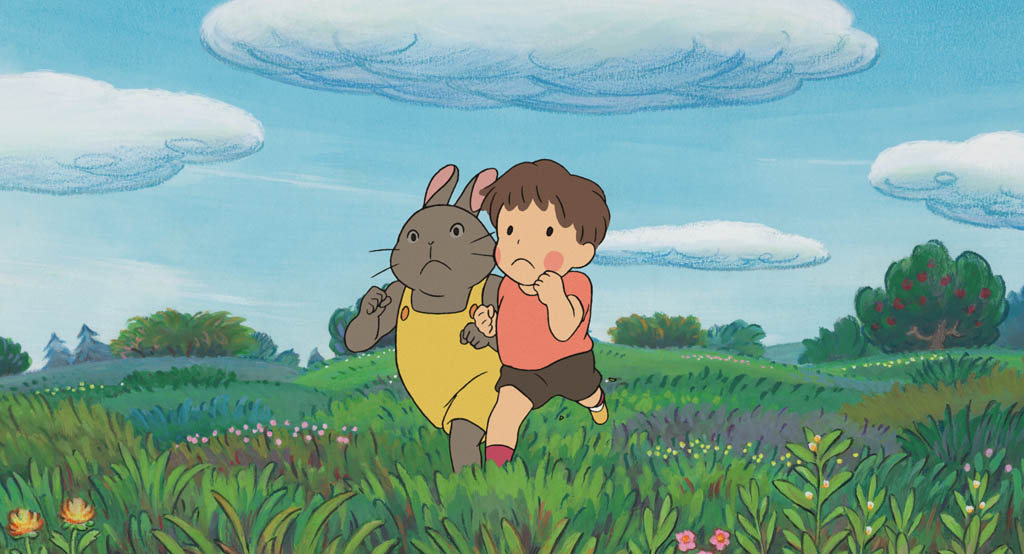
New Ghibli Museum short film tells of competition between boy and bunny

by Chris MaGee

It was nearly a year ago that we reported on a pair of new films being produced for the Studio Ghibli Museum. Wed dropped the ball on the follow up on this story, we're sad to admit, as the first of these two, titled "Mr. Dough and the Egg Princess" got its premiere at the Museum, located in Mitaka, in November. "Mr. Dough and the Egg Princess" will soon end its run though and on June 4th the second film we reported on last year, "Treasure Hunting" will begin screening for visitors.

Anime News Network has got the details on this new 9-minute short which was overseen by Hayao Miyazaki himself. "Treasure Hunting" turns out to be an adaptation of a picture book by Rieko Nakagawa and Yuriko Yamawaki which tells the story of a boy named Yuji and a bunny named Gikku who compete against each other to see who can keep a stick they found. Like all Studio Ghibli shorts there are no clips of "Treasure Hunting" floating around to share with you, but there is the above promotional still that has come to us courtesy of the Ghibli Museum website. Guess you'll just have to get yourself to Mitaka to get a look at the short film this summer.

George Takei gives Warner Brothers a piece of his mind about their remake of "Akira"

by Chris MaGee

We've been bashing the proposed Leonardo DiCaprio/ Warer Brothers produced and Albert Hughes directed live-action remake of Katsuhiro Otomo's seminal anime film "Akira" for a long, long while now. As much as we wish it would just go away reports of screenplays and potential casting keep popping up on film industry websites. Most recently came the report that a number of high profile actors are in the running to star in "Akira". The big problem now is that the setting of New Tokyo has been shifted to New Manhattan, and the original Japanese characters are being transformed into Caucasians and (possibly) set to be played by talent such as Robert Pattinson, Andrew Garfield, James McAvoy, Chris Pine, Justin Timberlake, Joaquin Phoenix and Michael Fassbender.

With this in mind I was very, very happy to see an interview with Japanese-American actor George Takei posted at the Advocate in which he doesn't mask his displeasure at this transmutation from Asian to Caucasian for this remake. 74-year-old Takei, best known for his role as Lt. Sulu on "Star Trek". says that this kind of white-washing of Asian characters is "an old Hollywood tradition that we’ve always been battling." He goes on to express his dismay that Warner Brothers would be taking this route when the original manga and anime have such a devoted following, "It originated in Japan, and, of course, it has a huge Asian fan following. But it’s the multi-ethnic Americans who are fans of Akira and manga. The idea of buying the rights to do that and in fact change it seems rather pointless. If they’re going to do that, why don’t they do something original, because what they do is offend Asians, number 1; number 2, they offend the fans."

Can we get an "amen"?! How about a "hallelujah"?! To read all of what George Takei has to say about this remake of "Akira" head to The Advocate here.

REVIEW: Repast

めし (Meshi)

Released: 1951

Director:
Mikio Naruse

Starring:
Setsuko Hara
Ken Uehara
Yukiko Shimazaki
Haruko Sugimura
Yoko Sugi

Running time: 97 mins.


Reviewed by Bob Turnbull


The immediate post-war years in Japan were obviously a transitional period for the country with a new constitution, the continued Allied occupation and infrastructure that still needed to be rebuilt. The boom years were still a ways off, so the late 40s and early 50s were indeed, as several characters mention in Mikio Naruse's 1951 film "Repast", "hard times". By using an unfinished story by Fumiko Hayashi as his starting point, Naruse takes a look at a specific segment of society that was struggling to find its place - lower and middle class women. Specifically a salaryman's wife named Michiyo (played wonderfully by Setsuko Hara), but the tale as told touches on numerous aspects of other women's daily lives.

Context for the film is important. Though struck from a similar mold as Douglas Sirk's Hollywood melodramas, Naruse played more with small details and subtle wordless looks by his characters than grandiose moments, so there's more room for interpretation. When a character at the end of the film states "maybe that's where a woman finds her true happiness", it could easily be construed to represent a statement by the film about where a woman's place lies. Given the push and pull of what society thinks and what options may or may not be open to women (some of which gradually appear throughout the film), that final statement seems to address the sad fact that there are few available opportunities for Japanese women at that point in time. Michiyo is essentially trapped in her situation as the wife/maid of a disengaged office working husband (Naruse doesn't hesitate to frame her in boxes or shown behind the barred double set of doors of her house) since everyone keeps telling her how happy she must be as a wife and how sad their own lives are.

Michiyo's feelings of wanting a better life are stirred by the arrival into her life of her husband's lovely, flirtatious 20-year old niece Satoko. She's run away from home and an arranged marriage to try her hand at an office job of some kind. At least, that's her story. As a representative of the first generation of women growing up post-war, she's more aggressive and self-centered wanting to marry for both love and money. Her presence catches husband Hatsunosuke's attention - he may be her uncle, but it's hard to resist Satoko's giggles and coy smiles. Michiyo isn't so much jealous as annoyed since his day to day conversation with her isn't much more than wondering when his meals will be brought to him. As she visits her old school friends, runs into her handsome cousin (who is obviously taken greatly with her) and visits her family in Tokyo, she wonders about what else life could have in store for her. What options could be open to her? One woman after another tells her, however, that she should be happy with what she has. At least she isn't either alone or incredibly poor.

The film's title in Japanese ("Meshi") translates typically to "A Married Life". Though one can read this as an attack on marriage and how couples might typically fare, another view is that perhaps the characters actually learn and realize that effort must be put into a married life in order to get something back out. Watching the film 60 years on, it's hard not to grow frustrated at Michiyo's husband and at her own position, but given the circumstances of the post-war period, the film posits that they should try to make the most out of life. The film's English title refers directly to a meal - the time that one should pause and recharge oneself. Michiyo (and many of the characters in the film) has a habit of simply ignoring difficult or unwanted questions by avoiding any response. By the end of the film, though no one's lot in life has changed in any extraordinary way, some of the characters may have at least decided to engage themselves again. The country itself is going through its own "repast", so the characters need to keep trying in the mean time. It's a bit hopeful, a bit sad and wonderfully subtle in leaving all possibilities open.

Read more from Bob Turnbull at his blog.

Weekly Trailers


Let's Make the Teacher Have a Miscarriage Club - Eisuke Naito (2010)


Hot on the heels of the dark high school set revenge tale of "Confessions" comes an even darker tale from the world of Japanese indie film. Based on a true story Eisuke Naito 's "Let's Make the Teacher Have a Miscarriage Club" follows a group of vicious high school girls as they plot a way to make their teacher lose her unborn child.


Blue Spring - Toshiaki Toyoda (2001)

Out of control boys take over a high school and run it by their own savage rules in Toshiaki Toyoda's 2001 film "Blue Spring", based on the manga by "Ping Pong" and "Tekkon Kinkreet" creator Taiyo Matsumoto.

REVIEW: Sleepy Eyes of Death 3: Full Circle Killing

眠狂四郎円月斬り (Nemuri Kyōshirō Engetsugiri)

Released: 1964

Director:
Kimiyoshi Yasuda

Starring:
Raizo Ichikawa
Kyoko Azuma
Ryonosuke Azuma
Saburo Date
Hajime Etsukawa

Running time: 86 mins.


Reviewed by Matthew Hardstaff


Given Raizo Ichikawa’s popularity, Daiei studios assumed they would have a hit on their hands by adapting Renzaburo Shibata’s tales into films with the glamorous star. However, by the third film, it was obvious the series wasn’t the huge success they had hoped for. The fault for this lies with the studio and the fact that they wanted to present a watered down version of Nemuri Kyoshiro, a nihilistic ronin content with spending his time destroying other bastard samurai, worried people would be turned off by his anti-hero ways. Apparently not. And so "Sleepy Eyes of Death 3: Full Circle Killing" is the last film in the series that uses the more subtle depiction of Kyoshiro’s peculiarities.

The film opens with a young lord Takayuki, wandering through the slums, protected by his samurai, his face concealed, as he practices his swords craftsmanship by beheading innocent people, an act known as tsuji-giri. Kyoshiro stumbles across the scene, and knows a bastard samurai when he sees one. Even the Shogun himself has outlawed the vile act, so Kyoshiro becomes embroiled in what winds up being a bitter scheme for the title of Shogun. You see Lord Takayuki, like Takahime in part 2, is a child of the Shogun, although in this case, he is a bastard child with a mother hell bent on seeing her son attain the throne. Takayuki is in love with Konami, the daughter of a wealthy merchant who helps through monetary support Takayuki and his mother, in exchange that he will wed Konami when he becomes Shogun. Everyone in this film is dirty, save the lower class folk who reside in huts under the bridge which Takayuki assaults in the films opening. Kyoshiro becomes even more fascinated by the situation when he discovers Takayuki is an avid sword collector who has an eye on Kyoshiro’s masterwork Musou Masamune sword, and will stop at nothing to get it.

This is the last film that presents Kyoshiro in his more restrained portrayal, which isn’t to say that he’s still everyone’s favorite ronin. We are treated to what at times must be the softest side of Kyoshiro, but his motives are always a mystery. He’s an empty vessel, allowing the audience to fill him with their own notions of good and evil. He helps the innocent lower class folk who are abused by the samurai and the wealthy, the proud and the greedy, but his actions don’t reflect a good heart. Early on, he visits the best sword smith in Edo who is working on his Masamune sword, and the smith mentions that the sword ‘emanates evil, as though it is accustomed to killing’, the sword representing the samurai’s soul. He often talks down to the under dwellers he’s saving, and defiles Konami to not only draw Takayuki into fighting him, but to also break her of her pride (what he does is left to the imagination as the film cuts once he cuts off her clothes, but he does leave us with the words ‘I will have you’).

The film, like the others is fantastically crafted, this time the directing reigns passed onto Kimiyoshi Yasuda who direct several "Zatoichi" films, as well as the first "Daimajin" and "Yokai Monsters" films. It features a wonderful POV display of swordsmanship when Kyoshiro dispatches some swordsman on a stone stair ascension, and a great final duel on a burning bridge. The films have grown more bloody in their depiction of violence, this time opening with a beheading, and following up with severed limbs and many corpses. It also presents Kyoshiro with his first moment of regret when forced to battle a samurai he recognizes as one who actually upholds the code of bushido and doesn’t abuse it. This is not the kind of samurai Kyoshiro wants to kill This seems to trigger his selfless act shortly thereafter when he surrenders himself to Takayuki if he spares the under dwellers, an act that seems off for Kyoshiro. Of course, it is also part of his plan for brining down Takayuki and his mother, but for a moment it seems like the crossing paths of the two swordsman gives meaning to Kyoshiro. Of course, by the end, when he realizes he was also a pawn in the political game, it all gets blown out of the water.

The film does a great job of subtly alluding to the past films, keeping Kyoshiro a bastard who still has some dignity, and presenting us with a highly complex film. It also has a terrific, soul shaking score by Ichiro Saito, who did scores for Mizoguchi, Ozu and Naruse. Yes, this is the last of Kyoshiro the subtle, but comparatively speaking, even a subtle Kyoshiro is still a great bass ass anti-hero ronin who ensures he pisses off everyone he crosses paths with.

Read more by Matthew Hardstaff at his blog.

Thursday, April 21, 2011

Toronto Comic Arts Festival brings Otsuichi adaptation "Zoo" to the city on May 9th

by Chris MaGee

Regular readers of the J-Film Pow-Wow will remember that back in February we told you about how the 2011 Toronto Comic Arts Festival was bringing some very special guests to the city, namely manga artists Natsume Ono and Usamaru Furuya. It was shortly after that announcement that Festival Director and co-founder Christopher Butcher contacted me about arranging a special screening of the omnibus film "Zoo" based on work of Japan's horror and mystery wunderkind Otsuichi. What's the connection? Let me explain...

"Zoo", which brings together five chilling tales of murder, mayhem, as well as twisted family and love connections, includes a single animted segment titled "Sunny's Song". This story, about a scientist who has constructed a female cyborg, was adapted to the screen by manga artist, and TCAF '11 guest, Usamaru Furuya (above left). Not only did Furuya write the screenplay for "Sunny's Song", but he also drew up the storyboards and created the character designs. For fans of Furuya, best known for his avant-pop manga like "Palepoli" and "Short Cuts", "Zoo" is a film of special interest.

Now Toronto audiences will be able to see "Zoo" on the big screen on Monday, May 9th at 7:00PM at the Toronto Underground Cinema (186 Spadina Avenue)... and the best part is that Usamaru Furuya will be in attendance! Makew sure to stick around after the screening for a Q&A session with Furuya conducted by yours truly!

You can check out additional details about TCAF's screening of "Zoo" and all the other great events for this year's festival by visiting the Toronto Comic Arts Festival website here.

Animation director Osamu Dezaki, 1943 - 2011

by Chris MaGee

Sad news from the world of anime this past week. Veteran animation director Osamu Dezaki, best known for helming Fuji TV's "Ashita no Joe" animated series and the subsequent animated feature film spin offs, passed away on Sunday the 17th after a battle with lung cancer. He was 67.

Dezaki began his career as a manga artist and then joined Osamu Tezuka's animation studio, Mushi Pro, in 1963. Dezaki was right on time to act as a director for a number of the episodes of the original "Astro Boy" animated series and would then go on to work on other Mushi Pro Tezuka animated adaptations like "Dororo" and "Black Jack". In 1970 Dezaki got his big chance when he became the main director of Fuji TV's animated series "Ashita no Joe" based on the iconic boxing manga by Asao Takamori and Tetsuya Chiba. Episodes of the series, which ran between 1970 through 1971 would later be edited together in 1980 to create the feature film "Ashita no Joe". Dezaki would go on to be a co-founder, along with Masao Murayama, of famed animation studio Madhouse in 1972.

A service for Dezaki was held in Tokyo today, and our deepest condolences go out to his family and friends during this difficult time. We leave you with the opening of 1980's "Ashita no Joe" below. Thanks to SG Cafe for the details on the life of Osamu Dezaki.

Udine Far East Film Fest features pink film retrospective programmed by Rolan Domenig

by Chris MaGee

We here at the Pow-Wow, myself and Marc Saint-Cyr specifically, have been gearing ourselves up for next week's 11th annual Nippon Connection Japanese Film Festival in Frankfurt am Main, Germany. One thing is, though, that Nippon Connection isn't the only dose of Asian film that Continental Europe will be seeing next week. Southeast of Frankfurt Asian film fans will be gathering for the 13th annual Udine Far East Film Festival.

Of very special interest to Japanese cinephiles will be Pink Wink: A Tribute to Asakura Daisuke, a program of fourteen pink films created under the auspices of producer Daisuke Asakura. These include Kan Mukai's "Blue Film Woman" (above), Shinji Imaoka's "Lunchbox" and Rei Sakamoto's "Yariman". Rei Sakamoto will be joining Pink Wink curator Roland Domenig, Assistant Professor from the University of Vienna, in Udine to chat with the audience during the screenings.

Along with Pink Wink this year's Udine Far East Film Festival will feature a tribute to director Masaharu Segawa, plus a great selection of films from Japan including Yoichi Higashi's "Wandering Home", Sang-il Lee's "Villain", Ryuichi Hiroki's "The Lightning Tree", Tetsuya Nakashima's "Confessions" and Shinji Imaoka's "Underwater Love", amongst many others.

The 13th annual Udine Far East Film Festival will be taking place from April 29th to May 7th. To browse the full line-up and check out ticket details head to the fest's official website here. Meanwhile check out the trailer for this year's Udine fest below.

Sion Sono goes from directing to screen writing on manga adaptation of "Himizu"

by Chris MaGee

With Sion Sono's "Guilty of Romance" set to have its international premiere at this year's Cannes Film Festival (check out the teaser poster for the film at Twitch) the speculation is already beginning on what will be the bad boy director's next project.

Sono has been set to make his English-language directorial debut for some time with the screen adaptation of Michael Moynihan and Didrik Soderlind's true crime book "Lords of Chaos: The Bloody Rise of the Satanic Metal Underground", but according to Tokyograph the next project for Sono will see him not behind the camera, but sitting in front of a keyboard.

Sono is set to pen the screen adaptation of Minoru Furuya's manga "Himizu" (above right) which tells the story of a young man traumatized by an event in his past and how it has slowly warped him as he grows up. Perfect fodder for Sono's own often warped sensibilities, no? Although this news has leaked out there is no director or cast attached to "Himizu" yet, but the film is apparently slated for a 2012 release in Japanese theatres. More info on this soon!

Japanese Weekend Box Office, April 16th to April 17th


1. Detective Conan Quarter Of Silence* (Toho)
2. Crayon Shin Chan 2011* (Toho)
3. Gulliver's Travels (Fox)
4. OOO, Den-o, All Riders: Let's Go Kamen Riders* (Toei)
5. Sp The Motion Picture II* (Toho)
6. Tangled (Disney)
7. Sucker Punch (Warner)
8. Pretty Cure All Stars 3 Deliver To The Future! The Rainbow Flower Of The Worlds* (Toei)
9. Doraemon The Movie: Nobita And The Steel Troops: The New Age* (Toho)
10. The Rite (Warner)

* Japanese film

Courtesy of Box Office Japan

Sunday, April 17, 2011

REVIEW: The Incite Mill

インシテミル 7日間のデス・ゲーム (Inshite Miru: 7-kakan no desu gemu)

Released: 2010

Director:
Hideo Nakata

Starring:
Tatsuya Fujiwara
Haruka Ayase
Aya Hirayama
Shinji Takeda
Satomi Ishihara

Running time: 107 mins.

Reviewed by David Lam


On paper, “The Incite Mill” makes for an intriguing movie. A group of strangers from all walks of life are brought together after hearing about a job opportunity with a mysterious corporation that will pay 112,000 Yen ($1,236 USD) per hour. These strangers are all placed in a mansion in a remote area and are monitored 24/7 by surveillance cameras. Each person is assigned to separate rooms with a specific apparatus that may or may not be used for murder. The rules are simple, no one is allowed to leave the premise for 7 days, each contestant has to return to their room by 10PM and finally, the whole ordeal will end when there are only two participants standing. What? That’s right, before night fall, someone will be murdered and we are told that all of the participants involved in the crime will be financially rewarded. The person that solves the crime will receive a handsome payout, as well as the victim (the money will go to their family) and perpetrator. Now how’s that for a premise? It’s equal parts taut psychological thriller and murder mystery. It’s Agatha Christie meets “Panic Room”. It’s a great idea that should make for an exhilarating watch. That would be the case if the writing and execution weren’t so laughably bad. Just how bad? The security system that’s in place is a ridiculous 80s looking robot that scales the ceiling of the mansion and mows down anybody that’s loitering around the hallway after 10PM with its machine gun appendages. That’s how bad.

In an ensemble like “The Incite Mill”, the dramatic tension hinges on the dynamic between each character. Instead of concentrating on the interaction between each character and how they react to one another and their new environment, the film goes for cheap thrills by introducing one grisly murder after another without any real motive or consequence. Basically a murder occurs, characters convene to deliberate, the perpetrator is caught, hysteria takes over, repeat. And that’s it for 107min. It’s almost unfair to discuss the lack of interesting characters in this movie because it seems that they solely exist for the audience to watch them inevitably meet their demise. Instead of characters, each one is more of an archetype. You have the dangerous criminal, the unassuming girl next door, the arrogant jerk, the rich old man that knows more than he’s letting on, the annoying couple and Tatsuya Fujiwara being Tatsuya Fujiwara. With these cardboard cut-outs, it’s hard to muster up any emotional attachment for anybody one screen. Worst of all, for a movie that’s centered on some sort of psychological evaluation, it surprisingly has very little to say about the complexities of human nature. The profound conclusion it comes to is that we’re all capable of doing heinous things when greed is the driving force.

The biggest surprise of the movie comes from the fact that it was directed by Hideo Nakata. Nakata has proven to be quite the innovative filmmaker in the past. It’s hard to fathom that the director of such captivating films such as “The Ring” and “Chaos” could be responsible for a dud like “The Incite Mill”. The chilling atmosphere that permeated his earlier movies is nowhere to be found here. It used to be that Nakata would come up with inventive ways to provoke the viewer, now he’s just intent on trotting out poorly rendered CGI effects to dress up vapid filmmaking. Even his more commercial work like “Kaidan” and “Death Note” showed more visual flare and better command of storytelling.

While watching “The Incite Mill” I often found myself thinking about another movie, “Kaiji: The Ultimate Gambler” (2009). Both films share a similar premise and even a leading man in Fujiwara. And as ridiculous as “Kaiji” was, it still managed to be wildly entertaining to watch. There was an audacity to the filmmaking and somehow Fujiwara’s over the top style of acting added to the overall outrageousness of it. I wished Nakata could have taken a page from “Kaiji” by injecting some energy to the movie. Too often, “The Incite Mill” is caught up with its own relevance. It tries too hard to convince the audience that there’s a profundity to what they’re watching. And unfortunately, the movie ends up being not very insightful or entertaining to watch.

Read more by David Lam at his blog

First look at Miike's "Harakiri" remake "Ichimei" on the eve of its Cannes premiere

by Chris MaGee

Have we been belly-aching about Takashi Miike's 3D remake of Masaki Kobayashi's 1962 classic "Harakiri"? Sure we have! Just click here to read up on our general outrage. Of course the anger of a crew of a half-dozen or so Japanese film bloggers won't derail a film production (sadly) so now we are on the eve of the international premiere of Miike's "Ichimei". It was announced this week that the film, starring kabuki actor Ebizo Ichikawa in the role made famous by Tatsuya Nakadai, will be receiving its premiere at the 64th annual Cannes Film Festival. In advance of this premiere the above promotional still showing Ichikawa in the role of masterless samurai Hanshiro Tsugumo who seeks to commit ritual seppuku in the forecourt of lord Kageyu Saito... and damned if it doesn't look like a carbon copy of Kobayashi's original film! Only this time it'll be in colour... and in 3D!

Okay, we'll calm ourselves down with other Cannes 2011 screening announcements. Joining "Ichimei" at the French fest will be "Hanezu no Tsuki", the latest film from international festival darling Naomi Kawase, as well as the animated screen adaptation of the work of manga artist Yoshihiro Tatsumi, titled simply "Tatsumi", directed by Eric Khoo. You can check out all the films screening at this year's Cannes Film Festival (running May 11th to 22nd), Japanese or otherwise, by visiting the fest's official site here.