Wednesday, August 31, 2011

Masato Harada and Takahisa Zeze both take home awards from Montreal World Film Festival

by Chris MaGee

Back at the beginning of the month we had reported on how directors Masato Harada and Takahisa Zeze would both be in competition at Montreal's 35th World Film Festival. At that point we speculated on which filmmaker would leave the fest with one of its highly coveted awards (awards especially coveted by the Japanese film industry), but as the fest wrapped up this past weekend both filmmakers walked away with a trophy for their mantles.

Tokyo Hive reported that not only did Masato Harada's “Waga Haha no Ki”, the story of an author's struggle with his mother's old age and dementia starring Koji Yakusho and Kirin Kiki, receive the Special Grand Prix of the Jury Award, but Takahisa Zeze's “Antoki no Inochi” (Zeze pictured above with his cast), about a man coping with a traumatic past, picked up the festival's Innovation Award. Expect these wins to help both these films at the Japanese box office and throughout the coming months on the festival circuit. Congratulations to both Harada-sana nd Zeze-san!

Take a sneak peek below at Harada's “Waga Haha no Ki” in the report about the film's win as broadcast on NHK this weekend. "Thanks to the MWFF Flicker account for the above photo.

Takeshi Koike's "Redline" comes to Toronto After Dark this October!

by Chris MaGee

If you are reading the blog in our home town of Toronto then chances are that you have been spending the past few days recovering from a long and very fun weekend at the annual Fan Expo at the Metro Toronto Convention Centre. If that is indeed the case then you will most likely have also run into Adam Lopez, the director of the Toronto After Dark Film Festival. Adam was on hand to give folks a look at the first eight titles in this year's 6th annual line-up. Amongst the genre gems assembled by the programmers is one that Japanese film fans will be very excited to see when After Dark happens this October.

Takeshi Koike's animate feature "Redline" joins the After Dark line-up! The film follows racer "Sweet" JP as he speeds and crashes his way along the road to fame in the dangerous no-holds-bared Redline, a race with no limits and no rules. With a script by Katsuhito Ishii, the man who brought you" Taste of Tea" and "Funky Forest: The First Contact", and a voice cast that includes Tadanobu Asano, Takuya Kimura and Yu Aoi, this will be an event Japanese film and anime fans will not want to miss.

Check out the trailer for "Redline" below, and then follow the link above to the official website of the Toronto After Dark Film Festival, taking place between October 20th and October 27th at the Toronto Underground Cinema., to see what else Adam and his crew have on tap this year.

Shinji Imaoka's "Underwater Love" gets its UK premiere and a live soundtrack by Stereo Total

by Chris MaGee

Shinji Imaoka's latest film "Underwater Love: A Pink Musical" has been winning fans around the international festival circus since premiering at the Tribeca Film Festival this past April. The film tells the story of Asuka (Masaki Sawa) a married woman whose uneventful life working in a fish processing plant is shaken up both psychologically and sexually when she encounters a kappa, a mythical spirit of Japanese folklore.

Besides being shot by legendary cinematographer Christopher Doyle and scripted by Midnight Eye's Tom mes "Underwater Love" has a soundtrack composed by German/French synth-pop duo Stereo Total. Now there is word via the film's UK distributor, Third Window Films, that for its UK premiere Stereo Total will be on hand to perform the soundtrack to "Underwater Love" LIVE!

The screening and performance will be happening Sunday, October 16 at 6:30pm at Rich Mix
(36-47 Bethnal Green Road) in London. Besides Stereo Total's live soundtrack set there will also be a party with various DJ sets. Sounds like a ton of fun, so if you're in London make sure to check it out. In the meantime take a listen to Stereo Total's track "L'Amour" below.

CALF Animation joins forces with experimental filmmakers at Eurospace Shibuya

by Chris MaGee

Both Jasper Sharp and I were very proud to feature the CALF Animation Special at this year's Shinsedai Cinema Festival here in Toronto. The animation collective founded by critic Nobuaki Doi and animators Mirai Mizue, Atsushi Wada and Kei Oyama, is producing some of the most wildly imaginative visions coming out of not just the world of Japanese animation, but from the international animation scene. CALF has toured around the globe with their films at festivals like Shinsedai, the Ottawa Animation Festival, Nippon Connection in Frankfurt, the Trixi Animation Festival in Stuttgart, amongst many others; but this week they will be having a sort of homecoming with a special screening in Tokyo.

From September 3rd to 9th Eurosapce in Shibuya will be hosting the CALF Short Film Festival in Summer. This will not just be a screening of animation by Mizue, Oyama, Wada, and light animators TOCHKA though. CALF is joining forces with a number of today's most respected experimental filmmakers to make this week-long event truly special. Joining the CALF crew will be works by director Masanori Tominaga (The Pavilion Salamandre), Isamu Hirabayashi, Takashi Makino and Dairiki+Miura (one of my personal favorites). The programme will also feature works by legendary pop artist Keiichi Tanaami (above).

To learn more about CALF Short Film Festival in Summer head here (Japanese only), or to Nishikata Film Review for English coverage.

Animator Mitsuyo Seo, 1911-2010

by Chris MaGee

The end of an era for the world of Japanese animation nearly went unreported and unrecognized in the past few months. Had it not been for this report posted this past week by Japanese film scholar Aaron Gerow we may not have known about it at all. According to the post, Mitsuyo Seo, one of the pioneers of Japanese animation and director of the very first feature length animated film in Japanese cinema history, "Momotaro's Divine Sea Warriors", passed away a year ago, August 24, 2010 to be exact. He was 99.

Misuyo Seo was born in Himeji, Hyogo Prefecture in 1911. He began his career studying painting (working as a sign painter to pay the bills) until he found himself gravitating to the then still new world of animated films. In those early days Seo, a staunch leftist, became involved with the The Proletarian Film League of Japan whose membership at various times included such noted filmmakers as Kenji Mizoguchi and Daisuke Ito. It was due to his involvement with the Prokino that Seo was arrested and spent 21 days in jail. Upon his release he would form a brief creative partnership with fellow pioneering animator Kenzo Masaoka before founding his own animation studio in 1935.

The number of firsts that Seo was involved in in the world of Japanese animation is astounding. He and Masaoka produced the very first animated film with sound, "The World of Power and Women", at Shochiku Studios in 1933. Then, a decade later, Seo would produce the longest animated film produced in Japan at that time, 1943's "Momotaro's Sea Eagles" (original poster above). The film depicts the mythical Peach Boy of Japanese folklore leading an army of cute monkey, birds and rabbits in an aerial attack on a U.S. naval base. The film was produced at Shochiku under the order of Japan's Naval Ministry to glorify the December 1941 attack on Pearl Harbor.

It may seem strange that Seo, being a proven leftist, would become involved in producing war propaganda, but at that time in Japanese social and cinematic history the nation's motion picture studios had been conglomerated and given direct orders to produce "National policy" films to aide in the war effort. It was under these strict directives that Seo would make the sequel to "Momotaro's Sea Eagles", titled "Momotaro's Divine Sea Warriors" in 1944. With a running time of 74 minutes this would be the very first feature length animated film produced in Japan.

After the war Seo made an effort to inject some of his own politics into his work, producing pro-Democracy film titled "Osama no Shippo" in 1949 for Toho. The film was shelved after it's leftist message was seen as being out of line with the then U.S. Occupation. Shortly thereafter Seo would leave the industry that he had helped to found and concentrated on being an illustrator.

Again, we share Prof. Gerow's surprise that the passing of Seo was not accompanied with more attention and acclaim for this pioneering artist. We thank Aaron for bringing this to everyone's attention here in the West. We leave you with Seo's 1934 animated short "
Sankichi the Monkey: Shock Troops".

"Ninja Kids!" to go the remake route in North America?

by Chris MaGee

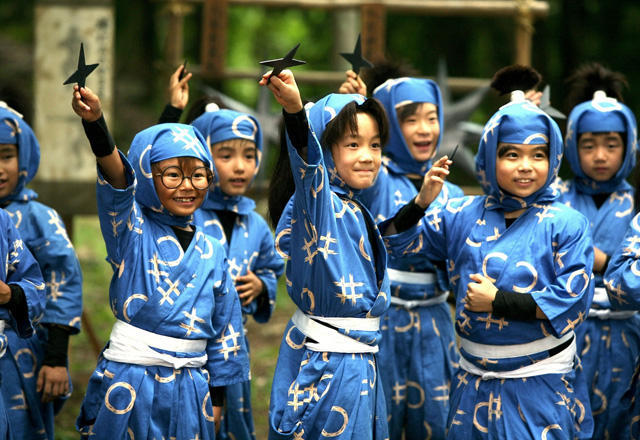
With the decade-long "Harry Potter" series of films finally wrapping up there will obviously be a big hole in theatres for kids (and kids at heart) who want to make an annual cinematic visit to a wondrous wizard school. Maybe instead of studying wizardry kids may want to enroll in a course the in ninja arts...?

As many of you already know Takashi Miike's latest film "Ninja Kids!" has been riding high at the Japanese box office as well as making waves at international film festivals like this year's New York Asian Film Festival. The film is a live action adaptation of Sobe Amako's classic animated series based around a class of children studying at a school for ninja.

Apparently director Miike recently let slip the fact that along with interest in theatrical and DVD distribution rights for his film there has been "a major U.S. production company" who would like to produce an English-language remake. Miike, nor anyone at Toho, have let drop any other bits of information about this, but as we just said, with "Harry Potter" on the way out we'll need something to fill the void.

More on this as the story develops. Thanks to Tokyograph for this.

The world of Hayao Miyazaki recreated in Lego

by Chris MaGee

We love Hayao Miyazaki here at the J-Film Pow-Wow, and I personally have very fond memories of playing with Lego as a child. (It really is a thousand toys in one!) So if you take the wondrous visions of such films as "My Neighbor Totoro", "Nausicaa of the Valley of the Wind" and "Spirited Away" and you combine them with someone with a bucket of Lego and a pair of deft hands you get this Filcker gallery. Created by someone with the user name Miyazakitopia we see the full cast of favorite Miyazaki characters ingeniously rendered in Lego. Make sure to check them out!

Thanks to our friend Cathy Munroe Hotes at Nishikata Film Review for pointing this out.

Japanese Weekend Box Office, August 27th to August 28th


1. In His Chart* (Toho)
2. Harry Potter and the Deathly Hallows: Part 2 (Warner)
3. Kung Fu Panda 2 (Paramount)
4. Pikachu The Movie 2011* (Toho)
5. Kamen Rider OOO/Kaizoku Sentai Go-kaiger: The Movie* (Toei)
6. Up On Poppy Hill* (Toho)
7. Transformers: Dark of the Moon (Paramount)
8. Cars 2 (Disney)
9. Usagi Drop* (Showgate)
10. Shanghai (Gaga)

* Japanese film

Courtesy of Box Office Japan.

Sunday, August 28, 2011

REVIEW: Intimidation

ある脅迫 (Aru kyouhaku)

Released: 1960

Director:
Koreyoshi Kurahara

Starring:
Nobuo Kaneko
Kojiro Kusanagi
Ko Nishimura
Mari Shiraki
Zenji Yamada

Running time: 65 min.


Reviewed by Bob Turnbull


I can't help but feel that the cracking opening of "Intimidation" is director Koreyoshi Kurahara's own attempt to throw down in front of his peer directors - "So you think you can make a noirish crime thriller? Well look at this!" The blast of a train whistle kick starts the fast paced affair as the camera rides the back of a locomotive through a wintry country side and mountain tunnels while the blaring soundtrack accompanies the ride. As the train pulls into the station (and delivers a character that will begin the chain of events), you know you're in for a ride. It's a short one (the film is a mere 65 minutes long), but there won't be many stopovers or delays before getting to the final destination. In fact, the train is also where our main characters meet their fates at the end of the movie and, in the greatest tradition of noir, they are appropriate to their actions.

One of those main characters is Takita who is an assistant manager at a district bank and has just received a promotion to head office. The promotion may be a bit questionable since he's married to the president's daughter, but that doesn't stop him from puffing out his chest and smirking just a little bit more than he normally would. On the flip side is his old friend Nakaike - a man who would rather hide in the back room during Takita's farewell party and help heat the sake. He's slightly nebbish, unsure of himself and comes across as someone who is perhaps a bit too scared to "make a move" and get what he wants out of life. Takita stole his woman (and therefore his chances of upward mobility) and his sister won't forgive him since she was with Takita at the time and now has to make do with simply being his mistress. Takita makes it seem as if he is doing Nakaike a favour by still addressing him in friendly terms and offers to drink with him like they were old friends. Nakaike can't help but remain in deference to his superior and when he's reminded by another superior that they are supposed to be drinking as friends, Takita gives a wonderful backhanded compliment to Nakaike: "I hate to call him slow, but I actually I like that about him."

Takita's confidence gets knocked down a few notches when he meets up with the passenger brought in earlier by the train. The shifty individual claims he has proof of some very illegal loans Takita has made and he will expose him unless he gets paid 3 million yen. Of course, Takita's only recourse is to rob his bank before he leaves for the head office. It's at this stage that the film jumps into its higher gear - it becomes a heist film with numerous small and big twists. Particularly when Takita needs to work around Nakaike who just happens to have inherited the role of night guard on the evening the theft is planned. The story shifts around as the role of intimidator moves between the characters: blackmailer over Takita; Takita over Nakaike's sister; sister over Nakaike ("you're a spineless fool"). Kurahara seems to have complete control over the pace of the plot and the switching of roles. Though he doesn't overdo the genre conventions or pile on an overabundance of style, he does bring a great deal of energy to the proceedings by using quick cuts and close framings. If it sounds like the film might be pared down to the bone at 65 minutes, it isn't. But it is efficient as hell.

Though the characters of "Intimidation" don't have much personality - Kurahara is using archetypes and playing them broad - the film still flies by with such speed and is, simply put, a great deal of fun. Whether he's cutting extra close to Takita's eyes or we watch the camera make yet another encircling move, there's always something of note happening. Kurahara's rebellious youth film "The Warped Ones" (also released in 1960) goes several steps beyond in regards to playing with style, but "Intimidation" uses it to craft its story with all the right beats. In all likelihood, Kurahara had no intention of intimidating other filmmakers via this film - given how he treats his intimidators in the film, one would expect he would know better - but it doesn't mean that we can't still be impressed by (at the time) a young artist's use of his medium.

Read more from Bob Turnbull at his blog.

Fukushima-set drama "Totecheeta Chiquitita" goes in front of the cameras this October

by Chris MaGee

Back in May we received a post on our Facebook wall from director Atsushi Kokatsu. He wanted to let us and our members know about a very special project that he and production partner Tatsuko Kokatsu were working on. Titled "Totecheeta Chiquitita", the film would be set in and shot on location in Atsushi Kokatsu's hometown of Fukushima. Of course since the Great Tohoku Earthquake on March 11th the name Fukushima has been associated with the nuclear disaster at the Fukushima Dai-ichi plant, but Kokatsu wants to change that by bringing the story of a 70-year-old retired teacher named Yuriko who reunites with family members killed in the war who have been reincarnated in present day Fukushima.

In May "Totecheeta Chiquitita" was only in pre-production, but since then the Kokatsus have secured enough funding for the project to schedule the beginning of principal photography on October 8th. They have also assembled cast that includes Kosuke Koyohara, Chieko Matsubara, Shono Hayama and newcomer Jurina. The film will still need further donations to be completed (donate at the official website here), but the premiere has already been scheduled for March of next year in order to mark the first anniversary of the quake and tsunami.

Check out the teaser trailer for "Totecheeta Chiquitita" below, and thanks to Tokyograph for this good news.

Shota Matsuda goes from heartthrob to gritty for upcoming film "Hard Romanticker"

by Chris MaGee

Shota Matsuda has been starring in TV series and on the big screen in films like "A Long Walk" and "Ikigami: the Ultimate Limit" since 2003, but the 26-year-old actor has has not only had to wrestle his way of from under the shadow of his famous father, Yusaku Matsuda, but also his famous brother Ryuhei Matsuda. Most of the younger Matsuda's roles have played up his striking good looks, but he'll be getting gritty with his next role.

Matsuda is starring in "Hard Romanticker", the story of a bleached blond Korean named Gu living in Shimonoseki, Yamaguchi Prefecture who works part-time jobs during the day and gets into trouble as a street thug at night. The film is directed by Su-yeon Gu (The Yakiniku Movie: Bulgogi) and it's based on his semi-autobiographical novel. This film is a bit of a homecoming for Matsuda as his legendary father was born in Shimonoseki in 1949.

The cast of "Hard Romanticker" is being rounded out by the likes of Tokio Emoto, Yuya Endo, Cluade Maki, Dai Watanabe and Keiko Awaji. No specific release date yet has been announced by Toei Studios, the folks producing the film, but thanks to Jason Gray (who is subtitling the film) for the word on this.

Criterion Collection finds mint condition print of "Godzilla" for possible upcming release

by Chris MaGee

To say that The Criterion Collection has become the high watermark for DVD and Blu-ray releases of classic and art house films is a bit of an understatement. Many home collectors don't feel that a film has done proper justice until the folks at the Criterion give it their loving care and release a DVD restoration complete with their legendary extras. It's a pastime for many film buffs to writes up wish lists of films that they hope The Criterion Collection will add to their catalogue. One film that many have hoped would eventually make the cut is Ishiro Honda's genre-defying kaiju film "Gojira". Now, according to kaiju expert August Ragone and Twitch fans of the giant prehistoric lizard have something to be very happy about.

Although it has yet to be confirmed by The Criterion Collection themselves, Ragone blogged that it is nearly a done deal that Honda's 1954 original "Gojira" and Terry O. Morse's re-cut American release "Godzilla: King of the Monsters" will both becoming part of the Collection in the very near future. There are a few out there who may ask what makes this such huge news given the fact that both films were already released on a pretty impressive (and economical) two disc set by Classic Media in 2006. Well, it's because of the source material that Criterion has tracked down for their possible release. Apparently The Criterion Collection have found a "fine-grain sub-master" 35mm print of the film starring Raymond Burr and released by Jewell Enterprises Inc. in 1956. This is the equivalent of finding an original mint quality print, so obviously the hope is that not only will "Godzilla: King of the Monsters" will look better than it's looked in decades, but that the footage in it from "Gojira" will contribute to an equally impressive DVD of that film.

August Ragone goes into much, much greater detail of this potential release and what makes it so important, so we encourage you to follow the above link to his blog to read up on this some more.

REVIEW: Muddy River

泥の河 (Doro no kawa)

Released: 1981

Director:
Kohei Oguri

Starring:
Nobutaka Asahara
Takahiro Tamura
Yumiko Fujita
Minoru Sakurai
Makiko Shibata

Running time: 105 min.


Reviewed by Chris MaGee


Depending on your film tastes the 1970's and early 80's in Japanese film were either a time of important creative transition or a period of stagnation when sensationalism and cheap nostalgia trumped artistic vision. Both viewpoints carry a certain truth. Due to the collapse of the studio system and the decline in box office receipts many directors entered into the new frontier of independent filmmaking, as epitomized by the Art Theater Guild. This gave them a forum for new ideas and innovative new filmmaking methods. Conversely, the surviving major studios either became extremely conservative in their output (Shochiku with its "Tora-san" series) or pandered to the lowest common denominator to get bums in seats (Nikkatsu with its Roman Porno films). One thing was certain -- the kind of films produced by Golden Age directors like Ozu, Mizoguchi and Kurosawa were pretty thin on the ground. The former two had passed away years before and the latter, Kurosawa, saw his career take a disastrous turn with 1970's "Dodes'ka-den". In 1981, though, a director came along from the pioneering indie scene, but with a film that hearkened back to the shomen-geki masterpieces of the late 1940's and 50's. That director was Kohei Oguri, and his film was "Muddy River".

Set in Osaka, a decade after the end of WW2, "Muddy River" tells the story of 9-year-old Nobuo (Nobutaka Asahara) and his family. His father (Takahiro Tamura) and mother (Yumiko Fujita) run an udon restaurant on the banks of the Kyū-Yodo River. Life is finally good for the family after years of post-war sacrifices. Nobuo's father sometimes wonders if the hardships of the past decade were worth anything, if he shouldn't have perished, like so many of his friends, in the hills of Manchuria during the war. The one bright spot for him is his son though. Nobuo, he says to his wife, is his greatest accomplishment. For the most part Nobuo is too young to appreciate what his parents have gone through, but he is beginning to sense a bigger and more brutal world beyond the family noodle shop. After witnessing the the neighbourhood horse cart man being trampled by his own horse Nobuo's life begins to change. Shortly after this traumatic incident a houseboat moors itself across from the family's restaurant. Nobuo quickly makes friends with the two children who live on the boat, Kiichi (Minoru Sakurai) and his older sister Ginko (Makiko Shibata). Nobuo and Kiichi play games along the banks of the river and try and spy the giant carp that is said to live in its muddy bottom; but a visit to Kiichi's houseboat reveals a life that Nobuo never knew existed. Keiichi and his sister often appear dirty and malnourished, and neither of them attend school. Their father is dead and their mother is only a disembodied voice that emanates from the back cabin of the boat. The adults along the river gossip that the boat travels the waterways of Osaka and that Kiichi and Ginko's mother prostitutes herself to get money. While somewhat alien Nobuo can't help becoming friends with his new young neighbours and soon their life and the life of his family begin to intermingle.

Like so many filmmakers who came to prominence in the 70's and 80's, Kohei Oguri began his career making pink films, as well as working as an assistant director to such filmmakers as Masahiro Shinoda and Nobuhiko Obayashi. You would think that with cinematic mentors who created such bold films as "Double Suicide" and "House" that Oguri's work would revel in the expwerimental and the avant-garde. Not so, at least not with "Muddy River", his directorial debut. Based upon the novel of the same name by Teru Miyamoto, "Muddy River" is populated by the little folks, the downtrodden and the unsung, the kind of people who so fascinated Ozu, Mizoguchi, Naurse and Kinoshita. He and cinematographer Shohei Ando shoot the film in black-and-white to drive this point home; but don;t expect a story of conflicting generations and the dissolution of the Japanese family à la "Tokyo Story". The main concern of "Muddy River" is showing how circumstance can mold people's lives. Nobuo's father made his way back from Manchuria has anchored himself in his restaurant and has become a loving, almost doting, father to his son. Had the hardships of post-war Osaka been too much, though, he could have died, like Kiichi and Ginko's father (who we learn was also a veteran of the Second Sino-Japanese War). Without the security of a husband and the noodle shop who is to say if Nobuo's mother would have had to resort to drifting along the river, selling herself to keep food on the table? Little Nobuo may only get inklings of these vagaries of fate, but seeing events through his eyes the "there but by the grace of God go I" nature of the plot becomes clearer the longer we watch the film.

The most remarkable thing about "Muddy River", especially in comparison with so many 70's and 80's films from Japan that have become painfully dated over the years, is just how timeless it feels. Like Kiichi and Ginko's houseboat, the film isn't fettered to one time and place. Yes, the film is set in the mid-50's, but the struggles of its characters are not specific to one point in time. Poverty, hardship, war, the coming of age of a young child and the mono no aware, "the pathos of things", thought by so many to be a peculiarity of Japanese aesthetics, are common to all people's lives. Watching a film like "Muddy River" we can easily see ourselves in innocent Nobuo, feeling his way through new emotions and situations. We can feel the weariness of Nobuo's father, but also his hope represented by his son. We can even, if we care to admit it, begin to understand Kiichi and Ginko's mother, badly damaged by life, but doing her best to carry on by any means necessary. It's this universal quality of "Muddy River" that has made it so well-respected in Japan, and even saw it nominated for Best Foreign Language Film at the 1981 Academy Awards. Sadly it's a film that has now been eclipsed in many ways by the endless retrospectives the filmmakers that is so directly references. It's a shame. Hopefully Oguri's reputation will be reassessed sooner than later, and "Muddy River" will get the lasting international recognition it deserves.

Yu Aoi stars in upcoming shot in Ireland feature "Tamatama"

by Chris MaGee

One of the biggest box office hits in Japan in 2009 was Toho/ Fuji TV/ Pony Canyon's production of Hiroshi Nishitani's "Amalfi: Rewards of the Goddess". The film, a romantic thriller starring Yuji Oda and Yuki Amami, was shot entirely on location along the Amalfi coast in Salerno, Italy. Obviously the exoticism of the location translated into dollars, so it was only a matter of time before Toho and Pony Canyon would deliver another film set in another far flung location.

This time out muci video director-turned-feature director Mayumi Komatsu has helmed "Tamatama (By Chance)", a fantasy drama starring actress Yu Aoi (above), which was shot entirely on location in Ireland. The film, which centers around Aoi's character traveling through the Emerald Isle and experiencing various "miracles", will try and capture lightning in a bottle twice with it's international locale.

Expect to see "Tamatama" to be released in Japanese theatres on October 15th. Thanks to Tokyograph for this news.

Director of "Saw" says he'd love to shoot a live-action remake of "Ninja Scroll"

by Chris MaGee

We don't have to tell you how Japanese cinema and anime have been a key influence for some of Hollywood's biggest hits from the last decade or so. Without animated film like "Akira" and "Ghost in the Shell" it's doubtful we would have "The Matrix", and without the influence of films like "Audition" and the infamous "Guinea Pig" series we may never have had such torture porn films as "Hostel" and "Saw" (although there may be more than a few of us who wouldn't have missed this particular genre). This past Anime News Network added another chapter to the saga of cross-pollination between Japanese and Hollywood films with the news that one of the creators of the "Saw" films has hopes of potentially remaking an anime classic.

James Wan (above left), director of, and co-creator along with Leigh Whannell, of the the original "Saw" revealed that he would love to direct a live-action remake of Yoshiaki Kawajiri's "Ninja Scroll". Wan made the remark while promoting the Japanese release of his latest film "Insidious"; but before you getting all knotted up about yet another Japanese film remake read this exact quote from Wan: I love anime and manga. I especially love ninjas. I think I would definitely like to work on a remake of 'Ninja Scroll', which is very popular in America." Wan's project very much seems to be a wish at this point rather than a reality, so file this one under a "what-if" project. Still, what do you think? Would you love or hate seeing a live-action remake of "Ninja Scroll" from the man who brought us "Saw"?

Weekly Trailers


Soro Nante Kudaranai - Kota Yoshida (2011)


Koya Yoshida, the director of the erotic comedy "Yuriko's Aroma" returns with his equally provocative new feature "Soro Nante Kudaranai". The film stars Tateto Serizawa as a man who is struggling with premature ejaculation. Warning -- this trailer is NSFW!


Shinsengumi Chronicles - Kenji Misumi (1963)

Legendary actior Raizo Ichikawa stars as an idealistic young samurai who joins the Shinsengumi, the police force loyal to the Shogun in 19th century Kyoto. He soon realizes, though, that his fellow Shinsengumi aren't as noble as he thought.

REVIEW: Paprika

パプリカ (Papurika)

Released: 2006

Director:
Satoshi Kon

Starring (voice talent):
Megumi Hayashibara
Toru Furuya
Koichi Yamadera
Katsunosuke Hori
Toru Emori

Running time: 90 min.


Reviewed by Marc Saint-Cyr


As of this review’s posting, it is just a few days after the one-year anniversary of the tragic death of Satoshi Kon at the age of 47. Easily one of the most significant forces in both Japanese cinema and animation, he was known for such complex, imaginative films as "Perfect Blue," "Millennium Actress," "Tokyo Godfathers" and "Paprika," which, sadly, turned out to be his swan song. At the time of his passing, he was at work on a fresh project, "The Dreaming Machine," the production for which having been halted earlier this summer. While it is a shame that this film may never be fully realized, viewers can thankfully venture back into Kon’s filmography to see other examples of his longstanding fascination with dreams. Among them, "Paprika" certainly holds its own as a mesmerizing flight of fantasy.

"Paprika" is set in a future where great technological advancements have been made for dreaming – specifically a new psychotherapy device called the DC Mini that allows therapists to enter their patients’ dreams for treatment and recorders that enable dreams to be stored, viewed and analyzed. Three of the DC Minis are stolen, with Himuro, one of the technicians involved in its creation, considered a likely suspect. The team assigned to its recovery consists of Tokita, the giant, child-like genius who invented the device; the cool, professional Dr. Atsuko Chiba and their chief, Shima. Also involved in the case is Detective Konakawa, who is tormented by an unsolved homicide and painful elements of his past, and Paprika, a perky young woman who only exists as an alter-ego of Chiba in the dream world. As Konakawa is aided by Paprika in special therapy sessions, they and the others must race to recover the stolen DC Minis and prevent the cataclysmic consequences that could result from their misuse.

As many noted both last summer in the wake of "Inception’s" release and after Kon’s death, Christopher Nolan’s dream heist film shares quite a few similarities with "Paprika," which preceded it by four years. But while there are some common links – most notably through the machine that allows access to other people’s dreams – "Paprika" has a noticeably lighter vibe to it. Much of it comes from Paprika herself – indeed very much the polar opposite of Chiba, the pixie-like being pops up frequently when least expected and aids Konakawa and the DC Mini team with a perpetually cheery attitude. One of the film’s most intriguing qualities is the way in which it communicates that Paprika is a facet of Chiba’s personality. Through reflections and double imagery, the connection between the two characters is expressed in an extremely subtle, almost subliminal manner. "Paprika" also goes beyond "Inception’s" somewhat rigid presentation of dreams, instead diving headfirst into the wild, fantastical, physics-defying possibilities that compose the dream realm. The unknown culprit behind the misuse of the DC Mini is frequently represented by an absurd parade of walking appliances, statues, instrument-playing animals, robots and floats that noisily crashes from one dream to the next. Many times, Konakawa grapples with his conscience in a number of incredible scenarios, including a circus performance, a vine-swinging visit to the jungle à la "Tarzan" and a struggle on a speeding train straight out of a James Bond film.

These scenes and more help illustrate the film’s rather brilliant concept of dreams operating in a manner similar to movies. As Paprika explains, apparently dreams experienced in early REM cycles resemble experimental art films, while those had in later cycles resemble big-budget, mainstream entertainments. Later on, dreams are also compared to the Internet, and sure enough, one of the dream places where Konakawa meets Paprika is an online chat site called the Radio Club that becomes a warm, inviting bar where the two sit and drink. But it is clear that Kon prefers the link between dreams and movies, and throws in several irresistible nods and references, the best of all being a short lesson in filmmaking terminology delivered by a Konakawa dressed up as Akira Kurosawa.

Quite fittingly, "Paprika" bears a wonderfully cinematic style that shines through in the richness, color and detail of the animation, the smooth energy in which the film’s mystery plot coasts along and compelling manner in which the viewer is pulled into this incredible story about the merging of dreams and reality. While Kon’s "Perfect Blue" addresses similar subject matter using the claustrophobic dread of a horror film, "Paprika" is definitely more along the lines of a fantasy, conducting a more positive examination of how dreams and movies can impact one’s life. The triumph of this film and the abundance of creativity within it (not to mention its remarkable predecessors) make the sad loss of Satoshi Kon all the more resonant one year later.

Read more by Marc Saint-Cyr at his blog

Sunday, August 21, 2011

Ten Films about Hiroshima and Nagasaki


by Chris MaGee

Between August 6th and August 9th, 1945 Japan was the site for a titanic shift in human history. After nearly four years of conflict between the United States and Japan the U.S. military would end the Second World War with two horrific attacks. Not only were the bombings of Hiroshima on August 6th and Nagasaki on August 9th used as examples of gross military power against the Japanese Empire, but they were also used as Frankensteinian experiments in atomic weaponry. A quarter of a million people were killed in the bombings of both cities, not all of them instantly. Japanese and U.S. physicians dealt with the mysterious plague of radiation sickness on citizens of Hiroshima and Nagasaki, but for years after the attacks images and stories of what occurred that August would be classified as top secret by General MacArthur's occupying forces. Japan needed to deal with the historical, physical, and psychological effects of the bombings though, and they did so (and continue to do so) through motion pictures. To honour the 66th anniversary of the bombings of Hiroshima and Nagasaki this month the J-Film Pow-Wow would like to present ten films that explore the events and impact of these four fateful days. We aren't categorizing these as "Our Top Ten" or "Our Favorite". This month's list is different. Instead we suggest you seek out any or all of these films as a means to educate so that we never forget, and hopefully never repeat these terrible actions.


10. Women in the Mirror (Yoshishige Yoshida, 2002)

Yoshishige "Kiju" Yoshida was one of the filmmakers who defined the Japanese New Wave in the late 1960's and early 1970's with such films as "Eros Plus Massacre" and "The Affair". Many of these films would feature Yoshida's wife, actress Mariko Okada. Unlike many of the New Wave directors who have either passed away or sidelined by illness Yoshida is still with us, and in 2002 he again cast his wife in a film that would deal with the psychological scars of the bombing of Hiroshima. Okada stars as Ai Kawase, a woman whose life is haunted by the bombing of Hiroshima. Her late husband, a physician, treated soldiers affected by radiation sickness, and her prodigal daughter returns home having been missing for years. Now Kawase must deal with a documentary filmmaker who wants to discuss her husband's time in Hiroshima and her daughter's amnesia; her memory wiped except for the image of the bombed city. Yoshida is a meditation on the trauma of the bombing of Hiroshima which repeatedly uses imagery of broken mirrors to symbolize the fractured psyche of its lead characters and Japan as a nation.


9. The Bells of Nagasaki (Hideo Oba, 1950)

Dr. Takashi Nagai is one of two people on our list whose lives were directly affected by the bombings of Hiroshima and Nagasaki. Born in Nagasaki in 1908 Nagai graduated from the Nagasaki Medical College in 1932 and began a career as a radiologist. His own spiritual curiosity and a stint in the Imperial Army saw Nagai being baptized as a Roman Catholic in 1934, and during WW2 he would bring both his medical expertise and deep faith to treating wounded Japanese soldiers. Due to his radiological research Nagai would be diagnosed with leukemia in June of 1945, but he would soon find himself at the center of the beginning of the atomic age. Nagai was in Nagasaki on August 9th. He was seriously injured and lost his wife Midori in the blast, but the month after the attack he and his two children built a small hut close to the hypocenter of the blast. It was here that he spent the remainder of his life in prayer and writing a number of books. The most famous of these was his 1949 memoir "The bells of Nagasaki". A year after its publication Shochiku and director Hideo Oda released a screen adaptation of Nagai's book written by Kaneto Shindo. Actor Masao Wakahara would star as Dr. Nagai and Yumeji Tsukioka would portray his wife Midori. Oda's film, the first film to deal with the atomic bombings, was threatened with censorship by the occupying U.S. forces.


8. Hiroshima Nagasaki Download (Shinpei Takeda, 2009)

The hibakusha, or "explosion-affected people", is the name used by the Japanese for the survivors of the bombings of Hiroshima and Nagasaki. Even now, nearly seven decades after the attacks, the Japanese census recognizes nearly 220,000 hibakusha. These men and women receive special government subsidies and hold a unique position in Japanese society -- living reminders of the horrors of the war and the (to date) only nuclear attack in modern history. Despite individuals like manga artist Keiji Nakazawa (who will appear later in this list) and peace activist Koko Kondo the majority of hibakusha have remained quiet about their experiences in Hiroshima and Nagasaki, maybe due to the discrimination and misunderstanding that they suffered in the years following the war. Filmmaker Shinpei Takeda challenged this wall of silence surrounding a special group of hibakusha in his 2009 documentary "Hiroshima Nagasaki Download". Takeda travels from Vancouver, Bristish Columbia down the U.S. west coast speaking to 18 hibakusha who in the years since August 1945 have immigrated to North America. Stories of starting lives anew in a country which once categorized Japanese as "the enemy" contrast with the ever present spectre of the atomic bombings. "Hiroshima Nagasaki Download" has met with enthusiastic audiences worldwide, but its frank discussions with hibakusha has dogged the film with controversy in Japan.


7. Rhapsody in August (Akira Kurosawa, 1991)

The lives of the hibakusha forms the center of the 1991 film "Rhapsody in August". Although legendary director Akira Kurosawa dealt with the atomic attacks of 1945 in such films as "I Live in Fear" and (in part) "Dreams" its with his story of three generations of a family affected by the bombing of Nagaski that his feelings on the subject reach their pinnacle. Sachiko Murase stars as Kane, the matriarch of two generations of Japanese and Japanese-Americans. One summer Kane's children fly to Hawaii to visit a man claiming to be Kane's long lost brother. They in turn send their children to visit their grandmother in Kyushu. Kurosawa shows a touch of the work of fellow film master Yasujiro Ozu with the grandchildren chafing against the boring ways of Kane. During one part of the film the kids get out from under their grandmother and head to Nagasaki where their grandfather, and Kane's husband, lost his life in the bombing. More tender family scenes follow once all three generations, including an American cousin played by Richard Gere, reunite at Kane's home, but Kurosawa makes it clear that the shadow of Nagasaki still casts its shadow over these people... and all Japanese.


6. NN-891102 (Go Shibata, 1999)

Indie filmmaker Go Shibata is known for his brash and sometimes disturbing visions like those in 2004's "Late Bloomer" and 2009's "Doman Seman", but for his directorial debut in 1999 Shibata cut his cinematic teeth on the daunting subject of the bombing of Hiroshima. More specifically "NN-891102" examines how music and art can act as a way for someone to process a traumatic event. The film tells the story of Reiichi Otonashi who in 1945 is a young boy, the son of a Japanese military researcher working on sound experiments in a mountain cave above the city of Nagasaki. When the United States drops the bomb on the city Otonashi's father has his recording devices running and what they pick up becomes the driving obsession of the rest of Otonashi 's life. His mission now is to recreate the sound of the explosion captured on a reel of tape marked NN-891102 (Nagasaki, August 9th, 11:02AM -- the time of bomb detonation). From early experiments recording water boiling and wooden geta on rough gravel to attempts to record his own suicide by blowing himself up with dynamite, Otonashi veers from being objective and clinical to nearly losing himself in the madness that brought about the destruction of Nagasaki in the first place. Shibata uses ambient sound and music to create an abstract journey into the mind of his protagonist. We follow along on this journey and into a film unlike any made on the bombings of Hiroshima and Nagasaki.


5. Godzilla (Ishiro Honda, 1954)

Godzilla, the 80-metre tall, fire breathing lizard who roared up from the bottom of the Pacific to christen a seemingly endless stream of kaiju monster movies might seem like an anomaly on a list of sobering films about Hiroshima and Nagasaki; but a closer look at the life of Ishiro Honda, the creator of Godzilla and the director of 7 of the 29 films in the series, reveals the reasons why 1954's "Gojira" appears on this list. Starting in 1936 Honda did three tours of duty in the Japanese Imperial Army, including a tour through Japanese occupied Manchuria. Honda saw more than enough of war's inhumanity by 1945, but once Japan had surrendered and Imperial soldiers saw themselves being repatriated back home Honda would see something that few could forget. On his way back to Tokyo Honda passed through Hiroshima. The devastation was almost beyond comprehension. Once Honda was settled back into civilian life and work at Toho Studios he began to conceive of a project that was originally going to be Japan's answer to RKO Radio Pictures' monster movie "King Kong". Over time though "Gojira", as the film would be called, became more than just a monster movie. Soon Hinda and screenwriter Takeo Murata began consciously incorporating elements of the recently unleashed atomic energy into the attributes of their giant lizard. The climactic sequence where Godzilla attacks Tokyo contained shots that looked as if they had been lifted from news reel footage of the bombing of Hiroshima. Honda would eventually admit that his 1954 film was meant to inspire the end of nuclear weaponry and technology. Instead it inspired a whole new genre of motion picture entertainment.


4. Black Rain (Shohei Imamura, 1989)


The horrific destructive power unleashed by the atomic bombs dropped on Hiroshima and Nagasaki shocked the world, but it was the horrors of radiation sickness that would breed paranoia and fear in the Japanese for years to come. While Japanese who had survived the firebombings of cities like Tokyo and Osaka could go on with their lives enjoying perfect health the survivors of the bombings of Hiroshima and Nagasaki could suddenly exhibit symptoms including bleeding, hair loss, fatigue, fever and vomiting, and in many cases death. And what was even more mysterious was that this could occur years after the bombings took place. Very few doctors, scientists or civilians understood the effects of radiation sickness in the late 1940's and early 1950's, and it was this misunderstanding that bred the aforementioned prejudice against the survivors of the atomic attacks. In 1989 director Shohei Imamura combined the plight of the hibakusha with a plot that would not have looked out of place in an Ozu film to create "Black Rain". The Shizuma family is looking to find a husband for their daughter Yasuko (Yoshiko Tanaka), but they are having a very hard time of it. The family were in the hills outside of Hiroshima at the time of the "pika-don", or "flash-boom" as the Japanese called the explosion, so they feel that Yasuko should be healthy and her status as a hibakusha should not stand in the way of her being married. They don't take into account the family's march through the destroyed city (depicted graphically by Imamura in the film) and Yasuko's exposure to the inky "black rain" heavy with radioactive fallout. The characters in "Black Rain" do their best to go on with their lives and loves, but somewhere underneath it all is the terror that the bomb is still seething through their veins... and sadly, in many cases it is.


3. The Face of Jizo (Kazuo Kuroki, 2004)

"The Face of Jizo" is the best known stage drama dedicated to the bombing of Hiroshima. Written by playwright Hisashi Inoue in 1994 it is a deceptively simple story of a father and daughter living in the slowly reassembling city of Hiroshima. The two bicker and chat like any family, but the twist if "The Face of Jizo" is that fact that the daughter, Mitsue, is actually living alone. Her father, Takezo, still inhabits their meager home, but he is a ghost. He was one of the many who lost their lives in the bombing. Even from beyond the grave Takezo lectures his daughter on how she should go on with her life, but it's Mitsue's survivor's guilt that stops her from moving on. Even when a handsome young man named Kinoshita comes to the library where Mitsue works she can't bring herself to give into her feelings for him, especially given that he has come to Hiroshima to research the bombing. "The Face of Jizo" has been translated into English, Italian and German and has been staged worldwide to great acclaim. In 2004 director Kazuo Kuroki adapted Inoue's play to the screen, casting Rie Miyazawa as Mitsue, the late Yoshio Harada as Takezo and Tadanobu Asano as Kinoshita. Kuroki's film went on to sweep that year's Japanese film awards, with accolades showered on Miyazawa and Harada's performances... and rightly so. The onscreen chemistry between the two is the key to making Kuroki's "The Face of Jizo" one of the most human and accessible cinematic takes on the horrific subject matter of Hiroshima and Nagasaki.


2. Barefoot Gen (Masaki Mori, 1983)

Keiji Nakazawa was six-years-old when his hometown of Hiroshima was bombed. His family members who were in the city that August morning all died (his mother and baby sister would succumb to radiation poisoning a few days later), and all that would save the young Nakazawa was that he bent down behind a concrete wall at the very moment of the flash. Obviously this day has continued to haunt Nakazawa up to the present day, but the way that he has dealt with his experiences on August 6th, 1945 and the months and years since was to write about them in the pages of his manga. From the beginning of his career as a manga artist in 1961 to his retirement in 2009 Nakazawa would commit his memories of growing up before, during and after the bombing of Hiroshima to the pages of several manga, the best known being the 10-volume "Barefoot Gen". The series revolves around the semi-autobiographical character of Gen Nakaoka, who like Nakazawa survives the bombing of Hiroshima. The manga would gain unrivaled popularity in Japan, being adapted into animated TV series and three live-action films, but for our list we focus on the 1983 animated film directed by Masaki Mori. In the film Gen is voiced by Hiroshima-born voice actor Issei Miyazaki, and although the action occasionally veers a little too close to being a "cartoon" it is the brutal honesty and terrifying depiction of the immediate aftermath of the bombing that sets elevates "Barefoot Gen" to being on of the most valuable visual resources on the attack on Hiroshima.


1. Children of Hiroshima (Kaneto Shindo, 1952)

Veteran screenwriter and director Kaneto Shindo was born in Hiroshima in 1912. Throughout his over 60-year career he would return to the city of his birth again and again, either physically (he would shoot his best known film "Onibaba" in a rural area outside Hiroshima) or ideologically (Shindo would make a film on the Lucky Dragon No. 5 Incident in 1958). The epitome of his homages to his home city has to be his 1952 film "Children of Hiroshima" though. Like so many of Shindo's films "Children of Hiroshima" stars his late wife Nobuko Otowa as Takako Ishikawa, a school teacher from Hiroshima who, after years teaching elsewhere and years after the bombing, returns to the city of her birth. What makes "Children of Hiroshima" so remarkable is the fact that with the U.S. Occupation ending in '52 Shindo was free to return home and shoot his film about Hiroshima at the very site of the tragedy. Scenes in which Takako encounters her old neighbour, now reduced to being a half-blind beggar, are made all the more poignant due to the fact that they are shot near the remains of the Aioi Bridge, ground zero for the detonation of the bomb. A child runs to see his mother who is at work with other women constructing the Hiroshima Peace Memorial Museum. Takako stands by the ruins of the Hiroshima Prefectural Industrial Promotion Hall (now known as the Atomic Bomb Dome), the spot where tourists from around the globe now have their pictures taken. To think that only seven years before Shindo's hometown had been leveled by an atomic bomb and now we can watch the reconstruction of the city in "Children of Hiroshima" makes it a historical piece of cinema. It is also a monument to the endurance and spirit of the people of Hiroshima and Japan.

Japan Foundation Toronto presents free screening of "Kokoyakyu: High School Baseball"

by Chris MaGee

The PBS series "POV" has brought us some truly amazing documentary filmmaking over the years, especially films relating to aspects of Japanese arts and culture. Emiko Omori's "Rabbit in the Moon", Risa Morimoto's "Wings of Defeat" and Kazuhiro Soda's "Campaign" have all been a part on "POV" over the series' 23-year history. One film that aired on "POV" back in 2006 will be enjoying a new audience here in Toronto at the Japan Foundation (131 Bloor Street West, Suite 213) on August 25th at 7:00PM.

Kenneth Eng's documentary "Kokoyakyu: High School Baseball" examines not only the Koshien Baseball Tournament that happens in Japan each August, but also Japan's national obsession with what many think is strictly an all American sport. Eng follows young high school baseball teams who go through immense stress as they vie to become 49 out of over 4,000 which will have the honour of competing in the tournament. Check out the trailer below to see just how fascinating the film is. What's best is that this screening of "Kokoyakyu: High School Baseball" is entirely FREE. All you have to do to attend is to RSVP at the Japan Foundation Toronto website here. See you there!

REVIEW: Household X

家族X (Kazoku X)

Released: 2011


Director:
Koki Yoshida


Kaho Minami

Taguchi Tomorowo
Tomohiro Kaku


Running time: 88 min.


Reviewed by Nicholas Vroman


“Household X” opens with a handheld shot of a family photograph – a mother, a father and their son. Perhaps it’s held a little too long in the unsteady gaze of the camera’s lens, but serves as a perfect metaphor for the shaky and unstable foundation that holds this particular Japanese family together. We will only see the family together again in a single frame in the closing shot of the movie. By then, the tragedy of contemporary alienation that director Koki Yoshida has committed so well to the screen will have covered some familiar territory, but with a clear hard eye and technical and emotional finesse that moves “Household X” into the profound territory of the Dardenne brothers or Chantal Akerman.

The story is pretty simple. Michiko (who’s name we only learn about three quarters of the way into the movie), housewife and mother, silently and alone endures a daily routine of preparing dinner for her husband, always coming home late from work, and son, also emotionally absent when coming home from his shit work temporary jobs. Her only interaction, if you can call it that, with others happens when she takes out the garbage or when she visits a friend who’s only concern is getting a sale for her son. Michiko obsessively cleans and arranges the dining room table, wanders around the house, restlessly tries to sleep and descends into bulimic excess, secretly gorging on store-bought bentos and prepared food and purging herself.

Her husband, Kenichi spends his extra-long days, ostensibly as the go-to guy in the office for computer problems. He’s way over his head, obviously unknowing and inept. When he’s not absently staring at his computer monitor, not even looking busy, but filling space, he’s trying to bone up on his lack of computer savvy with books. He knows he’s on the short-timers list at his company. His desperate overcompensation finds him hanging at his desk, not leaving until he’s the last one in the office.

The son, Hiroaki, remains a 20-something enigma, working, eating and sleeping through life. He’s aimless, uncommunicative and largely angry at the bad hand he’s been dealt.
Household X follows these disparate lives with a series of telling and complementary images and a slowly compounding trajectory that builds a seamless tapestry of alienation and crises. Through the domgma-90 style handheld shakiness there’s not a wasted shot in the film.

For example, early on, Michiko gets conned into buying a water cooler. We see her pouring her last glass of tap water and watering plants on the balcony. The water cooler is installed. She offers some water, not from the cooler, to the salesman, an old classmate of her son. Later, when her son comes home, he can only remark on the frivolity of buying the cooler. The husband returns later, dumbfounded as he pours himself a drink of water. As the film progresses, the cooler will show up again, a fine flowering of mold and muck illuminated in the glass jar. The plans will be shown, dead. And the son will meet up with his old buddy, the only bit of conversation being about the cooler. By then, Michiko is well on the way to a breakdown, Kenichi well on the way to being out of work.

In contrast, Hiroaki, has just completed a job delivering some furniture. As he leaves he’s asked to take a snapshot of the happy (?) family where he’s delivered the goods. Later his boss gives him a small shout out for the good work he’s done.
Despite the obsessive slit-your-wrist downbeat trajectory of the tale, there are some minimal moments of light, as when Kenichi gets invited to go out drinking by another loser office mate to the most depressing and banal of capsule hotels – with a white walled fluorescent-lit cafeteria when the guys go to drink. He shows a little mettle when he escapes from what will surely be one of the worst nights of his life and walks all night back home. He returns home only to see Michiko waking up. They exchange some flat words and he escapes back to work, missing out on a potential moment of connection. Granted the light is dim, at best.

When Michiko finally freaks and disappears, the father and the son - perhaps only because of obligation - set out to find her. Kenichi finally finds her passed out in a booth of a chain restaurant. It’s as if he knew she would be there, that this had all happened before. The final shot finds them reunited within the frame, a telephoto shot of the husband and wife in the car, their son in the foreground on his bicycle. The screen shows them moving forward, yet trapped in the flatness of the shot.

The trio of actors, though rarely ever in the same frame together, manifest a family’s disintegration, even as they strangely hold on. Kaho Minami is relentlessly focused as Michoko, caught solely in a pathological reaction to events outside of her control. Taguchi Tomorowo, who may be a bit better known for being the main character of “Tetsuo” and fronting the punk band Bachikaburi inhabits Kenichi with sensitivity and the last vestiges of humanity in a lost and broken man. Tomohiro Kaku holds it close as Hiroaki.

Koki Yoshida takes a tale similar to Kiyoshi Kurosawa’s overwrought “Tokyo Story” and cuts it to the bone with resonance, compassion, intelligence and style. Following in the steps of “Jeanne Dielman, 23 Quai du Commerce, 1080 Bruxelles” and “Why Does Herr R Run Amok?,” Yoshida takes the classic parable, contemporizes it without being preachy, demonstrating a monumental talent.

Read more by Nicholas Vroman at his blog

Former Miramax director Stephen Earnhart brings "The Wind-Up Bird Chronicle" to the stage

by Chris MaGee

We like to keep an eye on the outer fringes of Japanese film and visual culture here at the J-Film Pow-Wow, and this past week we came across something that looks utterly fascinating. We know that there are more than a few Haruki Murakami fans out there, or at least we hope there are; and one of our favorite's by the award-winning author is his 1994 novel "The Wind-Up Bird Chronicle". It's hard to explain exactly what this semi-surreal epic is all about. If you've read it you'll know what we mean. On one level it could be thought of as a psycho-sexual dream journey through post-War, post-Bubble, media-obsessed Japan. On another level it's just about an unemployed 30-something man looking for his lost cat. Anyway you interpret it "The Wind-Up Bird Chronicle" is an amazing read... but I doubt many people have interpreted Murakami's novel like Stephen Earnhart, former Director of Production at Miramax Films, has.

No, Earnhart hasn't made a film adaptation of "Wind-Up Bird"... Not exactly. Earnhart has assembled a team that includes writer Greg Pierce, puppeteer Tom Lee, musician Bora Yoon, and more to create a live, multi-media interpretation of "The Wind-Up Bird Chronicle". The end result will be premiering this month at the annual Edinburgh International Festival and then go on to tour throughout North America during the rest of 2011 and 2012. You can find out more about this production of "The Wind-Up Bird Chronicle" at its official website here, but before you do check out clips from the film component of the production below. Some gorgeous imagery here... but be warned, it's not entirely safe for work.

REVIEW: Revenge

仇討 (Adauchi)

Released: 1964

Director:
Tadashi Imai

Starring:
Kinnosuke Nakamura
Yoshiko Mita
Eitaro Shindo
Takahiko Tamura
Tetsuro Tamba

Running time: 104 min.


Reviewed by Chris MaGee


Honour, unquestioning loyalty to one's master, severe austerity and meditation on death -- these are some of the keystones of the samurai philosophy of bushido. For centuries bushido was held up as the ideal of behaviour for all well-born Japanese, but looking at the history of Japanese cinema one has to question if bushido was something best left to being just an ideal rather than a model for daily life. In film after film we are shown how bushido could just as easily be the cause of defamation, destitution and death as it could be for elevation. The umpteenth screen adaptations of Japan's national epic, the Chushingura or The Loyal 47 Ronin, we're shown how a group of 18th-century samurai had to break the rules of bushido in order to uphold the honour of their master, Lord Asano. All 47 of them paid the price for their transgression with their lives. In Buntaro Futagawa's 1925 film "Orochi" Japan's first screen superstar Tsumasaburo Bando portrayed a samurai who found himself branded an outlaw after he adhered too strictly to the ideals of bushido. Veteran actor Tatsuya Nakadai has played both a ronin who must expose the hypocrisy of the samurai class in Masaki Kobayashi's "Harakiri" and a samurai whose adherence to the code of bushido has caused him to develop a frightening god complex in Kihachi Okamoto's "Sword of Doom". Yet another example of the pitfalls of bushido comes to us in the form of Tadashi Imai's 1964 film "Revenge", recently released on DVD by North Carolina-based company AnimEigo.

Kinnosuke Nakamura (Goyokin, Incident at Blood Pass) stars as Ezaki Shinpachi, a low-ranking samurai who one day makes a breach in protocol that will change his life forever. Okuno Magodayu, head of the influential Okuna clan, makes an offhand insult and Shinpachi calls him on it. Offended by his presumption Magodayu challenges him to an illegal duel. Stupidly (or honourably, depending on your point of view) Shinpachi accepts and ultimately kills Magodayu. The problem now is that the stability of the Okuna territory has been severely damaged. To prevent even more bloodshed the chancellor of the Okuna declares that both Shinpachi and Magodayu were insane at the time of the duel. For his crimes Shinpachi will be exiled to a local Buddhist temple and branded a madman, which is certainly not the case... at least not right away. Not only are the Okuna clan, now headed up by Magodayu's bother Shume (portrayed by Tetsuro Tamba), furious with Shinpachi, but so are a number of their allies. When Shume goes to the temple to avenge his brother's death Shinpachi does the only thing he knows to do -- defend himself -- and in doing so he ends up killing Shume as well. A bad situation has just gotten a thousand times worse, and with nothing but time to sit around the temple and mull over his fate Shinpachi really does begin to lose his grip on sanity. He is finally tipped over the edge when he learns that he has been ordered to fight Tatsunosuke Okune, the youngest of the Okune brothers, to the death. The problem here is that Shinpachi and Tatsunosuke are old friends. The rules of bushido, tempered by local politics, have taken an honourable man and driven him to the edge of madness.

As opposed to jidai-geki and chanbara directors like Hideo Gosha and Hiroshi Inagaki, Tadashi Imai is not as well known in North America, but the man who scripted "Revenge" is. Shinobu Hashimoto is the man who penned the Akira Kurosawa classic "Rashomon", and with "Revenge" he attempts a little of what he achieved with this landmark film. The story of Shinpachi's fall from grace and slow mental undoing is told through flashbacks and flash forwards, mirroring the fractured narrative of "Rashomon". Director Imai is no Kurosawa though, so despite the intriguing ideas of personal integrity vs. samurai honour and sanctioned "insanity" vs. personal responsibility, viewers may find themselves a little lost at times throughout the film. Political maneuvering and bloodthirsty power struggles can be snakey enough, so to have "Revenge" told in a non-linear fashion may not always be the best idea. One thing that Shinobu and Imai know without question, though, is that what's needed to hold a story of this complexity together is a fascinating protagonist portrayed by a skilled and charismatic actor. Kinnosuke Nakamura fits this bill perfectly.

Born into the venerable Nakamura family of kabuki actors, Kinnosuke Nakamura understood the importance of physicality and raw emotion in a performance. He was a powerful presence on screen throughout his 40-plus year film career, but his turn as Ezaki Shinpachi may be one of his most powerful. Any actor revels in the prospect of playing a madman, but Nakamura makes us understand the pride, ferocity and naïveté of Shinpachi before we see him lose his mind entirely. Shinpachi, like so many other examples of conflicted cinematic samurai, is a good man whose mind and spirit has been short circuited by the stifling strictures of the bushido code. During the climactic duel between Shinpachi and Tatsunosuke we see Nakamura unleash his basest instincts, howling like an animal as he faces his opponents, not a noble samurai engaged in a show of great swordsmanship, but a man slashing the air between himself and his enemies in a desperate bid to save his life. This final scene erases whatever narrative shortcomings that came before it and makes Tadashi Imai's "Revenge" a film for samurai enthusiasts to put on their must-see list.

Jasper Sharp brings the best of Japan to Estonia for the East by Northeast Festival

by Chris MaGee

Jasper Sharp is one of the busiest writers and programmers in the world of Japanese film. That's a given, but this year he has been exceptionally busy, taking part in the 11th annual Nippon Connection Japanese Film Festival in Frankfurt, bringing a programme of pink films to the New Horizons International Film Festival in Wroclaw, Poland, co-programming the 3rd annual Shinsedai Cinema Festival (with yours truly) here in Toronto and prepping the 2nd annual Zipangu Fest in London. It makes me tired just reading the list, but Sharp isn't finished yet.

Between August 25th and August 28th Sharp will be in Tallin, Estonia to present the East by Northeast Festival. Sharp has brought together a programme that includes some amazing films including Gen Takahashi's "Confessions of a Dog", Yoshihiro Ito's "Vortex and Others" (above), Koji Shiraishi's "Shirome", Go Shibata's "NN-891102" and Neil Cantwell's and Tim Grabham's documentary "KanZeON: The Magical Potential of Sound"... plus much more! We appreciate that you all can't jet off to Estonia to catch this great festival, but at least head to the official website for the East by Northeast Festival here to turn green with envy... or call your travel agent to book a flight to Tallin!