Monday, December 21, 2009

Happy Holidays from the Toronto J-Film Pow-Wow... and Ultraman!


Well, It's the end of another year, but what a year it's been! None of us here at the Pow-Wow could have anticipated how successful this year would be what with trips to Nippon Connection and Fantastic Fest, a slew of great interviews, our Otaku O-Tanjobi celebration in May, the inclusion of Bob, Marc and Matt's work in the upcoming "Directory of World Cinema: japan", and of course the founding of The Shinsedai Cinema Festival here in Toronto. Bob, Marc, Matt, Eric and I couldn't have done all this on our own though, so as we approach the holidays we'd like to wish all the best to some of the folks who made 2009 such an amazing year. Thanks to:

James Heron and the staff at the Japanese Canadian Cultural Centre, Jasper Sharp, Masayuki Suzuki, Toshi Aoyagi, Anna Suzuki and the Japan Foundation Toronto, Marty Gross, Adam Lopez and the crew of the After Dark Film Festival, Sonia Sakamoto Jog and the crew of the Toronto Reel Asian International Film Festival, Alex Zahlten, Maria Klomfass, Petra Palmer, and the crew at Nippon Connection, Daniel Hanna and the staff at Eyesore Cinema, Lindan McCann and the staff at Things Japanese, Tim League and everyone at Fantastic Fest in Austin, Don Brown, Todd Brown, Andrew Mack and Twitch Film, Jason Gray, John Berra and Intellect Books, Kurt Halfyard, John Allison and the staff at Row Three, Trista Devries, Thomas Silver, Kevin Ouellette, Da Hye Kim, Catherine Munroe Hotes, Rieko Fuji and Viz Pictures, Stephanie Trepanier and Evokative Films, Shannon the Movie Moxie, James McNally, Robert Harding, Richard Iwasa, M.J. Di Rocco, Miyuki Kobayashi, Robyn Dranfield, Yoshi & Chie, Shaun Sayer, Polly Esther, Blake Ethridge, Grady Hendrix and the New York Asian Film Festival, Marc Walkow, Tetsuki Ijichi and Tidepoint Puictures, The Victory Cafe, Paupers Pub, Akino Kondoh, David Hudson and IFC, Naomi Hocura, Brandon Hocura and Vowls, Kazuhiro Soda, Yukie Kito, Keiko Kusakabe, Edmund Yeo, Yojiro Takita, Yuki Nakamura and Omni TV, Nobi Nakamura, Yuki Tanada, Aaron Gerow, Hiroyuki Matsumoto, Risa Morimoto, Alice Shih and Fairchild Radio, Kieran Grant and the staff at Eye Weekly, Kazuyoshi Kumakiri, Ryuichi Honda, Takagi Masakatsu, Yoshihiro Ito, Masaki Iwana, Kayoko Tombo, Yasutomo Chikuma, Atsuko Ohno, Tetsuhiro Kato, Touru Hano, Junko Kimoto, Miki Ohi and the staff of the Pia Film Festival, Fujiko Takeyama and the staff at UniJapan

To all these folks and to all of our regular readers all the best of the season, have a safe and happy holiday and we'll see you all on January 5th when we'll continue to bring you the best of Japanese film.

And now a little bit of the season with Ultraman and his cast of kaiju sidekicks and Wham!'s "Last Christmas". Strange but true....

Top Ten Favorite Scenes in Japanese Cinema: Chris MaGee


Well, we've come to the end of what has proven to be the most popular feature that we've ever featured on the J-Film Pow-Wow, Our Top Ten Favorite Scenes in Japanese Cinema. All five of us who write for the blog have very diverse tastes, so each of us have had a chance to share the cinematic moments that inspire us, move us to tears and laughter, and just make us go "Wow!". You can check out Matthew Hardstaff's here, Bob Turnbull's here, Eric Evans' here, and Marc Saint-Cyr here, and now to end of the feature we bring you Chris MaGee's list of favorite scenes. Be forewarned, there are some serious SPOILERS ahead, but still... Enjoy!


10. He Shoots! He Scores! - Bastoni The Stick Handlers (Kazuhiko Nakamura, 2000)

Flowers blooming, rockets blasting off into space, trains speeding into tunnels, the curtains blow and then the inevitable fade to black. There have been a lot of ham-handed cinematic tricks used in motion picture history to represent the act of love, but I can't think of a more ingenious visual trope than what Kazuhiko Nakamura cooked up for his 2000 film "Bastoni: The Stick Handlers". Nakamura got his start as a filmmaker in the early 80's penning scripts for pink films like "The Red Shoe Incident", "Taboo X", and "Teacher, do not put a fire in my body" and working as an assistant director on the adult films of Rokuro Mochizuki. When it came time for Nakamura to direct his own feature film he, along with his old boss Mochizuki who went on to direct such contemporary yakuza classics as "Onibi: The Fire Within" and "A Yakuza in Love", wrote what they knew. The result, "Bastoni: The Stick Handlers" was a behind the scenes look at the adult film industry as seen from the viewpoint of a pair of adult film stars, Ryo (Shunsuke Matsuoka) and Natsuo (Yuka Kojima), who also happen to be engaged. Lord knows that getting ready for a wedding can be a stressful and complicated time for a young couple, but when you factor in that fact that you're having sex on camera as your day job... well multiply that stress and complexity a hundred fold. One such hard day on the job has Ryo filming a scene with a new actress named Midori in the back of a jeep that's being driven through Tokyo. Ever wonder what keeps a male porn star motivated (for lack of a more polite word) when the cameras are rolling? Nakamura gives us a hilarious scene where we enter into Ryo's imagination and witness him going up against his co-star in a one-on-one soccer match. Ryo advances up the field with Midori as the goalkeeper. He's maneuvering, psyching Midori out with his footwork and, strangely enough, the closer he gets to making a goal the skimpier Midori's uniform becomes. For me it's Shunsuke Matsuoka's facial expressions and his ridiculous victory dance once he scores on Midori that makes the scene for me. After that I doubt I'll ever look at a sex scene the same way again.


9. Lucky Hole striptease - 9 Souls (Toshiaki Toyodo, 2003)

There are some scenes that take a film and make them better, that if that one scene were to have ended up on the editing room floor the rest of the film just wouldn't be the same. For me a perfect example of the is the Lucky Hole strip club scene in Toshiaki Toyoda's "9 Souls". Now, I can hear you all out there saying, "Yeah, Chris, of course you'd like that scene. It's got Misaki Ito stripping down to her underwear!" True enough. It does have that, but there's more about this scene than a little bit of bump and jiggle. Inspired by such classic jailbreak films as John Sturges' "The Great Escape" Toyoda's "9 Souls" adds this young director's own twist on the genre. The film follows nine convicts (murderers, street punks, a mad bomber, and a porn king amongst them) as they escape from prison and go on a quest for a stash of counterfeit yen at the foot of Mt. Fuji. The first time a saw "9 Souls" I was entertained, but not much more for the first 48-minutes. It only takes the prisoners about 10-minutes into the film for them to escape with the help of Shiratori, a midget escape artist (played by Mame Yamada) and then Toyoda has them go on a series of (mis)adventures in rural Japan - robbing convenience stores, hiding out at an old buddy's house, spending some "special time" with a flock of unfortunate sheep, even car-jacking a stoned young man's van after he stops to pick them up. Toyoda does give us some glimpses of who these men might be under all the hijinks, but there are few and far between... that is until the escaped cons unexpectedly reunite with the owner of the van. It turns out that he's opened up a strip club, named The Lucky Hole, and soon the "9 Souls" of the title are enjoying the hospitality of this establishment; but again, this isn't just a chance for a bit of gratuitous T&A. Not only is the lovely young actress Misaki Ito's dance made instantly memorable by setting it to avant-jazz/ blues singer Maki Asakawa's funky 1970 hit "Chichana toki kara", but it comes hot on the heels of a vicious fight between the two alpha males in the group of convicts - Michiru (Ryuhei Matsuda) and Torakichi (Yoshio Harada). The fragile alliance between these men is crumbling and this scene represents the turning point of their journey together. Just as Ito is about to slips off her bikini top Shiratori pipes up and we learn that he and this girl have a very important history. The Lucky Hole scene goes from being the epitome of cool to utterly emotionally vulnerable as Shiratori reaches through a peephole and gently touches Ito's belly. In that moment "9 Souls" goes from being hip and ironic to a deeply felt and moving masterpiece.


8. Pootan's fear of whistling - Cromartie High: The Movie (Yudai Yamaguchi, 2005)

Yes, there are going to be a lot of serious, artsy scenes on my list (that's just the kind of guy I am), but I like to laugh just as much as the next guy (really); and each of us have scenes from certain comedies that no matter how many times we watch them they always send you us into fits of giggles. For me one of those scenes is the "Hilarious Heartwarming Pootan Show" in Yudai Yamaguchi's 2005 live-action adaptation of Eiji Nonaka zany manga and anime series "Cromartie High". After Yamaguchi's first indie feature "Battlefield Baseball" became a huge success at midnight screenings throughout Japan the folks at Aries Productions (the people behind "Blue Labyrinth" and "Backdancers!") tagged him for this adaptation. The added support and cash got him CGI effects and a cast that included such heavy duty talent like Takamasa Suga, Itsuji Itao, Tak Sakaguchi, Yoshihiro Takayama, and Hiroyuki Watanabe; but for the pink and white teddy bear and bunny-suited comedy duo Pootan whose TV show is so popular with the hooligans, delinquents, and chimpira gangsters (and robots, gorillas and Freddie Mercury) of Cromartie High, Yamaguchi picked an unlikely pair of actors: popular TV actor Noboru Takachi and Takashi Miike regular Ken'ichi Endo. As unlikely as they might seem for the roles the pair's deadpan performances are hilarious. First off the segment of the "Pootan Show" pops into the middle of the film with zero explanation and then we get treated to that great question that has plagued humankind for ages, "Is it true that snakes come out if you whistle at night?" Hold on! What...? Snakes coming out when you whistle? Coming out of where? We're never quite sure and it doesn't matter. All we need to know is that Endo's Pootan is afraid to find out whether this whole snakes and whistling thing is true or not. Once he does whistle... well, something else comes out and I laugh out loud every time it does. I won't tell you what and I can't really tell you why I find the whole scene so damn funny. Maybe it's like the kid with the afro at the end of the scene says "It must be the costumes." Ah well... Maybe it is.
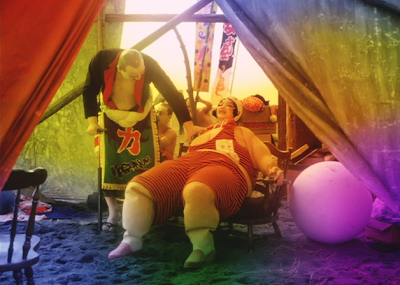

7. Introduction to the circus - Pastoral: To Die in the Country (Shuji Terayama, 1974)

I have a soft spot for the strange, the surreal and the illogical, but when I was putting this list together I consciously tried to keep a balance and make sure that it wasn't made up of obscure and inscrutable film moments. There was one moment, though, that I couldn't ignore and it comes from one of Japanese cinemas masters of the avant-garde - Shuji Terayama. Terayama, much reviled here in the West for his experimental classic "Emperor Tomato Ketchup" delved further into his surreal imagination while leaving the controversy behind with his 1975 masterpiece "Pastoral: To Die in the Country". The film, which follows a boy who wants nothing more to escape his remote rural village and his adult counterpart who is attempting to rewrite his personal history through film, is a very loose autobiography of its director. With imagery that includes disappearing ninja, literal rivers of blood, shamans, crazed dancers, and a village populated by people wearing white face how could it be anything else? Still Terayama incorporates some tried and true narrative devices to illustrate his young protagonists quest for independence, the main one being a circus that sets up camp on the edge of town. What young 15-year-old hasn't entertained the thought of running away with the circus? This is a Shuji Terayama film, so this circus takes goes a little bit beyond the usual dancing bears and assorted acrobats. The introduction to this traveling troupe in "Pastoral" comes with a charge of children lead by an officer of the Imperial Army waving the Hinomaru flag, a humpback dressed in a Japanese school girl uniform, a midget with a mohawk, and his wife, a fat lady who isn't fat at all - she's just wearing an inflatable fat suit, one that she gets other male performers to pump up in what is obviously a sexual turn on for her. This introductory scene is the window for Terayama's young cinematic other into a larger, permissible, and sometimes frightening world, but the underlying menace is offset by the use of multi-coloured camera filters that add a rainbow sheen to the boy's growing awareness that these circus performers may have more than children's entertainment on their mind. As he peeks through a gap in one of the tents he witnesses a full on orgy that has him falling backwards in shock and exclaiming "Jigoku da! (This is hell!)"


6. "There are times when victory is very hard to take." - Merry Christmas Mr. Lawrence (Nagisa Oshima, 1983)

I have a theory and that is that Takeshi Kitano is a better actor in other people's films rather in his own. Not to take anything away from that classic, stoic, surly and prone to sudden violence persona that Kitano takes on in most of his directorial efforts, but check out some of other acting roles to see what I mean. In films like Kinji Fukasaku's "Battle Royale" and even his minor role in Jean-Pierre Limosin's "Tokyo Eyes" he dominates any scene he's in with his inventiveness, unpredictability and sheer screen charisma. Maybe when he doesn't have to worry about the camera angle, the lighting and whether the boom mic is in the shot he can loosen up and muster all his acting energy. I'm not sure, but I do know that I get much more out of watching Kitano being directed by others. For me the best example of this is the first example - Kitano's performance as the sadistic Sgt. Hara in Nagisa Oshima's 1983 WW2 film "Merry Christmas Mr. Lawrence". At that point in his career Kitano had cemented his reputation as a comedian and TV host, so for Oshima to cast him as bellowing, brutal soldier put in charge of a prisoner of war camp was quite the stretch. Of course Kitano would take that brutality and run with it, but my favorite scene from the film, an one of my favorite scenes of all time, is the final subdued scene between Kitano's Sgt. Hara and his former POW inmate Col. John Lawrence played by British actor Tom Conti. It is the night before Hara's execution for war crimes and Lawrence comes to visit him one last time. These old rivals have now, strangely enough, become dear friends and we watch as Lawrence is slowly torn apart seeing his former captor stoically face death. They reminisce about the night that Hara freed Lawrence and his fellow inmate Jack Celliers (David Bowie) from their own death sentence, but there will be no such mercy for Hara. "You are the victim of men who think they are right," Lawrence tells Hara, "but in the end no one is right." No matter how many times I watch this scene I am a blubbering by the time Kitano gives the famous final "Merry Christmas, Mr. Lawrence!" I can't say Kitano has ever brought me to tears with any of his own films. Worth thinking about...


5. Remember me, but ah! Forget my fate - Pale Flower (Masahiro Shinoda, 1964)

Each time I watch Masahiro Shinoda's 1964 yakuza film "Pale Flower" I find myself enjoying it more even though it has the same stereotypical narrative of umpteenth other yakuza movies: Muraki, played by Ryo Ikebe, is out on the street after a three year stint for murdering a rival gangster. Like so many lone gangsters in yakuza movies he soon discovers that the world has changed while he's been locked up. His gang has made peace with its enemies and formed an uneasy alliance against an encroaching yakuza clan, young chimpira hoods alternately revere and attempt to kill Muraki, but he never lets on that he cares one way or the other. The one aspect of the genre that Shinoda and screenwriter Masaru Baba, working from the source novel by Shintarô Ishihara, play with is the "fallen woman" that Muraki befriends. Unlike the various hookers, junkies, and cocktail waitresses that people yakuza eiga Muraki finds a kindred spirit in Saeko (Mariko Kaga), a wealthy young woman with a taste for gambling and a deep, abysmal dark side. Muraki's only pleasure seems to come from schooling Saeko in the ways of the Tokyo criminal underworld and his tutorial comes to a bloody end when he has Saeko witness him killing the boss of the rival gang in a posh supper club. Judged on the cinematography alone this would be a great scene. With the clubs stained glass windows, spiral staircase and dark wood interior the whole scene has the feeling of taking place in a church and the blood about to be spilled by Muraki a sacrament that he's giving to Saeko. What takes the scene from good to great though is Shinoda's choice of music. He sets this brutal murder to the the famous aria from English Baroque composer Henry Purcell's late 17th-century opera "Dido and Aeneas" in which Dido, the Queen of Carthage, laments the departure of her lover Aeneas for Troy. As she prepares to take her own life she sings "When I am laid, am laid in earth, May my wrongs create/ No trouble, no trouble in thy breast/ Remember me, remember me, but ah! forget my fate/ Remember me, but ah! forget my fate..." Of course the piece is put in a totally different context, but that's what makes it so compelling. As Dido sings her words are like a haunting warning to Saeko that however dark her desires that she should only follow Muraki down his criminal path so far.


4. At the Noh theatre - Late Spring (Yasujiro Ozu, 1949)

I've always thought of Yasujiro Ozu as a miniaturist. He was a director that didn't need to indulge any epic cravings by surprising audiences with a war movie or a historical jidai-geki. Epic is the antithesis to what Ozu the Artist was about. What makes his work so profound and universal was his understanding of the moment - a family sitting around the dinner table, a train ride into the city, a line of middle-aged men slouched along a bar after too much sake, the lead up to a wedding or the aftermath of a funeral (but never the actual wedding or funeral). It was these moments, miniature epics of everyday emotion set in tatami rooms, street corners and nomi-ya, written with longtime screenwriting partner Kogo Noda and strung together by Ozu's famed "pillow shots" that have spoken to film lovers around the globe. When compiling this list I was very tempted to choose one of these quiet moments focusing on landscape and everyday objects that helped to set the emotional and narrative basis for the following scene. Instead I chose what I feel to be the next best thing - the scene in the Noh theatre that comes halfway through Ozu's 1949 film "Late Spring". The film stars Setsuko Hara as Noriko, a woman in her late 20's whose family is trying to find a suitable husband for. Noriko has no interest in marriage though. She's dedicated to taking care of her elderly widowed father, Somiya-san (Chishu Ryu), a university professor. In order to gently nudge Noriko from the nest her aunt and father make her believe that he is considering remarrying, an idea Noriko feels is "dirty". It's while taking in an afternoon performance at the Noh theatre that father and daughter encounter Noriko's potential mother-in-law, Miwa-san (Kuniko Miyake), and it's here that Noriko fully realizes that her life is about to change for good. Ozu crafts this moment expertly, including the entire emotional arch of Setsuko Hara's character in just 7-minutes without any dialogue and without any tears. By setting it during a Noh performance he insures that no hystrionics can take place. Norkio's realization that her life at home with her father is coming to an end is communicated as she looks between her father and Miwa-san. With a few glances ending in Noriko dropping her head on the verge of tears Ozu gives us the emotional core of "Late Spring" in miniature. Masterful.


3. Nishimura-san...? - After Life (Hirokazu Kore-eda, 1998)

To come up with the screenplay for his film "After Life", in which the recently deceased are asked to choose one defining memory from their lives to take with them into eternity, director and writer Hirokazu Kore-eda had to, in a way, take on the role of one of the films after life case workers. Continuing in the vein of his 1996 documentary "Without Memory" which centered around a man who loses his short term memory after a botched medical procedure, Kore-eda interviewed dozens of people, asking them to chose their most important memories, memories he would use for the characters in "After Life". To say that everyone on screen was an actor delivering these shared memories, though, is a bit of a misnomer. Kore-eda cast some of his interview subjects alongside professional actors in the film so that they could discuss their defining memories in person, and even for a hardcore fan of Japanese cinema like myself it's sometimes difficult to tell the actors from the non-actors. It took me a number of years to realize that my favorite character in "After Life", the elderly woman Nishimura-san, was in fact veteran of Japanese stage and screen, 89-year-old Hisako Hara. In her performance as Nishimuar-san, the one interview subject who seems to have no memories at all, Hara is utterly natural, sweet and child-like as she lines up acorns, dried flowers and gingko leaves along the desktop in front of her. Her case worker Kawashima (played by ubiquitous character actor Susumu Terajima) gently questions her, "Nishimura-san... Were there any nice memories? Were you married? Did you have any children?", but the old woman across from him is totally absorbed in the beauty of the objects in front of her. She doesn't have any need for memories. This very moment is her whole world. She only breaks concentration once when she asks if there are any flowers around the way station. When Kawashima answers yes, "they bloom in the spring" her happiness only deepens. Koreeda cuts to a scene in a conference room and has the case workers surmise that Nishimura-san is living life as if she was a 9-year-old, that she may be senile, but in my opinion this absolutely simple scene, with Hara disappearing into her character, is the one reminder in "After Life" that living... even after your dead... is about the very moment you are in. This is a scene that always makes me alternately laugh and well up with tears.


2.Train ride to Swamp Bottom - Spirited Away (Hayao Miyazaki, 2001)

It was only after I had assembled this list of favorite scenes that I looked back and realized that the vast majority of my choices were those that relied almost entirely on visuals and music to either forward the plot, or to heighten the emotional tenor of the film. From numbers ten through three there have already been some stellar examples of this, but for me one of the most perfect combinations of visuals, mood, and music has to come near the end of Hayao Miyazaki's "Spirited Away". After an action-packed sequence that that has our young heroine Chihiro saving her friend, the dragon-boy Haku, from the witch Zeniba and facing the voracious No Face in a one-on-one battle she is left with one final and crucial task. Teetering between life and death from a curse put on him by Zeniba young Chihiro is told that the only way to save Haku is to go to Zeniba's home in Swamp Bottom at the end of the train line that runs outside of the spirit's bath house. Many animated films would make quick work of Chihiro's trip out to Swamp Bottom to make sure the momentum of the last act doesn't lag and that the kiddies don't start fidgeting in their seats, but Miyazaki goes against popular wisdom and delivers a nearly dialogue free 4-minute scene to get her there. To set the mood for Chihiro's journey Miyazaki's longtime musical collaborator Jo Hisaishi provides a delicate and evocative piece of music that perfectly compliments the cool blue flooded landscape passing outside the train's windows. This trip to Swamp Bottom isn't just about music and color though. It marks a decisive emotional turning point for Chihiro. If you're one of the unfortunate few who hasn't seen "Spirited Away" and is reading this thinking, "Dragon-boy? Witches? No Faces?" well, all I can say is don't let these fairy tale elements fool you. Up until this point in the film Chihiro has lost her parents, has been forced to find employment in a world that she barely understands, made a handful of good friends and a few rivals, and has experienced true love for the first time. As the train trundles along, making stops to let off its ghostly passengers, Chihiro (accompanied by a trio of the film's former villains) looks out the window... and thinks. Miyazaki doesn't provide any voice over, nor does he have to. This scene may not forward the film's plot, but as Chihiro sits and contemplates everything that's lead up to this lonely train ride we witness her transformation from a whiny 10-year-old to a courageous little heroine.


1. Life is Brief - Ikiru (Akira Kurosawa, 1952)

There are so many amazing scenes in Japanese cinema, so it was a lot of hard work and brow beating to come up with just ten. I must admit though that the number one scene was in slot right from the very start and didn't budge from that place as the list went through its various permutations. That scene is the juke joint scene from Akira Kurosawa's 1952 classic "Ikiru". There are so many scenes from "Ikiru" that I could have included in this list, but this climax from a sequence of scenes that has the film's protagonist Watanabe (Takashi Shimura), an elderly municipal bureaucrat who has just learned he has terminal stomach cancer, being ushered around various dance halls, pachinko parlours, bars and strip clubs in Tokyo's red light district by a bohemian writer (Yunosuke Ito). This one last grand cathartic drunken night culminates (or finally fizzles out depending on your viewpoint) in a half full juke joint where the beer is flowing and a fat piano player is banging out jazz swing tunes. What is immediately evident when watching this scene is Kurosawa's technical mastery. Like the woman who boogie woogies to the music the camera just can't stay still. It pans out to capture her impressive dance floor skills, then pans up and shoots the piano player falling off his seat from an overhead mirror. You don't have to be drunk to catch a buzz from this scene, but when the song some to an end and the piano player calls out for requests it's Watanabe's hoarse whisper that calls out for "Gondola no Uta (The Gondola Song)" and the whole mood shifts. As this old Taisho Era classic ballad begins Kurosawa shoots the couple dancing through a beaded curtain that sways along with their movements. The dance doesn't last long though. At first quiet and then wavering over the piano we hear Watanabe singing the lyrics, "Life is brief/ fall in love, maidens/ before the crimson bloom/ fades from your lips/ before the tides of passion/ cool within you/ for those of you/ who know no tomorrow..." It's then that Kurosawa's filmmaking wizardry gives way to pure emotion. Everyone stops dancing and listens as Watanabe sings the entire song, tears welling in his eyes. It's as if they are hearing this song for the very first time, it's meaning chilling the room - No matter how much you drink, dance, make love all this pleasure is fleeting and will come to an end. This is a scene for the ages, one that gives me goosebumps every time I watch it.

Friday, December 18, 2009

Studio Ghibli announces its animated adaptation of the children's classic "The Borrowers"

by Chris MaGee

Back in October we reported that Studio Ghibli was going to be expanding its roster of directors with the announcement of a new feature film project. At that point all the folks at Ghibli were saying was that this new director would be a young talent, and many were speculating that it could be Hiromasa Yonebayashi, one of the key animators on Miyazaki Senior's "Ponyo" and the assistant animation director on Goro Miyazaki's "Tales from Earthsea", but as far as the film itself no details were released. Now Tokyograph is reporting that Gibli has broken their silence about this new director and his new film.

In a press conference that took place at Ghibli's headquarters on Wednesday it was confirmed that the new talent at the studio that's previously brought us "Princess Mononoke", "Grave of the Fireflies" and "Whisperings of the Heart" is indeed Hiromasa Yonebayashi, but the film that he will be helming is a bit of surprise. Ghibli and Yonebayashi will be adapting Mary Norton's 1952 children's novel "The Borrowers" into an animated feature titled "Karigurashi no Arrietty".

"The Borrowers" tells the story of a society of tiny people who live under the floor boards of an English manor and borrow items for our world. When a young boy has that feeling that we all get - "Where did I put that? I just set it down there..." - he ends up discovering this secret world below his feet. Norton's novel has already been brought to the screen three time, in 1973 for a TV movie, once in 1992 and most recently in 1998 by Peter Hewitt in a film that starred John Goodman, Hugh Laurie, and Jim Broadbent.

The official site for "Karigurashi no Arrietty" has already gone live (you can check it out here), and it's obvious that Yonebayashi isn;t going to be setting this in 1950's England like the source novel, but in present day Japan. Could be very interesting... Studio Ghibli plans to release "Karigurashi no Arrietty" in Japanese next summer.

REVIEW: Kagemusha


影武者 (Kagemusha)

Released: 1980

Director:
Akira Kurosawa

Starring:
Tatsuya Nakadai
Tsutomu Yamazaki
Kenichi Hagiwara

Jinpachi Nezu
Hideji Ôtaki

Running time: 180 min.


Reviewed by Marc Saint-Cyr


Made five years after his Oscar-winning Soviet Union co-production “Dersu Uzala” and ten after his beautiful but poorly received “Dodes’ka-den,” Akira Kurosawa’s “Kagemusha” marks the filmmaker’s rather triumphant return to the genre in which he made some of his greatest films: the samurai epic. Despite his legendary reputation and comeback from personal and professional crisis, he still required outside assistance for the production, leading to Francis Ford Coppola and George Lucas serving as executive producers and a series of Suntory whiskey commercials Kurosawa shot on the set with Coppola (which inspired one narrative strand in Sofia Coppola’s “Lost in Translation”). Yet it all paid off, resulting in yet another impressive artistic accomplishment for the master.

“Kagemusha” begins with a surreal image: three men, identical in appearance, occupying the same long shot. One of them is the powerful Lord Shingen (Tatsuya Nakadai); another is his brother Nobukado (Tsutomu Yamazaki), who often serves as his double. The third man (also Nakadai) is Kagemusha, a thief who was rescued from execution at the last minute because of his uncanny resemblance to the lord. He begins to undergo training as a brand new double for Shingen – a role he must suddenly inherit completely after the lord is wounded by a sniper’s bullet and dies soon afterwards. Suspicions abound regarding whether Shingen is truly alive or dead, and Kagemusha and his lords and counselors encounter many challenges as he tries to convincingly uphold his role before his court, family, mistresses and enemies.

Continuing the same streak of experimentation and freedom that he embarked upon with “Dodes’ka-den,” his first color film, Kurosawa provides a marvelous visual feast. Several scenes stand out simply for their stunning images: a line of soldiers passing in front of a radiant orange sun, the many shots of a sky lit in shades of red and blue, a rainbow appearing over an army of men and horses on a beach, Masayuki Yui’s soft-spoken Lord Ieyasu mourning Shingen’s death within his snowfall-enshrouded castle. Kurosawa partially intended “Kagemusha” to be a warm-up run for his incredible “Ran,” and indeed there are many images that would be echoed in the later film: rows of marching troops carrying different-colored banners, elaborately costumed lords and warriors attending to the business of war, deserted battlefields filled with the dead and dying. One standout sequence is the dream the thief has in which he is haunted by the armor-clad ghost of the late lord, presented in a hallucinatory manner with slow motion, bright colors, a painted sky backdrop and a darkly atmospheric score.

Just as remarkable as his painter’s eye is Kurosawa’s ever-sharp talent for storytelling. He and his team expertly weave a tale that is part “The Prince and the Pauper,” part historical drama. Nakadai turns in yet another excellent performance as both the proud Shingen and Kagemusha, who walks a tightrope of deception that is tested at every turn – most interestingly by Katsuyori (Kenichi Hagiwara), the lord’s jealous son who was overlooked for succession. The story also very much addresses the nature of identity through both Nobukado and Kagemusha, who lend theirs to Shingen, essentially becoming mere shadows of him (significantly, the film’s longer title is “Kagemusha the Shadow Warrior”). Kurosawa also uses more minor characters wisely, some of which include three snooping peasants who investigate the authenticity of the lord’s death and, early in the film, an attention-grabbing, mud-splattered messenger whose swift passage amongst scores of resting troops is highlighted by a spirited, Western-influenced score.

While it covers terrain previously covered in “Seven Samurai,” “Throne of Blood” and “The Hidden Fortress,” “Kagemusha” is a very different kind of film than those earlier classics. Like “Ran,” its bold use of color and cooler, more distanced perspective indicate the level of maturity and control that Kurosawa had reached by that point. And while many may unfairly label it as “the prototype “Ran,”” it easily fits alongside the Emperor’s other renowned masterpieces.

Read more by Marc Saint-Cyr at his blog.

Takashi Shimizu to adapt Satoshi Kon's "Paranoia Agent" into a live action film?

by Chris MaGee

While the popularity of the J-Horror craze has cooled worldwide one of its key directors continues to be a hot property, namely Takashi Shimizu. Not only has Shimizu turned his most popular film franchise "Ju-on (The Grudge)" into a video game for Nintendo Wii (read Matt Hardstaff's review of the game here), but he's also been making cameo appearances in the comedy/ gore/ horror films of friends like Noboru Iguchi and Yoshihiro Nishimura as well as helming Japan's very first 3D feature film, "Shock Labyrinth" (read our full coverage of "Shock Labyrinth" here). Now word has come from Bloody Disgusting (via Todd Brown at Twitch) that Shimizu may be slated to adapt the work of one of today's top animators into a live-action film.

Apparently Shimizu has signed on, or is in negotiations to produce and possibly help write a live-action film of Satoshi Kon's 2004 WOWOW animated TV series "Paranoia Agent". That series followed the twists and turns of a police investigation into the attack of an anime character designer's attack by a mysterious teenager nicknamed Lil' Slugger. At first police suspect that the character designer, named Tsukiko, is making up a story, but when a rash of attacks by Lil' Slugger who wields a bent aluminum baseball bat are reported around Tokyo things get much more complicated and surreal.

I have to admit that outside of specific scenes that I've been shown I'm not terribly familiar with "Paranoia Agent" (yet), but I love Kon's films "Millennium Actress" and "Perfect Blue", respect Todd Brown's long professed love for the series, and can't think of another director who could capture the reality twisting suspense of Kon's animated universe better than Takashi Shimizu (okay, maybe Katsuhiro Tomo who directed Satoshi Kon's script for "World Apartment Horror", but I digress...) We'll definitely keep our ear to the ground for more details on this proposed adaptation. Keep checking back.

From the author of "Paprika" comes the psychic warfare of "Nanase Futatabi"

by Chris MaGee

Even if you're not familiar with the name Yasutaka Tsutsui if you're a fan of Japanese film you've more than likely encountered his work. The now 75-year-old author has written dozens of novels and short story collections including the 1967 young adult novel "Toki o Kakeru Shōjo (The Girl Who Leapt Through Time)", which has been adapted into numerous TV and film adaptations including Nobuhiro Obayashi's live-action 1983 film and the 2006 Mamoru Hosoda animated feature, and his 1993 novel "Paprika" which formed the basis of Satoshi Kon's last feature film. With such a lengthy and influential resume you know it wouldn't be long before there was another Yasutaka Tsutsui adaptation announced, and that's just what happened this past week.

Kevin Ouellette over at Nippon Cinema is reporting that Tsutsui's novel "Nanase Futatabi" has been turned into a feature film starring Sei Ashina (above left). Ashina plays Nanase, a pyschic who must join forces with others gifted with ESP in order to track down and stop someone who is hunting psychics down. Eriko Sato, Kei Tanaka, and Ai Maeda round out the cast as Nanase's psychic colleagues.

"Nanase Futabi" is currently in post-production with director Kazuya Konaka at the helm and IMJ Entertainment and Magic Hour Inc are shooting for a June 2010 theatrical release. You can check out the teaser trailer for the film at Nippon Cinema here.

REVIEW: Vermilion Souls


朱霊たち (Shureitachi)

Released: 2008

Director:
Masaki Iwana

Starring:
Hiroshi Sawa
Mohamed Aroussi
Taku Furusawa

Valentina Miraglia
Yuri Nagaoka

Running time: 104 min.


Reviewed by Chris MaGee

For the past few months I've become increasingly interested in butoh (as a quick run through of my review for "Tatsumi Hijikata: Summer's Storm" will reveal). One of the big reasons for this new found interest in this avant-garde and revolutionary dance form has been the work of veteran performer Masaki Iwana, and specifically his 2008 directorial debut "Vermilion Souls". The now 64-year-old dancer and choreographer began his career in butoh in 1975 putting on minimalistic and mesmerizing performances, usually in the nude and in some cases verging on physical stasis. He toured the world as a dancer before settling in southern Normandy in the 80's where he established his own butoh company, La Maison du Butoh Blanc. It was with the help of members of his company that in 2004 Iwana shifted emphasis from the stage to the screen and began translating his vision of characters caught between life and death with "Vermilion Souls".

On the surface the narrative of "Vermilion Souls" is fairly simple if surreal. It's 1952 and a boy (Yuta Takihara) living on the outskirts of Tokyo follows leaflets being dropped by a low flying plane. the trail of leaflets lead him to a tract of restricted land owned by the Imperial family. It's here he discovers a medieval castle (Iwana actually filmed "Vermilion Souls" in a castle in Normandy) whose residents are afflicted by an unnamed disease. There is Hizume (Hiroshi Sawa), a calligrapher who must hold his brush between his teeth because his fingers are fused, Nean (Yuri Nagaoka), a prostitute who bears the scars of a failed double suicide with her lover, Maria (Valentina Miraglia) a mysterious, wheelchair bound woman who possesses the powers of an ancient oracle, and Kakera (Moeno Wakamatsu) a corpse. A former kamikaze pilot, Hinomaru (Mohamed Aroussi), is given the task of guarding this strange group until an appointed day when they will be put out of their diseased misery and be gassed by Imperial authorities. The progression of these characters to that fateful day is presented in a series of dramatic and dance-inspired tableaus, hinting at a greater world outside the castle walls - the emotional horror and terrible privation of Japan in the years immediately following WW2. In many ways Iwana's actors are like ghosts and I often wondered if this young boy had wandered into a haunted castle filled with the restless spirits of those torn from life during air raids, military assaults, and tradition dictated suicides.

I was deeply affected by "Vermilion Souls", if not by the loose narrative that Iwana and his players put together, than by the strange beauty of the film itself (the black-and-white cinematography by Pascale Marin is stunning) and the risks that Iwana takes with his actors. In amongst the several dance pieces both Miraglia, Aroussi, and Sawa participate in some brief but very graphic sexual scenes. On my first viewing of "Vermilion Souls" these scenes left me fairly shocked, but as I began to read up on the butoh dance movement, its founders Kazuo Ohno and Tatsumi Hijikata, and its genesis in the early 1960's, a time of enormous social and political upheaval, Iwana's choices became clearer to me. Butoh, an art form that has never been fully embraced by the majority of Japanese, acted like a grotesque and beautiful mirror to the troubled post-war years of its origin. Viewing other films of Hijikata, Ohno, as well as their students Yoko Ashikawa, Akaji Maro, etc., I was fascinated and dare I say a little bit frightened, but frightened in an exhilarated, giddy kind of way.

While it's true that the vast majority of butoh performances don't include live sex I have to applaud Iwana for provoking a reaction out of his audience. In my subsequent reading on butoh much of the material is zen-like at best, or dangerously new-agey at its worst. Regardless of which of these poles the authors gravitated toward I found people's interpretation of butoh and its philosophy of the body and how it relates to disease, sex and death to be polite, pretentious and fairly pastel. Thus far I've rarely encountered an author who has presented butoh as the revolutionary, provocative and confrontational art form that it started out as. We need to be reminded that Hijikata and Ohno's son Yoshito strangled a live chicken on stage in the first historically recognized butoh performance, 1959's "Kinjiki (Forbidden Colours)", and in 1968's "Hijikata Tatsumi and the Japanese: Rebellion of the Body" Hijikata performed with an engorged golden phallus strapped to his waist. Butoh is an art form that forces us to see life in all its wonder and ugliness and Iwana captures that feeling perfectly. If someone is offended that he's used fellatio and Sawa inserting his hand up to the wrist into Miraglia then all the better.

There is no doubt that "Vermilion Souls" is an art film with a capital "A", a criticism that I've heard leveled at it several times, but frankly I couldn't see the revolutionary core philosophy of butoh presented in any other way. A polite dance film simply would have not grabbed an audience and shaken them up like the early "happenings" of Hijikata and Ohno once did. So, if you're not afraid to be confronted, to be confounded and inspired, and possibly offended then you should definitely give "Vermilion Souls" a try. If you like your film experiences to be nothing more than entertainment then you'd best look elsewhere.

Robo Geisha, Gore Police... and now "Gothic & Lolita Psycho"?

by Chris MaGee

Well, we knew this was coming. We've had everything from Japanese school girls, geisha, ganguro girls, ninja, and of course the Japanese police lampooned in films like "Tokyo Gore Police", "The Machine Girl", "Robo Geisha", etc., etc., etc. So it was only a matter of time that we had a film that capitalized on yet another popular aspect of otaku culture, the goth loli girl.

Yes, Go Ohara, the man who directed “Geisha vs Ninja” and Jyun Nakajima, the producer of "Vampire Girl vs Frankenstein Girl”, are set to begin shooting "Gothic & Lolita Psycho" in Japan as soon as next week. The film starring Rina Akiyama, Ruito Aoyagi, Minami Tsukui, Yurei Yanagi promises to be “a martial arts action, Japanese grotesque art Gothic & Lolita explosion” featuring dolled up like in the photo above.

So after we have these goth loli girls impaling each other with the ruffled umbrellas what are we going to get next? Faux rockabilly dancers who slash peoples' throat with spurs on their blue suede shoes? Obese cannibalistic sumo wrestlers? Calligraphers who dip their brushes in blood? Your guess is as good as mine, but it seems that these gore films tailor made for the North American market are we going to continue mining stereotypical Japanese caricatures to get bums in seats.

Anyway... You can check out more details on "Gothic & Lolita Psycho" over at 24 Frames per Second, the folks who broke this story.

Weekly Trailers


Saru Lock - Tetsu Maeda (2010)


Based on Naoki Serizawa's manga "Saru Lock: The Movie" features "Rookies" and "Rainbow Song" star Hayato Ichihara as Yatarō "Saru" Sarumaru, a goofy high school student with a secret talent - he's a genius lock picker. It's this natural ability that gets Saru into a heap of trouble - with gangsters, the police and a few lovely young ladies. "Saru Lock" hits Japanese theatres on February 27th.


Red Handkerchief - Toshio Masuda (1964)

Yujiro Ishihara stars as Mikami, a drug detective who's been hiding out ion the country waiting for the heat to die down after he accidentally shoots a witness in a sting operation. It doesn't take long for him to returns to Yokohama - with a mission. Find out what went wrong with the case, and try and win back the woman he loves from his ex-partner.

REVIEW: Tomie: Replay


富江 Replay (Tomie: Replay)

Released: 2000

Director:
Tomijiro Mitsuishi

Starring:
Mai Hosho

Sayaka Yamaguchi
Yôsuke Kubozuka
Ken'ichi Endô
Makoto Togashi

Running time: 95 min.


Reviewed by Matthew Hardstaff


My favourite "Tomie" manga’s are the one’s that allow Junji Ito to plunge into the depths of madness and insanity. Sure it’s a pleasure to read almost anything by him, but it’s the parts of the "Tomie" mythology that try to reach the same lofty level of insanity and madness that his masterpiece "Uzumaki" reaches that really stand out. Not only on a narrative level, with the interweaving Tomie’s vying for supremacy over all others, the violent lengths that some of the characters take to kill/control Tomie, and the weird and surreal imagery derived from the various incarnations Tomie takes on, but also on a sheer artistic level, when Ito lets his imagination run wild, creating some truly striking imagery. It would make sense that taking one of these more epic tales would in turn produce a more devious and twisted "Tomie" film.

"Tomie: Replay" is just that film. All things considered, its really the first sequel to the original Tomie film, and unlike the original, its based more or less on one straight up tale as opposed to an amalgamation of several. The film opens with a young girl undergoing an operation. Her stomach is horribly distended, and whatever is causing this distention is slowly crushing her organs. A team of crack surgeon’s rush to remove the object, only to find that insider her bloated belly is the head of Tomie! From that point on its balls out insanity! Well, not really, but it really should be. Like the first film, it’s more a slow burn kind of horror film. But where as the first film tried to keep itself separate from the usual J-horror film tropes, the sequel attempts to play with them, giving us more graphic violence and more attempted chills, even delving into ghost story territory that didn’t really exist in the manga. Yumi Morita (Sakaya Yamaguchi) finds her fathers diary after he goes missing. He was the head doctor at the clinic responsible for the surgery on the young girl, and all the doctors involved with the surgery, save one, have gone missing. Yumi is keen to investigate. It leads her to Dr. Tachibana (Kenichi Endo) and to the truth about Tomie and the vat in the hospitals basement in which she was grown.

This film leaves me somewhat torn. It’s still a watered down version of Junji Ito, and doesn’t reach the level of brilliance it should, but there are parts, small, tiny parts, that come close. Tomie is still not the demonic she-beast that she should be, but from the "Tomie" films I’ve seen, this is the best depiction thus far (I’ve yet to see "Rebirth" and "Forbidden Fruit", which I know are considered the best, so this judgment is far from complete). It does trade in some of the ambiguity and surreal imagery from the first film for more straight up shocks, but it does still contain some great stuff. When "Tomie: Replay" works, it really works. It just seems like director Tomijiro Mitsuishi held back during the making of the film and was afraid to turn the crazy meter up to 11. He has it set at 7 for most of the film. Will a "Tomie" film ever really capture Ito’s true intention? I really hope so. This film is still required viewing if you’re really into Junji Ito, the "Tomie" mythology or J-horror in general, but as a stand alone film, not so much. Although I will give it props for not spoon feeding the audience on what Tomie is or what she is capable of. That ambiguity is still there, and keeps the film somewhat fresh.

If you like films featuring small children impregnated with disembodied heads of cute Japanese girls, you’ll probably really dig this film.

Read more by Matthew Hardstaff at his blog.

Fuji TV and Toho announce that "Bayside Shakedown 3" is in the works

by Chris MaGee

Okay. Confession time. I've never seen "Bayside Shakedown", nor have I seen "Bayside Shakedown 2". I know that the two films directed by Katsuyuki Motohiro, continuations of the wildly popular Fuji TV series, broke records and bot everyone in Japan all excited, but while I obviously love Japanese film I'm not a huge fan of Japanese TV series, or the way studios in Japan capitalize on their popularity by parlaying their success into big dopey feature films, which (at least to me) the "Bayside Shakedown" films are the epitome of. Still, with the truckloads of yen that these two films have brought in for Fuji TV and Toho the announcement of a third film in the series is news that any self-respecting Japanese film blog would be foolish to ignore.

Yes, that's right - Katsuyuki Motohiro is coming back to helm "Bayside Shakedown 3" and continue the adventures of police detective Shunsaku Aoshima, who once again will be played by Yuji Oda (above right). The new film will follow Aoshima after he is promoted to section chief in the police department, and the whole film will keep up the... police investigation... stuff.... Hey, I was honest! I've never seen one of these films. Excuse me! I was watching old Ozu films. Sue me!

"Bayside Shakedown 3" is set to start shooting early next year. Thanks to Japan Zone for this story that will come as great news to all you "Bayside Shakedown" fans out there.

German arts collective turn moviegoers into cargo with "Cargo Tokyo-Yokohama"

by Chris MaGee

Here's a very neat story that may not fall into the Japanese film category, but it definitely has a film component. German arts collective Rimini Protokoll has organized "Cargo Tokyo-Yokohama", a "documentary performance project" that takes busloads of people on a road trip between... you guessed it... Tokyo and Yokohama, but with an added and ingenious twist. The bus that can seat roughly 45 riders is equipped with three large video screens that run its length and as guests take the trip they are treated to a documentary on the elaborately decked out trucks that move goods along the highways and byways of Japan. If you've ever seen those old Norifumi Suzuki "Truck Rascals" films from the 70's then you'll know the kind of trucks we're talking about.

Hosted by two retired Japanese truck drivers who inform riders that they "are the cargo" the road trip/ documentary gives people the feel of this rarely glimpsed aspect of Japanese society and industry. Both the hosts and the drivers in the film discuss everything from the brakes on their trucks to the finer points of regional brands of sake. Plus getting to travel the routes that the drivers take beats being sequestered away in a dark theatre.

You can read more about "Cargo Tokyo-Yokohama" over at CNN Go, and if you're in the Tokyo Metropolitan area then you can head to the Crystal Yacht Club near Tennozu Isle Station for the once a day journey/ screening that runs from November 25th to December 21st.

January DVD Releases


Dear Doctor - Miwa Nishikawa (2009)
[Special Edition All Region]
Bandai Visual/ Release Date: January 8th

Onimasa: A Japanese Godfather - Hideo Gosha (1982)
AnimEigo/ Release Date: January 12th

Departures - Yojiro Takita (2008)
E1 Entertainment/ Release Date: January 12th

Hard Revenge Milly + Hard Revenge Milly: Bloody Battle - Takanori Tsujimoto (2008)
Well Go USA/ Release Date: January 26th

REVIEW: Shinjuku Triad Society


新宿黒社会 チャイナ マフィア戦争 (Shinjuku kuroshakai: Chaina mafia sensō)

Released: 1995

Director:
Takashi Miike

Starring:
Tetsuya Ikeda
Toshiki Kimura

Ken Takeuchi
Tsutomu Tsuchikawa

Runnining time: 100 min.

Reviewed by Bob Turnbull


Takashi Miike doesn't waste time getting across the kind of film "Shinjuku Triad Society" (the first film in his "Black Society Trilogy") is going to be. Within the first 2 minutes, you know that this will be a fast, furious and quickly edited movie that is grimy, violent and disturbing. If you've seen a Miike film before, of course, this shouldn't come as much of a surprise, but that opening section really emphasizes it by flitting between a murder scene, a dark dance club, sex in dingy hallways, a pig carcass and another bloody killing in a back alleyway. Fun times ahead...

I'll leave plot details out for the moment. Not that they aren't relevant, but it's not really the point of the film. Miike wants to take you on a ride within the underbelly - both to entertain and to convey what it must be like to live in that world. Is it as seemy, inhuman, constantly horny and as obsessed with the scatalogical as Miike portrays it? Likely not, but this is Miike's world, so he gets to decide. Having seen a dozen or so of his films at this point, I don't necessarily see Miike as someone reveling in all those elements, but as a director with a purpose in mind. That doesn't mean it doesn't get a bit tiring at times, though, as we get a lingering camera shot on a piece of dung that has just been stepped in by a detective, a pretty young male who seems completely devoid of any morals (and who apparently will give anyone at all fellatio at the drop of a hat) and, in particular, the police tactic of forcing anal sex upon witnesses.

Whether our central character, detective Tatsuhito Kiriya, is in Japan or Taiwan, the streets are always neon lit and inviting, but the internals are where the corruption lies. The ruthless leaders of Chinese mafia gangs square off against each other and provide the impetus for Tatsuhito getting deeper and deeper into not only the local issues, but some of their history as well when he overreaches his authority while in Taipei. If the gangs hadn't come across as ruthless enough, Tatsuhito discovers that they just happen to also dabble in organ harvesting from poor children (for richer counterparts). Since many of these organs are actually offered up willingly for the money, the police don't seem to do much about it. There's moral ambiguity that filters through this entire film as well as its its stock of extremely flawed characters with few redeeming characteristics. For example, Tatsuhito is outraged by the organ trafficking, but he also has no issues with slamming a chair across the face of a female witness.

Both Tatsuhito and his brother Yoshihito are of mixed parentage - their Dad was a Japanese orphan from China and their Mom is Chinese and cannot speak a word of Japanese. There's some similar mixing of the cultures in the gangs as well and it appears to be a launching point for much of their attitudes. Whereas Tatsuhito has no trouble expressing his anger and is an "ends justify the means" kind of a guy, younger Yoshihito has a stone faced external demeanor and has essentially given up on family and society. He's a lawyer, but represents the gangs and is actually privy to their criminal behaviour and decisions. The core of the story is centered on these two brothers as they are the most fully developed characters with the most interesting backgrounds. Not quite enough to really invest you with any emotional attachment to either of them, but their conflict is one of the more interesting "plot" elements of the film.

From scene to scene, the story is action driven and there are few slow moments as Miike keeps the pace of the film moving at a constant rate. Though Tatsuhito does make it his mission to find and rid his district of the gang leader Wang, the film is less of a through line of the plot than it is a series of episodes that convey the ugly underworld of Japan. A crash course in human depravity that you can fortunately walk away from at the end. I leave it to you as to whether that sounds entertaining.

Read more from Bob Turnbull at his blog.

Tuesday, December 15, 2009

Just who is this Chuck Johnson fellow Mr. Shimomura?

by Matthew Hardstaff

What’s it like being a foreign stunt man working in Japan? What does Yuji Shimomura think about action directing? And what moral boundaries are you willing to push to realize your dream?

If you’ve ever asked yourself these questions and more, then look no further! After covering the online martial art short film sensation "Yassy" over the past few months, always finding interest in the collaborative efforts of people like Yuji Shimomura, the kind people over at Kung Fu Cinema have turned us on to a gentleman by the name of Chuck Johnson. Who is this Chuck Johnson fellow you may ask?

Chuck is an American martial artist who has been living in Japan for the past few years, struggling to establish a career as a martial artist and stuntman. He has a role in Yassy, as well as Yuji Shimomura's Death Trance. If you wander over to his blog, he's even posted an interview with Shimomura about his thoughts on fight directing, as well as other articles about martial arts and film in general. But one of the most interesting things about Chuck is that he's part of an upcoming 13 part documentary called The Art of Fighting by Robert Clyne. Watch his segment below, which may or may not also be from a TV show, also by Clyne, called Fight! Japan, and prepare to be amazed how a foreigner in Japan, living many a martial artists dream of working in the Japanese film industry with the likes of Tak Sakaguchi, has to survive so that he can continue on his journey.

Short masterpieces of Japanese literature make their way to the screen

by Chris MaGee

We've seen quite a few classic Japanese novels get adapted to the screen over the years. From as far back as Shirô Toyoda's 1957 adaptation of Nobel Prize-winner Yasunari Kawabata's "Snow Country" all the way up to this year's critical and awards darling "Villion's Wife" directed by Kichitaro Negishi and based on the novel by Osamu Dazai classic Japanese literature has been used as inspiration for great films, but short fiction has sometimes had a tougher go making its way to the screen. That's about to change with a new six-part series coming to Japanese TV in the spring.

TBS is currently prepping a series of adaptations of short stories by some of the most respected names in Japanese literature under the title "Bungo: Nihon Bungaku Cinema" that will first air on the network in the spring of 2010 and then be screened in Japanese theatres in the summer.

Amongst the works being adapted are Ryunosuke Akutagawa's "Majutsu" directed by Kazuyoshi Kumakiri (Kichiku: Banquet of the Beasts, Non-ko), two Osamu Dazai stories "Ougon Fuukei" directed by Yuichi Abe (The Prince of Tennis) and "Good-Bye" directed by Tetsuo Shinohara (Karaoke Terror), Junichiro Tanizaki's "Fumiko no Ashi" (above) directed by Akira Hashimoto, assitant director on Yosuke Nakagawa's "Cobalt Blue", Motojiro Kajii's "Lemon" directed by Keisuke Yoshida (Cafe Isobe), and Ogai Mori's "Takasebune" directed by Shin Togashi "Tetsujin-28).

You can check out more on "Bungo: Nihon Bungaku Cinema" including galleries of stills from each film at the official site set up by TBS here. Thanks to Tokyograph for the news on this.

Butoh dancer Masaki Iwana's film "Vermilion Souls" comes to Toronto in February

by Chris MaGee

This past year through my duties as co-programmer of the Shinsedai Cinema Festival that I got to see a lot of new and lesser known films from Japan, the kind of projects that get me most excited. One of these was Masaki Iwana's 2008 film "Vermilion Souls". Iwana is an internationally known butoh dancer and choreographer, but with this sometimes subtle, sometimes downright shocking film he adds director to his resume and it's with great pleasure that the Toronto J-Film Pow-Wow and Naomi Hocura, curator of this past summer's "Seconds Under the Sun: Japanese Short Animation" are proud to present the Toronto premiere of Masaki Iwana's 2007 film "Vermilion Souls" on Friday, February 5th @ 7:30PM at Cinecycle.

The winner of the Best Film Award at Portobello Film Festival 2009 and official selection of the International Film Festival Rotterdam 2009 "Vermilion Souls" is set in 1952 Japan and tells the story of a young boy who, after following a trail of leaflets being dropped by an airplane, enters a restricted area outside his town. There he finds a medieval castle occupied by a handful of strange characters afflicted with a fatal disease - an old calligrapher with fins for hands, a prostitute who must hide from the sun, a surviving kamikaze pilot, and a mysterious woman with the powers of an ancient oracle. All exist in limbo between life and death, reliant on the whims of a government official for the word as to whether they will live or die.

Iwana describes "Vermilion Souls" as being about the "'skill of life that dares to live death', the underlying concept of Butoh since its inception 50 years ago." It takes the audience into a world infused with these concerns, a surreal cinematic vision that hearkens back to the tradition of avant-garde master Shuji Terayama.

This is a unique opportunity to see a film directed by a butoh artist, and it's sure to be a film that will divide audiences. Don't miss it, and make sure to check back Friday for our full review.

Akira Ogata wins best director at the 31st annual Yokohama Film Festival

by Chris MaGee

I don't really hide the fact that Akira Ogata is one of my favorite directors working today. His films "Boy's Choir" and "The Milkwoman" are criminally under-appreciated contemporary classics, so it was with great pleasure that I saw the 50-year-old filmmaker (above left) getting his due when the 31st annual Yokohama Film Festival announced its winners this past week. Of course Miwa Nishikawa's "Dear Doctor" ended up taking home Best Picture, Best Screenplay, and Best Cinematography, but I was very happy to sdee Ogata picking up best director for his adaptation of Kiwa Irie's manga "Nonchan Noriben" and 31-year-old Manami Konishi (above center) winning Best Actress for her lead role as the film's single mother.

Not only was Ogata honoured in these individual honours (the trophies are due to be handed out in a ceremony on February 7th), but "Nonchan Noriben" was also named by the Yokohama Film Festival as number four on its top ten films list of 2009.

Check out all the winners of the 31st annual Yokohama Film Festival below courtesy of the folks at Tokyograph.

Best Picture: "Dear Doctor"
Best Director: Akira Ogata ("Nonchan Noriben")
Best New Director: Sumio Omori ("Kaze ga Tsuyoku Fuiteiru"), Takuji Suzuki ("Watashi wa Neko Stalker")
Best Screenplay: Miwa Nishikawa ("Dear Doctor")
Best Cinematography: Katsumi Yanagijima ("Dear Doctor")
Best Actor: Masato Sakai ("Kuhio Taisa," "Nankyoku Ryourinin")
Best Actress: Manami Konishi ("Nonchan Noriben")
Best Supporting Actor: Yoshinori Okada, Yutaka Matsushige
Best Supporting Actress: Sakura Ando
Best Newcomer: Hikari Mitsushima, Masaki Okada, Marie Machida
Judges' Prize: Staff and cast of "Kaze ga Tsuyoku Fuiteiru"
Special Prize: Kaoru Yachigusa

Yokohama Film Festival's Top Ten Films of 2009

1. "Dear Doctor" (Miwa Nishikawa)
2. "Villon's Wife" (Kichitaro Negishi)
3. "Love Exposure" (Sion Sono)
4. "Nonchan Noriben" (Akira Ogata)
5. "Air Doll" (Hirokazu Koreeda)
6. "Feel the Wind" (Sumio Omori)
7. "The Sun That Doesn't Set" (Setsuro Wakamatsu)
8. "Summer Wars" (Mamoru Hosoda)
9. "Mt. Tsurugidake" (Daisaku Kimura)
10. "Osaka Hamlet" (Fujiro Mitsuishi)

Yu Aoi heads up cast of upcoming jidai-geki romance "Raiou"

by Chris MaGee

24-year-old Yu Aoi has fast become one of today's biggest "It Girls" on the Japanese film scene. She established that reputation by her roles as young and often troubled teens and young adults in films like Shunji Iwai's "Hana and Alice", Masahiro Takada's "Honey and Clover" and Yuki Tanada's "One Million Yen Girl", but in her next film Aoi will shake things up a bit by starring in her very first historical drama.

Based on bestselling novel and helmed by "Vibrator" and "It's Only Talk" director Ryuichi Hiroki "Raiou" will have Aoi starring opposite 20-year-old actor Masaki Okada in a tragic love story set during the late Edo period. The film will have Okada's character, a high born member of the ruling shogunate, fall in love with Aoi's, a girl raised in a rural community in the mountains.

Filming is currently taking place on "Raiou" with a Japanese theatrical release slated for the fall of 2010. Thanks to Tokyograph for this news.

Hayao Miyazaki's "Ponyo" toppled from top of box office heap by "One Piece Film Strong World"

by Chris MaGee

Last year saw Hayao Miyazaki's "Ponyo" set records at the Japanese box office, bringing in nearly ¥1 billion yen on its opening weekend back in July of 2008, but now it looks like 2009 will its own animated blockbuster, and one that has unseated Miyazaki's box office take. Munehisa Sakai's "One Piece Film Strong World: Movie 10" opened in Japanese theatres this past weekend and immediately squeaked past "Ponyo's" first weekend gross by ¥13.5 million. This tenth in the series of feature films based on the manga and subsequent TV anime created by Eiichiro Oda continues the adventures of Monkey D. Luffy and his Straw Hat Pirates, and if audiences keep flocking to theatres to join in then "One Piece Film Strong World: Movie 10" could easily be one of the biggest Japanese animated films of this (soon to be completed) decade.

Check out the trailer for "One Piece Film Strong World: Movie 10" below, and thanks to Anime News Network for the details on this.

Japanese Weekend Box Office, December 12th to December 14th


1. One Piece Film: Strong World* (Toei)
2. Kamen Rider x Kamen Rider W & Decade Movie Taisen 2010* (Toei)
3. Up (Disney)
4. 2012 (SPE)
5. Ultra Galaxy Legend* (Warner Japan)
6. Public Enemies (Toho Towa)
7. Space Battleship Yamato Resurrection* (Toho)
8. Disney's A Christmas Carol (Disney)
9. No More Cry!!!* (Toho)
10. Snow Prince* (Shochiku)

* Japanese film

Friday, December 11, 2009

REVIEW: Live Tape


ライブテープ (Raibu têpu)

Released: 2009

Director:
Tetsuaki Matsue

Starring:
Kenta Maeno
Tsugumi Nagasawa
The David Bowies

Tetsuaki Matsue


Running time: 74 min.


Reviewed by Chris MaGee


When I think of concert films I tend to think of them as static. Even if the filmmaker is following a band on tour things tend to progress from one stage show to the next. If the music is great then it can be electrifying, but concert films still present a real challenge to a director. How can people playing music on stage carry an entire feature film? Some have found that magic formula, namely my favorites like Chris Blum's film of Tom Waits's 1988 American tour "Big Time", Laurie Anderson's groundbreaking "Home of the Brave" and that little piece of Toronto punk rock history "The Last Pogo" shot at the city's Horseshoe Tavern. I was lucky enough to recently add to my list of favorite concert films when I got a chance to see Tetsuaki Matsue's "Live Tape", the winner of the top prize in the Japanese Eyes program at this year's Tokyo International Film Festival. It's a film that blurs a lot of lines, bends the genre in whole new directions, but might be a bit of a slow build for a lot of audiences.

First off "Live Tape" is an amazing technical feat. Matsue shot the film on New Year's Day 2009, following singer/ songwriter Kenta Maeno as he walks through Tokyo's Musashino neighbourhood from Kichijoji Hachiman Shrine to Inokashira Park. All the way Maeno strums his guitar, belting out a full set of his songs, and Matsue captures his entire performance and journey in one single 74-minute take. Besides a cameo appearance by Tsugumi Nagasawa, star of such films as "Tokyo Gore Police" and "Zombie Hunter Rika", offering alms and prayers at Kichijoji Hachiman there are no other actors on screen, just Maeno front and center while the citizens of Tokyo come and go, for the most part passing him by as if her were just another part of the scenery. Maeno might not have a flashing neon sign over his head saying "Watch me!" but with his blazer, Rayban sunglasses and mop of curly hair looking more than a little like the patron saint of guitar troubadours Bob Dylan he definitely stands out. Add to that that the first song he performs "Summer at 18" has him confessing about how he masturbated to Yoshimitsu Morita's 1997 erotic hit film "Lost Paradise" for a dose of cheeky appeal, but even singing this at top volume the crowds just pass on by.

It was this disconnect that first struck me about "Live Tape". As Maeno slips through the crowds at the Shinto shrine and into the relative quiet of the holiday streets he sings about everyday life - how it's as boring as plain tofu ("Tofu"), how he's getting older and softer ("Fat on My Heart"), and about meeting with an old love ("100 Years from Now") - and all the while everyday life is going on around him, but Maeno seems like a ghost in the city, apart from the people and the buildings and there were times I caught myself watching the pedestrians more than Maeno and growing nostalgic about wanting to return to Japan after too many years of being away from it. Not necessarily the reaction that a director would want to get from the audience of their concert film.

The turning point for me those was when Matsue starts to question Maeno from behind the camera, asking him "what power level are you on right now?" and coaxing him to go from 80% power up to 120%. From this point on in "Live Tape" until the rousing last minutes Maeno does indeed increase his power, sometimes by bellowing out his lyrics of love, loss and alienation so that echo through the main covered shopping arcades of Musashino to a wonderful scene where Maeno crosses paths with the erhu (Chinese stringed instrument) player in his backing band The David Bowies to perform the title track of his 2007 debut CD "Romance Car". He follows that up with the emotional core of the film (at least in my opinion), the heart-tugging ballad "Can't Be Just Friends" where Maeno delivers such evocative lyrics as "The flowers are out/ And the stars are too/ I'm a black lump/ I wonder if I can paint with my guitar..."

Yes, "Live Tape" starts out as a document of a day, of a neighbourhood, and of everyday life in Japan. Years from now people may watch "Live Tape" partially for this very reason, but as Maeno and Matsue discuss their families and Matsue's desire to make something on New Year's Day after a very tough twelve months of loss and pain his film and Maeno's performance become a testament to the cathartic and joyful power of music. After Maeno teams up with The David Bowies behind him for the films high-powered climax at an outdoor concert my initial misgivings about "Live Tape" totally melted away. I can only hope that this film will make its way to North America so even more folks can go on this journey with Maeno and Matsue.

CONTEST: Viz Pictures brings you "20th Century Boys"


It was back in July that we reported that San Francisco-based distributor Viz Pictures picked up the rights for Yukihiko Tsutsumi's "20th Century Boys" trilogy. It's been a long wait but this coming Tuesday Viz if finally bringing the first installment of this near future conspiracy theory epic to Region 1 DVD and just in time for Christmas they (and us) are giving you a chance to win one of three "20th Century Boys: Beginning of the End" prize packs. What's included in these? One DVD of "20th Century Boys", a theatrical poster, and a collectible lapel pin. Not too bad, and it's easy to win one. Just head you the J-Film Pow-Wow Facebook group and post the answer to this skill testing question on the wall:

Name the ultra-violent 2003 cat fight film by "20th Century Boys" director Yukihiko Tsutsumi.

Easy right? And you want one of those prize packs, right? Then get busy posting the answer! You have until Monday, December 14th at 11:00 PM. Good luck!

* Please note: This contest is only open to entrants in North America. If you have won a prize from the Toronto J-Film Pow-Wow in the past month you are not eligible to win.

"Female Convict Scorpion" director Shunya Ito return with "Lost Crime - Senkou"

by Chris MaGee

I know that there are more than a few fans of the "Female Convict Scorpion" films out there. Actually there are quite a few fans of the series here at the Pow-Wow, so it was with great excitement to see that 72-year-old director Shunya Ito it currently making a new feature film.

Ito was the man behind the first three "Female Convict Scorpion" films (a.k.a "Sasori"), "Female Prisoner #701: Scorpion" and "Female Convict Scorpion Jailhouse 41" both from 1972 and 1973's "Female Prisoner Scorpion: Beast Stable". Later that same year Toei replaced Ito with Yasuharu Hasebe for the last film in the series "Female Convict Scorpion: Grudge Song". That was far from the end of Ito's career though. He went on to make the award-winning and critically acclaimed 1985 film "Hana ichimonme (Gray Sunset)" about a university professor suffering from Alzheimer's Disease as well as numerous documentaries.

This new film, titled "Lost Crime -Senkou" is based on a novel by Shunsuke Nagase and tells the story of a pair of police detectives who go from investigating a murder case to possibly cracking one of Japan's most celebrated cases, the infamous true life robbery of 300 million yen of electronics giant Toshiba's money in December of 1968, a crime that has never been solved. This "300 Million Yen Incident" as it has become known, also formed the basis of Yukinari Hanawa's 2006 film "Hatsukoi (First Love)" that starred Aoi Miyazaki. "Lost Crime -Senkou" stars 25-year-old actor Dai Watanabe as the newbie half of a classic young cop/ old cop scenario. His veteran partner is being played by actor/ director Eiji Okuda.

Barring his documentary work this film will be the first feature film that Sunya Ito has directed since 1998 when his "Pride: The Fateful Moment", about the war crimes trial of general and former Prime Minister of Japan Hideki Tojo, was released. I find it interesting that Ito's replacement, Yasuharu Hasebe made his return to the big screen with the "Aibou (Partners)" spin-off film "Kanshiki: Yonezawa Mamoru no Jikenbo (The Case Files of Mamoru Yonezawa)" before passing away in June at the age of 77. That film was a floip, so here's hoping that Ito fairs better than his old colleague and rival.

"Lost Crime -Senkou" is set for release early next year. Thanks to Tokyograph for the news, and to Eiga.com for the above promotional still.