Wednesday, July 28, 2010

"Love Exposure" has its Toronto Premiere on August 21st!

by Chris MaGee

It's been a wild ride of films, filmmakers, very happy audiences and great new friendships this past weekend at the 2nd annual Shinsedai Cinema Festival. The event wouldn't have happened at all without the kind cooperation and hours of hard work put in by the fine folks at the Japanese Canadian Cultural Centre here in Toronto. Now the JCCC is going to be following up this great fest with a fabulous Toronto Premiere of one af contemporary Japanese cinema's biggest buzz films.

On August 21st at 7:00PM the JCCC and the Canada Japan Society will be presenting the Toronto Premiere of Sion Sono's 4-hour genre-defying epic "Love Exposure" in their beautiful Kobayashi Hall (the same amazing screening venue for the Shinsedai Cinema Festival). Why would you pass up the chance to see the film that topped not only the Midnight Eye writers poll for best film of 2009 but also Midnight Eye's 2009 reader's poll on the big screen... and when I say big screen I mean BIG screen.

Tickets are only $10.00, so to get detailos on "Love Exposure" at the JCCC click here and start getting geared up for next month's premiere!

Viz Pictures secures the rights for Toshio Lee's "Detroit Metal City"

by Chris MaGee

If you were one of the people who packed Toronto's Ryerson Theatre during Toronto IFF's Midnight Madness screening of Toshio Lee's "Detroit Metal City" back in 2008 then you have probably been one of the people scratching your head wondering when this feel good death metal comedy was going to make its way to North American DVD. It had international screen idol Ken'ichi Matsumoto, KISS bassist Gene Simmons, bone-crunching metal and some of the funniest moments in film of the past few years, so why the yawning gulf where a DVD release should have been?

Thankfully that yawning gulf is being filled, and what's better it's being filled by San Francisco-based distributor Viz Pictures. Viz recently announced that is has picked up the rights for the live-action adaptation of the Kiminori Wakasugi manga about meek and nerdy Soichi who moonlights as Johannes Krauser II, the lead singer of goth/ death metal band DMC. No specific release date has been announced (yet), but Viz Pictures is promising that North American Japanese film fans will be able to pick up the Region 1 DVD release of "Detroit Metal City" later this fall.

Thanks to Sci-fi Japan for this great bit of news.

IFC Midnight picks up two "Tetsuo" films for North American on demand distribution

by Chris MaGee

It's not just the rights for Toshio Lee's "Detroit Metal City" that have been scooped up recently. If you were one of the people who were wondering what was happening with the sequels to Shinya Tsukamoto's seminal indie classic "Tetsuo the Iron Man" since its North American distributor Tartan went out of business (was bought and is now rearing its head again) then here's a good piece of news for you.

Wildgrounds is reporting that IFC Films genre wing IFC Midnight has purchased the rights to the sequel to "Tetsuo the Iron Man", 1992's "Tetsuo the Iron Man" but also the third film in the "Tetsuo" trilogy, "Tetsuo the Bullet Man".

IFC Midnight will be making the two films available On Demand as well as through limited theatrical runs across the United States. What will this mean for a DVD release of "Tetsuo the Bullet Man"? Hard to say just yet. IFC Midnight hasn't announced official DVD releases yet, but is instead going to Video On Demand route. Makes sense in an age when Blockbuster is finally going bankrupt and niche DVD distributors are fights to stay afloat. Still it's nice to have that DVD on the shelf... Still Very good news for Tsukamoto fans! Check out the trailer for "Body Hammer" below to get yourself even more psychedabout this news...

"Mutant Girls Squad" gets a mini-prequel with "Yoshie Zero"

by Chris MaGee

One thing that Yoshihiro Nishimura and Noboru Iguchi do so well is... well, gross people out, but that's beside the point. No, what they really do well is not just bring us over-the-top features like "Machine Girl", "Tokyo Gore Police", and "Vampire Girl vs. Frankenstein Girl", but they also manage to squeeze in time to make short spin-offs and prequels for these very same films. Case in point - "Yoshie Zero", a short film/ prequel that Noboru Iguchi is adding to the Japanese DVD release of his "Mutant Girls Squad". Todd Brown over at Twitch has the trailer for this look at a lovely high school girl (portrayed by Suzuka Morita) who is endowed with... tentacles. Iguchi and Nishimura regulars Asami and Tak Sakaguchi are along for the ride, so if you;'re in the mood for laughs, gore and one WTF moment after another then head to Twitch here to check out "Yoshie Zero".

A little late to the party, but - Tran Anh Hung's "Norwegian Wood" gets a teaser

by Chris MaGee

Okay, while the Pow-Wow was being derailed by computer crashes and then the madness that was mounting the 2nd annual Shinsedai Cinema Festival a very teasing teaser trailer for Tran Anh Hung's screen adaptation of Haruki Murakami's novel "Norwegian Wood" spread like wildfire across the interwebs. It's gorgeous, it has The Beatles song that Murakami named his book after, and it has Ken'ichi Matsuyama in a role that will hopefully let him strectch the acting muscles that I know he possesses.

You can check out the teaser trailer for "Norwegian Wood" below, but I'm going to give Kevin Ouellette and Nippon Cinema the nod for finding this first. Enjoy All!

Japanese Weekend Box Office, July 24th to July 25th


1. Inception (Warner)
2. Karigurashi No Arrietty* (Toho)
3. Toy Story 3 (Disney)
4. Bayside Shakedown 3: Set The Guys Loose!* (Toho)
5. Pikachu The Movie 2010 (Toho)
6 The Last Airbender (Paramount)
7 Predators (Fox)
8 Confessions* (Toho)
9 Sword Of Desperation* (Toei)
10. Surely Someday* (Shochiku)
* Japanese Film

Courtesy of Box Office Japan.

Tuesday, July 27, 2010

Shinsedai Cinema Festival 2010: Days 2, 3 and 4

by Marc Saint-Cyr

As of this writing, the 2nd annual Shinsedai Cinema Festival has come to an end
. It was very much a success that exceeded last year's festival, with audience turnouts generally ranging from solid to absolutely fantastic, a wonderful selection of special guests who had traveled to Toronto to promote their films and an excellent lineup of features and shorts. I saw most of the films over the past three days and certainly experienced far more pleasant surprises than disappointments.

On Friday, July 23rd, only two films were shown, but both were quite enjoyable and, oddly enough, fit an old-fashioned, classic motif. The first film was actually an older film from 1933 - "The Water Magician," which was directed by universally acknowledged master Kenji Mizoguchi and is considered to be one of the first independently financed films from Japan, thus making it a fitting choice for Shinsedai. What made this screening truly special was the participation of the Toronto-based experimental group Vowls, who provided musical accompaniment for the film. The end result was a mesmerizing fusion of the band's ambient music and Mizoguchi's heartbreaking film - an all-around unforgettable experience. Following it was 2009's "Island of Dreams" by Tetsuichiro Tsuta, who shot the film on 16 mm and edited it by hand. Such work methods very much fit the film itself, which pays homage to the noir works of Akira Kurosawa and Seijun Suzuki while spinning a tale about a frustrated youth who strikes back against forces damaging the environment.

Toronto band "Vowls" preparing for their musical performance alongside "The Water Magician"

Saturday, July 24th began with a screening of Naito Takatsugu's "The Dark Harbour," a wonderfully deadpan comedy about a lonesome fisherman and his relationship with a woman and child who hide in his closet. It was preceded by Shoh Kataoka's short "Jellyfish Boy," a touching little film about youth and friendship. Yasunobu Takahashi's debut film "Locked Out" also concerns a little boy, but in a more harrowing scenario: young Keita wanders from his mother in a shopping centre parking lot and mistakenly gets into the car belonging to Hiroshi, a mysterious drifter who may have committed a crime. Though the narrative's focus distractingly wavers between the troubled young man, the little boy and the latter's worried mother, the film still contains an admirable amount of style, indicating much promise for Takahashi in the future. The short that screened before it was "That's All," Hiroshi Iwanaga's portrait of a depressed teenage girl and her relationship with her mother.

Next up was the short film "Gunman Champion" from sugarmountain (director Daisuke Sato and producer Takahiro Yamashita) and starring comedian and musician Shaq. It offered a charming, Chaplin-esque romp through an amusement park - an altogether different viewing experience than Katsuya Tomita's "Off Highway 20," an often grim portrayal of paint thinner-huffing, pachinko-addicted misfits trapped in a suffocating existence. Things picked up considerably afterwards with possibly the main highlight of the festival: Gen Takahashi's epic-scaled police drama "Confessions of a Dog." While it focuses on one cop in particular as he sinks deeper into corruption, the film is really an ensemble piece, gathering together curious journalists and morally questionable officers in its eye-opening, consistently compelling exploration of the darker aspects of Japanese law enforcement. The final film screened that day was "Late Bloomer" director Go Shibata's experimental debut film "NN-891102."

"Confessions of a Dog" director Gen Takahashi introduces his film as Shinsedai co-programmer Chris MaGee looks on.

The assembled audience for "Confessions of a Dog."

Kicking things off on Sunday, July 25th, was Takuya Fukushima's science fiction film "Our Brief Eternity," which I saw at the Nippon Connection film festival and have previously reviewed for the Pow-Wow. Tokachi Tsuchiya's documentary "A Normal Life, Please!" and the accompanying experimental short "Remnants" by Reiko Tahara brought viewers back down to reality - particularly the former, which focuses on cement truck driver Nobukazu Kaikura and the brutal conditions that his employers subject him to, among them inhumanly long working hours and violations of safety and health regulations. Tsuchiya's film follows Kaikura's efforts to join a union, stand up to the bullying bosses that run his company and gain the normal life of the film's title. Afterwards, there was Kotaru Wajima's lyrical short "Invitation" followed by Marie Miyayama's Japanese-German co-production "The Red Spot." Following a young woman who journeys to Germany to find the place where her parents and infant brother died, this film was a beautifully shot, emotionally revealing look at personal history and multicultural relationships.

One of my personal favorites of the festival was Tetsuaki Matsue's "Live Tape," which won the Nippon Digital Award at this year's Nippon Connection festival. Shot in one take, it follows indie musician Kenta Maeno as he walks through Tokyo's Musashino district on New Year's Day in 2009, performing his songs along the way. The film is great for the music alone, yet the way the camera explores the city spaces, captures people passing by the strumming musician and generously shares with the viewer little moments both planned and improvised all combine to form a fantastic experience. The final films shown in the festival were Satoshi Nagano's comical samurai short "The Finishing Touch" and Kota Yoshida's "Yuriko's Aroma," a quirky comedy about a massage therapist's rocky experiences with love.

It was a fantastic year for Shinsedai, proving not only that Japanese cinema is full of young, undiscovered talents, but that audiences in North America are eager to seize the chance to sample them for themselves. Stay tuned for deeper discussions of the above-mentioned films from myself and the VCinema podcast's Jon Jung.

Chris MaGee presides over a panel discussion about independent filmmaking in Japan


"Locked Out" director Yasunobu Takahashi and "Kakera: A Piece of Our Life" director Momoko Ando

Gen Takahashi with, far right, "A Normal Life, Please!" director Tokachi Tsuchiya and translators

From left to right: Chris MaGee, Momoko Ando, Yasunobu Takahashi, festival volunteer Polly Esther, Gen Takahashi, Tokachi Tsuchiya

Gen Takahashi with Chris MaGee

Friday, July 23, 2010

Shinsedai Cinema Festival 2010: Day 1


by Marc Saint-Cyr

Yesterday, the second Shinsedai Cinema Festival got off to a good start at Toronto's Japanese Canadian Cultural Centre. It was refreshing to see so many people out to support this event, which was intended by co-programmers Chris MaGee of the Toronto J-Film Pow-Wow and Jasper Sharp of Midnight Eye (who sadly couldn't make it this year due to the recent arrival of his newborn son, Thorin) to be a showcase of independent Japanese films that are seldom seen in North America. As one of the pictures below shows, it was nearly a full house for the opening films. They consisted of animator Akino Kondoh's dazzling, black-, white- and red-hued short "Ladybirds' Requiem," followed by the very touching and funny "Kakera: A Piece of Our Life" from debut director Momoko Ando based upon the Erika Sakurazawa manga "Love Vibes." Many notable guests were in attendance for the films and opening reception, including the JCCC's executive director James Heron, Kondoh, Ando, "Confessions of a Dog" director Gen Takahashi, "Locked Out" director Yasunobu Takahashi, comedian and "Gunman Champion" star Shaq, VCinema Podcast host Jon Jung, who I'll be guest hosting some podcast reviews of the festival with in the days to come, and, most surprisingly, acclaimed Canadian filmmaker Deepa Mehta.

Scroll below to check out photos from the event, and stay tuned for more coverage of Shinsedai 2010!

"Gunman Champion" star Shaq

Shaq, Jon Jung of VCinema and "Confessions of a Dog" director Gen Takahashi

JCCC executive director James Heron, "Kakera: A Piece of Our Life" director Momoko Ando and Deepa Mehta

From left to right: Shaq, "Locked Out" director Yasunobu Takahashi, Gen Takahashi, "Ladybirds' Requiem" director Akino Kondoh, Momoko Ando and James Heron


The audience for "Ladybirds' Requiem" and "Kakera: A Piece of Our Life"

Shinsedai co-programmer and Toronto J-Film Pow-Wow editor-in-chief Chris MaGee

Thursday, July 22, 2010

Pow-Wow On Hold for 2010 Shinsedai Cinema Festival

by Marc Saint-Cyr

Some of you regular readers may have noticed that the Pow-Wow's news and reviews have come to a stop. The reason for this is simple and well-founded - recently, all of us have been very busy getting ready for the 2010 Shinsedai Cinema Festival, which, beginning today, will be showcasing some of the most interesting films to come out of Japan from independent filmmakers. Shinsedai is co-programmed by the Pow-Wow's Chris MaGee and Midnight Eye's Jasper Sharp, and will be held at Toronto's Japanese Canadian Cultural Centre. Reviews and coverage of the festival will be posted on the Pow-Wow, and readers can expect business to return to normal once it wraps up.

In the meantime, thank you for your patience, and keep checking in for updates!

Wednesday, July 14, 2010

Top Ten "Thay Guy" Character Actors


We've all had a conversation like this...

"Who is that guy that was in that movie?"

"Which guy are you talking about?"


"You know! That guy! The guy who's in every movie! He played the gangster, and then the doctor and then the cop. That guy!"


Any fan of Japanese film, or film in general, will have their favorite character actor, their "That guy" whose face is etched in their memory but whose name is often a mystery. While the top billed stars get their names in biog letters above the title on posters and in the opening credits of films these character actors often only get second or third billing. For movie audineces here in North America these actors don't even have their names translated on English-subbed DVDs. This month we at the Pow-Wow thought we'd honour these character actors these "Those guys". You may not recognize ther names in the list below, but we can guarantee trhat you'll instantly recognize their faces.


10. Ken Mitsuishi

Occupying the space between character actor and lead role is where Ken Mitsuishi seems most comfortable. He's equally at home in period pieces and contemporary dramas, comfortable playing a shy single dad or a hardass by-the-book detective. This flexibility has earned him over a hundred roles in films from Shunji Iwai's "Love Letter" to Shinya Tsukamoto's "Nightmare Detective 2" to Takahisa Zeze's "Yuda: Eros Bancho #1" to Momoko Ando's "Kakera". In the biz, that's what they call range. Indie J-film directors have used Mitsuishi's distinctive, handsome-but-not-too-handsome looks for years, earning featured roles from such outsider all-stars as Sion Sono ("Noriko's Dinner Table", "Exte: Hair Extensions") and Naoko Ogigami ("Megane"). And despite having enough of a filmography to suit any taste, it's the latter of these two credits—both shot in 2007—that I'd present as both his most visible roles and examples of his credibility in creating wildly different onscreen characters. "Exte" is an exercise in J-Horror, but with a twist and Mitsuishi, as a police detective, is a no-nonsense voice of realism. It's the kind of thankless, hackneyed cop role common to these films and comes with little screen time. But Mitsuishi's skepticism and grit makes him the audience proxy in a film which could have gone off the rails. "Megane", a tale of an outsider finding her place in an unnamed island's strangely insular society, features unexplained yet soulful oddball characters one after another. Mitsuishi's Yuji is a seaside motel owner who draws extremely vague maps for his potential customers, seemingly as a test to see if they have the talent to find his establishment. The character's soft-spokenness comes through in Mitsuishi's eyes to such an extent that when he speaks, it's a foregone conclusion that what he'll say will be gently supportive. EE


9. Jun Kunimura

A prolific character actor, Jun Kunimura is almost certainly best known among Western viewers for his small yet highly memorable role in “Kill Bill: Vol. 1.” He plays Boss Tanaka, who is most displeased with O-Ren Ishii (Lucy Liu) assuming complete control over the Tokyo yakuza. He halts the celebration in her honor and proceeds to express his simmering anger at the fact that someone of Chinese-American heritage is now the head of his beloved crime council. A few seconds later, his head is swiftly severed from his body in a shocking spray of blood, serving as an example to anyone who dares disrespect O-Ren’s racial orientation. Shortly after viewing the first installment of Tarantino’s epic, I spotted Kunimura again in not one, but two of Takashi Miike’s most notorious films. In “Audition,” he plays Yoshikawa, the helpful friend to Ryo Ishibashi’s Aoyama who plans the titular event, investigates the mysterious Asami (Eihi Shiina) and tries to warn the love-struck widower of possible danger. He also appears in “Ichi the Killer” amidst the gory, bodily fluids-splashed cat-and-mouse game between the bleached-blond, scarred Kakihara (Tadanobu Asano) and the emotionally unstable Ichi (Nao Omori). A skim through Nakamura’s filmography reveals quite a few notable titles he has appeared in, including Toshiaki Toyoda’s “9 Souls,” Shinya Tsukamoto’s “Vital,” the Keira Knightley period piece “Silk,” Takeshi Kitano’s “Outrage” and, most intriguingly, John Woo’s “Hard Boiled,” in which he has a bit part. Judging from both his impressive work output and the memorable impression he has made on me in the few titles I have seen him in, both his talent and worthiness of acknowledgment extend far beyond his Tarantino-helmed walk-on part – as great as it may be. MSC


8. Yoshiyuki Morishita

There isn't a "that guy" character actor in Japanese film who is more recognizable yet more unknown than Yoshiyuki Morishita. That's the first time many of you have heard the name of this skinny, crooked toothed, nerdy-looking best known as one of Go Go Yubari's earliest victims in Quentin Tarantino's "Kill Bill, Vol. 1" and as the barely closeted gay burgaler in Gen Sekiguchi's "Survive Style 5+" isn't it? Then again that's the art of being a "that guy" - being available to a filmmaker to turn a minor role into a memorable moment. Born in Tokyo 48-year-old Morishita began his acting career on the stage as part of the Ranputi Panputi Theatre Company, but ended up being given his big break by Takeshi Kitano who cast the distinctive-looking Morishita as one of the beach bums who inhabited Kitano's 1991 film "A Scene At the Sea". In the the nearly two decades since then Morishita has starred in over 50 films by some of Japanese cinema's most revered directors such as Takashi Miike, Satoshi Miki and Seijun Suzuki. Morishita also has continued working with the man who kicked of his film career, starring in four more films by Takeshi Kitano - "Kids Return", "Hana-bi", "Zatoichi" and "Achilles and the Tortoise". CM


7. Sasano Takashi

The biggest laughs—who are we kidding, the only laughs—in Shinobu Yaguchi's "Happy Flight" come from an actor prominently featured in the previews, the little fellow asleep in his airline seat whose cheap toupee has slid forward, prompting Haruka Ayase to gently straighten it for him. He has about 5 minutes of screen time, seemingly all of them highlighted in the trailer. This is Tokyo native Sasano Takashi, he of the nonplussed expression that's popped up in films from "Bright Future" to "Dear Doctor" to TV shows like "Salaryman Kintaro" and "Kabe Onna, Yama Onna". His short wiry frame, slap-headed pate, and disarmingly infectious smile make him the butt of easy jokes onscreen, but it's his warm sincerity that has won him parts (however small) for decades. A stage actor since his college years in the late '60s, Sasano made his film debut in Yoji Yamada's Tora-san series in 1985 (and became a Yamada favorite in the process, later winning the Japanese Academy Award for Best Supporting Actor in the director's "Love and Honor") and never looked back. His brightest hour is in "Nezu no Ban"/"The Hardest Night" (also sometimes called "Longest Night"). As "Hardest Night"'s Kyoji, the hard-luck number-one student of a famous Rakugo practitioner, Sasano is given several key scenes which allow him to showcase his rapid-fire delivery, soulfulness, and undeniable charm. I'd point to the scene in which Kyoji inexplicably gets hit on (and lucky with!) a woman 30 years his junior as the film's funniest. No one is more shocked at the events than Kyoji, and Sasano sells Kyoji's unbelievable luck with a natural comic actor's understatement and flair. His reaction shots do more than merely punctuate the humor: they wordlessly define the character, making his work the most memorable in a film full of great performances. EE


6. Akaji Maro

If this were a list of "that guy" character actors with the most interesting lives offscreen then the man who would make it right to the top would be 67-year-old Akaji Maro. Maro along with friend Juro Kara practically invented Japanese underground theatre when they established the Jokyo Gekijo theatre company in 1964. Jokyo Gekijo's red tents defined a theatre that existed not only outside the cultural mainstream, but also outside of traditional brick and mortar theatres entirely. Maro didn't confine himself to theatre though. Shortly after founding the Jokyo Gekijo he sought out one of the architects of the Japanese avant garde, Butoh dance founder Tatsumi Hijikata. Maro joined Hijikata's dance troupe and then in 1972 would go out on his own to form the internationally accliamed Butoh troupe Dairakudakan. Life as an avant garde dancer isn't the most lucrative catreer choice though, so Maro took a page from his dance mentor Tatsumi Hijikata and took acting roles in films to supplement his dance troupe's communal living/ work space. At first maro worked in avant garde films by Nagisa Oshima and Seijun Suzuki, but as the years have gone on Maro has starred as everything from gangsters and criminals to beggars and ghosts in films by such varied directors as Kaneto Shindo, Sabu, Sion Sono, Toshiaki Toyoda and Takeshi Kitano. Maro even got to incorporate his Butoh dance skills in the dream sequence in Kitano's 1999 road movie "Kikujiro". CM


5. Renji Ishibashi

Another actor who has seeming appeared in every other film released in Japan for the past 25 years is Renji Ishibashi. Like Akaji Maro the 69-year-old Ishibashi began his career in the same underground theatre milieu of the 1960's that spawned Akaji Maro. After dropping out of the Nihon University of the Arts Film program in the early 60's Ishibashi appeared in avant garde productions by such Japanese stage luminaries as Yukio Ninagawa, Kunio Shimizu and Juro Kara. He also lucked into starring in a number of small roles in Toei's yakuza films directed by Kinji Fukasaku, Hideo Sekigawa and Yasuo Furuhata. Although Ishibashi would go on to star in an astounding number of films (over 200 and counting at this point), many of them directed by such well-known directors as Kenji Misumi, Noboru Tanaka, Shuji Terayama and Shinya Tsukamoto, there has been one filmmaker who has defined Ishibashi's career in the past 12 years. Starting with his shocking 1999 horror masterpiece "Audition" Takashi Miike has cast Ishibashi as everything from a kinky yakuza boss who gets off by shoving ladles up his ass in 2003's "Gozu" to a police detective trying to solve a murder in a men's prison in 2006's "Big Bang Love, Juvenile A". Ishibashi hasn't left behind his avant garde routes entirely though. In 2005 he starred in Akaji Maro's son's controversial directorial debut "The Whispering of the Gods" as an sexually abusive priest. Ishibashi hasn't forgoptten his early days at Toei either. Starting in 2008 he has headed up the studio's Toei University Project which mentors young actors. CM


4. YosiYosi Arakawa

Though he's known from many films (of recent note, the J-Film Pow-Wow fave "Fine, Totally Fine"), he'll always be Vinnie Jones' translator to me. During "Survive Style 5+" his look of almost constant surprise and arched eyebrows was perfect for the task of conveying Jones' hired killer's rants and yelled requests for what people's functions were in life (and the fact that he would then get as equally riled as Jones just put icing on the cake). Including a few TV shows, YosiYosi is running at a clip of about 3 projects a year for the last decade and I can't imagine it'll decline anytime soon. His recent appearance in the omnibus picture "Tokyo!" (in the final segment directed by Bong Joon-ho) has hopefully brought him a bit more exposure. There's something about his presence - maybe it's the comforting smoothness of his closely shorn hair - that puts you at ease and suggests that he could easily move from fun appearances in features such as "Kamikaze Girls" to lead roles that carry more weight. At only 36, he's got a lot of career ahead of him and I'm eager to see where he takes it. BT


3. Tomorowo Taguchi

Despite having been the ‘Man’ in "Tetsuo: The Iron Man", one of the most iconic underground cyberpunk films ever, Tomorowo Taguchi has long been someone I’ve always had trouble identifying. A friend of Shinya Tsukamoto since their early days as experimental theatre performers, Tomorowo has managed to maintain a pretty low profile, despite that magnitude of the films he’s been in. My theory goes that due to the physically kinetic and frenetic acting style demanded of Tomorowo in Tetuso, a film which thrives on aggressive, violently expressive body movements, when he’s bound by the normal physical constraints of everyday people like you or I, he’s much harder to recognize. He physically altered himself so much for the role, that the appearance of "Man" was part of the performance. Or maybe it’s just me. Maybe it’s because saying Tomorowo ten times fast is almost a tongue twister. Maybe it’s because he sticks to playing in smaller more independent fare, or always joining Shinya Tsukamoto for a role, no matter how in trivial, in his new film. Maybe he’s physically such an amazing actor he loses himself in the role. He’s used by Miike, Tsukamoto and Imamura, and yet for someone who’s played such a massive role, it’s crazy that he’s one of ‘those guys’. MH


2. Ren Osugi

30 years. Over 230 credits. Looking through Osugi's filmography, it appears that at this point in his career the greatest directors of modern Japanese films don't make a move (or a movie) without him - Kiyoshi Kurosawa, Takashi Miike, Hideo Nakata, Shinya Tsukamoto, Yoji Yamada and, in particular, Takeshi Kitano have all made use of his skills to varying degrees. His Kitano films are the ones that jump out at me immediately (he's appears in the majority of his films), but I'll probably best remember him for a short and almost wordless scene he appears in during Kurosawa's "Seance". Without really speaking to the waitress serving him, he manages to communicate his utter contempt in a wonderfully low key performance. Which goes to show you that his normally kind face belies his ability to take on a wide set of roles - straight up dramas ("Vacation"), sweet comedies ("Shall We Dance?") and oddball horror ("Uzumaki", "Exte: Hair Extensions") are all within his purview. Not bad for a guy who started with several "Subway Serial Rape" and "Molester Train" films on his resume. BT
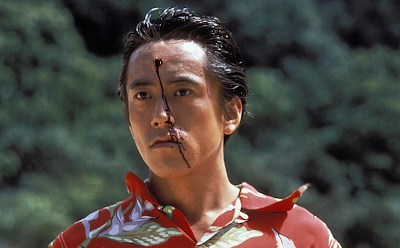

1. Susumu Terajima

I'm everyone, and no one. Everywhere, and nowhere. Call me...Terajima Susumu. This man has been over 100 films, numerous commercials, and TV shows, and he’s only 47! Plus he writes his own advice column in Cinema Today! And yet most of his roles are small. Seldom is he the star or is cast in the limelight. He’s the workingman’s actor. He’s represented by Office Kitano, and is in every day Kitano film, so he’s obviously got skills. He’s in a boat load of yakuza films, and yet makes an appearance in "Sonatine", "Air Doll", "Gamera: The Brave", "Tokyo Tower" and "Flower and Snake". He pours himself into each role, and creates a variety of different characters, proving his completely versatile and yet remarkably selfless; despite how small each role is, he still brings the intensity and the heat. He shifts in and out of the background like a chameleon, and yet you always seem to know who he is. He appears in everything, he is ‘that guy’. The "Darkman" of Japan . MH

Indie anime artist Non-chan Nosferatu brings us "The Messenger From The Sea"

by Chris MaGee

So much great anime seems to be coming out of the independent sector these past few years. The biggest name to come from the school of "get on your Mac and start making animated films" is of course Makoto Shinkai, creator of such lushly produced works as "Voices froma Distant Star" and "5 Centimetres Per Second", but there are many other indie anime artists making a splash on the scene. Now we can add a new name to this list - Non-Chan, Nosferatu. Okay, that most likely not his real name, but the animator has created what looks to be a real black-and-white action manga come to life with his "The Messenger From The Sea". Check out the teaser trailer below for some great animated sci-fi wizardry before heading to Non-chan's official website to check out even more of his work. A big thank you goes to Twitch for pointing the way to this.

Tran Anh Hung's "Norwegian Wood" licenses use of original Beatles song

by Chris MaGee

We've been following production on French-Vietnamese director Tran Anh Hung's screen adaptation of Haruki Murakami's 1987 novel "Norwegian Wood" for exactly two years now (you can read our full coverage here). Throughout that time there has definitely been some big news to report on this - the casting of stars Ken'ichi Matsuyama and Rinko Kikuchi for one, and the soundtrack that will be scored by Radiohead's Jonny Greenwood for another. Now the really big news is that producers of the film have managed to actually license The Beatles original 1965 song "Norwegian Wood" from which Murakami took the name of his story of a love triangle in 1960's Tokyo. Negotiations with Apple Music and Sony were apparently lengthy but it was Hung's insistence that the song be included in his film that made all the difference.

"Norwegian Wood" is set for a theatrical release in Japan on December 11th, no doubt after hitting a few spots on the festival circuit first. Thanks to Japan Zone for this exciting piece of news.

Here's a guy you won't see using an i-Pad anytime soon

by Chris MaGee

So have you, like so many people out there, run out and got yourself an i-Pad? Most of my techie friends have said that the reality lives up to the hype, and my brief run-ins with the i-Phone on crack have been pretty enjoyable. There is one person out there who isn't that impressed with this new piece of Apple technology though. That would be anime master Hayao Miyazaki. The 69-year-old creator of such modern animated classic as "My Neighbor Totoro" and "Spirited Away" has been quoted as saying that that the i-Pad, which has had people lining up at electronics retailers worldwide, is "disgusting". If that wasn't bad enough the notoriously grumpy and workoholic Miyazaki has compared the touch and scroll movements of i-Pad users to those of people masturbating. Ouch! Tell us what you really think, Miyazaki-san!

Thanks to Anime News Network for relating this bit of bubble-bursting news.

Japanese Weekend Box Office, July 10th and July 11th


1. Toy Story 3 (Disney)
2. Pikachu The Movie 2010* (Toho)
3. Bayside Shakedown 3: Set The Guys Loose!* (Toho)
4. Predators (Fox)
5. Confessions* (Toho)
6. Sword Of Desperation* (Toei)
7. The Extraordinary Adventures of Adel Blanc-Sec (Asmik Ace)
8. Soreike! Anpanman The Blacknose And The Magical Song* (Tokyo Theatre/Media Box)
9. Sex and the City 2 (Warner)
10. Iron man 2 (Paramount)

* Japanese Film

Courtesy of Box Office Japan.

Sunday, July 11, 2010

REVIEW: Sideways


サイドウェイズ (Saidoueizu)

Released: 2009

Director:
Cellin Gluck

Starring:
Fumiyo Kohinata
Katsuhisa NamaseRinko Kikuchi
Kyoka Suzuki

Running time: 123 min.


Reviewed by Eric Evans


A confession—well, sort of two—before the review begins: I don't have a knee-jerk hatred of remakes, Japanese or otherwise, but I consider Alexander Payne's 2004 "Sideways" to be the best American comedy of the last 10 years. So it was with equal parts curiosity and dread that I approached Cellin Gluck's "Saidoueizu", last year's Japanese remake. Having watched and enjoyed it inasmuch as one can enjoy a neutered albeit pleasant diversion of a movie, I'm struck by what changed and what didn't. Some of the choices very clearly reflect the Japaneseness of the intended audience, and are easily explained. Others not so much. And while every film should be discussed on its own merits, remakes more or less demand that they be compared with the films being remade, so this review presupposes a familiarity with the original. Spoilers will be present.

In both the 2004 and 2009 vintages, "Sideways" follows the wine country misadventures of former college roommates on a bachelor's last gasp. One, a shlumpy writer (Miles/Michio), wants to savor a week of time away from his life and sample the craft from various wineries. The other, a former small-time actor now marrying into a wealthy family (Jack/Daisuke or "Danny") wants to scope and score chicks before he takes his vows. Since the film's humor and narrative are character-based rather than situational, the casting is of the utmost importance. There are some films that can get by with whoever is hot at the moment, but if 2004's "Sideways" proved anything, it was that actors who aren't usually considered 'leads' are sometimes the best possible choices. "Saidoueizu" follows suit, but slightly to its detriment.
Though he'd done very fine work in a number of small indies (most notably the Harvey Pekar biopic "American Splendour"), "Sideways" put Paul Giamatti on the map. His performance as Miles was a bravura warts-and-all revelation, and the character as written was a clearly flawed man: short-tempered, floundering around the lower end of middle class, struggling with his mediocrity. The character's flaws, pronounced as they were, didn't make him unlikeable but there were moments where the audience was genuinely unsure if they could root for him. "Saidoueizu"'s Michio shares the struggling writer aspect with Miles, but in nearly all other ways is a well-put-together fellow. There is no point in the film in which he isn't a model citizen, a reliable friend, well-dressed and polite, a stand-up guy… and that's a shame. Without Miles' ambiguity, Michio becomes a more traditional protagonist, which robs the story of a bit of its honesty and realism. Fumiyo Kohinata deserves no blame for this, however, and gives a career-best performance. If there's another actor with as many smiles I'm unaware of him, and each one conveys something different; There's a subtlety, even delicacy, to his work here that I found touching. The script doesn't give him the highs or lows that Payne's gave Giamatti, yet he creates a character that does justice to the source. Giamatti was famously bitter at the prospect of the remake, inexplicably lowering himself to describe Kohinata as a "strange little troll," but should he ever consent to watch the film I expect he'll be as impressed as I was to see Michio's hopes dash amid one of those smiles. It's a truly Japanese Miles that would refrain from glowering and ranting, preferring to internalize and present a pleasant face to his disappointment. Kohinata's performance is quietly emotional, contemplative, and spot-on.

Thomas Haden Church imbued Jack with an affability and swagger that make women fall for him despite being smart enough to know better, but make no mistake: His daytime-TV-actor looks, hardly diminished by the onset of middle-aged paunch, both got the conversation started and sealed the deal. Bafflingly, inexplicably, tragically, "Saidoueizu" casts the very funny but completely inappropriate Katsuhisa Namase as Daisuke, TV's former 'Captain Ninja' who now manages a restaurant. His wild, bug-eyed mugging draws laughs but would not inspire the lust in women half his age that we see in the film anywhere, let alone California. It's hard to knock the guy since he does what he can with the role, but he simply doesn't have the near-matinee looks or charm the character needs. If ever a part screamed for Hiroshi Abe's brash grin, this is it. Koichi Sato, perfect. Masaharu Fukuyama, not over the hill enough maybe, but still good. ANY actor with the easy manner that comes from being handsome would have worked. That Namase would be able to seduce blonde California girls in their early 20s, never mind a chirpy and glowing Rinko Kikuchi, is simply too much. It plays like a spoof skit on his "Neo Office Chuckles" when it should be convincing.

Speaking of Kikuchi, her role here is drastically changed from Sandra Oh's in the original. No longer a single mom a little too eager to be swept off her feet, her Mina is a Japanese American free spirit happy to be painting and waitressing, delighted to flirt with a former TV star. (Mina speaks Japanese with a slight American accent, and gets some phrases wrong enough to prompt correction; it's another carefully crafted performance from Kikuchi, a sorely underutilized talent.) Her scenes have little weight since her character has none at all. In "Sideways", Jack's behavior was reprehensible since a single mother invests so much more in a man who says 'I love you' and talks of their future together. Conversely, Daisuke is off the hook from the start since Mina is a carefree kid who can chalk up the week as a sex adventure without consequence. His dalliance with her has none of the gravity of the original, so his facial injuries at the frying-pan-weilding Mina feel like an odd overreaction—or worse, a plot contrivance.

Since director Cellin Gluck and the rest of the creative team behind "Saidoueizu" have changed so much from the original, why they feel they need to hit many of the same dramatic beats regardless of the film around them is beyond me. "Sideways" was in part about normal adult behavior verging on extremes, so when big dramatic events happened—a motorcycle helmet to the face, a character sloppily chugging from the spit-barrel at a wine tasting—they felt like the culmination of something, a crescendo that had been building. In "Saidoueizu" these moments happen more or less out of the blue, without emotional investment or context. It's depressing because they didn't need to hit those specific notes, but by including them at any cost they broke with what really does work about the film: Michio's careful talks with Mayuko (a pitch-perfect Kyoka Suzuki), his friendly bickering with Daisuke, his delight at a well-cooked meal. Most damagingly, the most touching and effective moment in "Sideways"—Miles' talk with Maya in which he describes why he loves pinot noir wine, when he is in fact presenting himself as nakedly as one could—is reduced to cocktail-party chitchat in "Saidoueizu". It's a depressing moment. Why include something which had such emotional resonance in the original as an afterthought?

This "Sideways" could have been a riff on the original, a divergent path that borrowed a premise or character types without compulsively literalizing elements from the source. Gluck is nothing short of a journeyman director, ADing/second unit directing on films as diverse as megahits "20th Century Boys" 1 and 2 and "Transformers" to "A Cheerful Gang Turns the Earth" and "Trapped Ashes". Though his work here lacks some of the verve and polish of Payne's more assured directorial eye, he never gets in the way of telling the story; A project like this doesn't require an auteur anyway. At some point very early in the process, the producers decided to jettison the less pleasant or introspective aspects of the source material to craft a more conventional romance. And that's fine. But when Michio finally blows up over producers removing the personal aspects of his script in favor of something more commercial, I couldn't help but hope it was metacommentary from Glick and co. on how this "Sideways" is a nearly bloodless knockoff of its source material.

For all my complaining the film is a fine diversion. Go into it free of expectations and it's an inoffensive exercise with a talented cast doing all that could have been done under the circumstances. The New York Times decried it as a shameless travelogue, a tourism film disguised as drama in which "each location gets a plug that approaches parody." I didn't find those aspects of the film objectionable in the least, though they were somewhat obvious. The cast played off of these situations brilliantly, and no doubt the 30-day shoot and $3-million budget would have strained under the weight of recreating such realistic sets and venues. No, this film's problem isn't product placement, but emotional anemia. Given how well the cast did under the circumstances, I'm sorry Glick didn't just use Payne's shooting script and let the chips fall where they may.

Tadanobu Asano to portray manga artist Fujio Akatsuka in upcoming biopic

by Chris MaGee

Remember when Tadanobu Asano was that actor who starred in left-of-center films and was dubbed the "Johnny Depp of Japan"? It seems like the 37-year-old actor has, like Depp, graduated to the big leagues and has in the past two years starred in some major studio pictures both at home (Villon's Wife, Mt. Tsurugidake) and abroad (Mongol). Now Asano is going to be stepping into the shoes of one of Japan's most respected manga artists in an upcoming biopic.

As we reported just last month that director Hideaki Sato would be making a film based on the life and work of famed gag manga artist Fujio Akatsuka (above) best known for creating such iconic manga as "Tensai Bakabon", "Osomatsu-kun" and "Himitsu no Akko-chan". Titled "Korede Iinoda! Eiga: Akatsuka Fujio" the film will chart the relationship between Akatsuka and his longtime editor Toshiki Takei between 1967 and 1974. Now Tokyograph is reporting that Tadanobu Asano has been cast as Akatsuka in "Korede Iinoda! Eiga: Akatsuka Fujio". Co-starring with Asano will be 21-year-old actress Maki Horikita as Toshiki Takei. This won't be the first time that Asano has starred as an eccentric manga artist. Asano starred as manga artist Yoshiharu Tsuge in Teruo Ishii's 1998 film "Screwed".

"Korede Iinoda! Eiga: Akatsuka Fujio" is currently film and is due to be relkeased in Japanese theatres next year.

"Twenty-four Eyes" and "Insect Woman" art director Kimihiko Nakamura, 1916-2010

by Chris MaGee

Sad news in the Japanese film world this past week. Art director Kimihiko Nakamura, whose credits included such iconic films as Keisuke Kino-shita's "Twenty-four Eyes" and Shohei Imamura's "Pigs and Battleships" and "The Insect Woman" passed away on Tuesday in Tokyo from renal failure. He was 94.

Nakamura was born in Kumamoto Prefecture in 1916 and initially worked for Mitsubishi Heavy Industries before joining the Shochiku Ofuna studio in 1951. After a year working at the studio he was assigined to work under director Keisuke Kinoshita for whom he did art direction for both "Twenty-four Eyes" and "The Garden of Women". After his time at Shochiku Ofuna Nakamura joined Nikkatsu Studios where he did art direction for two of Japanese New Wave director Shohei Imamura's best known films - "Pigs and Battleships" and "The Insect Woman".

Our deepest condolences go out to Nakamura-san's friends and relatives during this time. Thanks to Tokyograph for the details on his remarkable career.

"Shall We Dance?" director Masayuki Suo to return to the dance stage with upcoming film

by Chris MaGee

One of the most successful Japanese films, at least in terms of crossover appeal in the West, in the past 20 years has to be Masayuki Suo's 1996 comedy "Shall We Dance?" The film followed a salaryman's discovery of himself through ballroom dance lessons and made its star Koji Yakusho an international sensation. It was also turned into a film starring Jennifer Lopez and Richard Gere in 2004, but we'll try and forget about that. Now director Masayuki Suo will be returning to the the big screen with another dance-themed film.

The 54-year-old filmmaker is set to direct "Dancing Chaplin", a loose adaptation of French choreographer Roland Petit's ballet "Chaplin". This return to dance for Masayuki Suo is a labour of love in more ways than one. The star of "Dancing Chaplin" will be Suo's wife, ballet dancer Tamiyo Kusakari. Although Kusakari will be starring opposite dancer Luigi Bonino (above) she will be apparently taking on six different roles in the film including a turn as Charlie Chaplin on whom the ballet was based.

Look for "Dancing Chaplin" to his Japanese theatres (and undoubtedly the film festival circuit) in the spring of 2011. Thanks to Tokyograph for the details on this.

REVIEW: Insane Mask


狂 い 面 (Kurui Men)

Released: 2009

Director:
Eiichi Tsukiashi

Starring:Kentaro Suga
Kazunari Taniwaki
Makoto Nakashima
Hisanobu Sato
Eiichi Tsukiashi

Running time: 55 min.


Reviewed by Chris MaGee


You have to have done something really bad for someone to piss in your mouth. There are very few other punshiments that are worse than a mouth full of urine. That's the kind of torture that the main character of Eiichi Tsukiashi's "Insane Mask" must endure at the hands of four mysterious masked figures, but trust me when I tell you that whatever punishment doled out onscreen pales in comparison to the torture that anyone sitting and watching this self-described "bizarre Japanese cult movie" must put up with for its 55-minute run time.

So here's the basic plot of "Insane Mask" - a faceless interviewer named Mukai brings a line-up of characters into a dimly lit room and with video camera running he asks them one by one to "Please tell me your name age and occupation." In this way we meet Momoyo, who says she's a 29-year-old prostitute while in actual fact he's the campiest drag queen this side of RuPaul, Ninamata, a 42-year-old Buddhist shrine craftsman, Mitsuru, a 28-year-old pseudo-hippy, and Taichi, a seemingly mentally-challenged 40-year-old school boy. It seems that each of these four are guilty of exacting some pretty foul deeds on a young man named Juji Agita. Actually let me rephrase that. Some of them exact some pretty foul deeds on Agita. Momoya only gives Agita a bad haircut while he/ she minces around and Ninamata drips melted candlewax all over Agita's naked torso, treatment some of us would pay good hard-earned money for. Mitsuru on the other hand slops down handfuls of earthworms onto Agita's face and chest which isn't the most pleasant way to spend your time, but it's really Taichi who wins the cruelty prize by playing war games with Agita during which he throws a bucket of shit on him and then pees in his mouth. Oh, and Agita is chained up through all this... Oh, and all his four tormentors wear Japanese festival-style masks when they're not mugging for the camera, which I guess makes the torture artsy and bizarre and "Insane Mask" an instant "cult movie". And that's it.

Well, okay, let's be fair... That isn't the full plot of "Insane Mask". Writer/ director Eiichi Tsukiashi, who used to sing in the Japanese goth-punk band Roidegyarudo before turning to filmmaking, adds a twist to the proceedings that any clever viewer can see from a mile off. For all those who are rabid about spoilers be forewarned... It turns out that Agita suffers from multiple personality disorder and these alter egos are trying to both protect themselves and punish Agita for introducing a fifth personality intho their midst, a ninja assassin named Daigo who's part Darth Vader and part visual kei rock star and is played by Tsukiashi himself. Daigo is going to destroy these multiple personalities using his razor sharp katana and some laughable digital effects.
Now you may ask some basic questions about this whole scenario, things like do we discover the reason why Agita suffers from multiple personality disorder throughout the film? Do we learn why Agita has created this dark ninja assassin-saviour to free him from these destructive alter egos? Who is this faceless Mukai person - a therapist or just another aspect of Agita's splintered psyche? Anyone asking these questions about "Insane Mask" will be disappointed to hear the the answers - no, no and we don't know but maybe a therapist, but maybe not. Of course why bother with such minor plot quibbles when you can rip off imagery from Shuji Terayama like the sulphuric landscape and the white-faced school boy from his 1974 film "Pastoral: To Die in the Country". I mean, if you use some Terayama weirdness and mix it with S&M and throw a ninja in to the miz then VOILA! You have am instant "bizarre cult movie". The only problem is that there is no "cult" audience out there for this mess, although someone at the 2009 New York International Independent Movie Festival awarded "Insane Mask" the Best International Cult Movie (Short Film Category). Maybe the head of the jury was Tsukiashi's mom, or girlfriend or suffered from multiple personality disorder.

You have to understand that I don't normally like to trash a film in a review, but when you come across a film that feels like it was written by a mopey high school goth girl and looks like it was shot alternately in someone's basement and in a dry ravine behind their house there really isn't much good you can say about it. I'm sure that Tsukiashi put a lot of hard work and love into "Insane Mask", but in the end what comes across onscreen is painful, and not because of the torture that Agita must endure. And that all being said let's leave "Insane Mask" well enough alone and carry on with our day...