Friday, April 30, 2010

HOT DOCS '10 REVIEW: Eat the Kimono


Eat the Kimono

Released: 1989

Director(s):
Claire Hunt & Kim Longinotto

Starr
ing:
Genshu Hanayagi


Running time: 60 min.


Reviewed by Bob Turnbull


Hanayagi Genshu certainly is an interesting woman. She's a dancer, singer, storyteller, political activist, feminist and even a former inmate. She travels throughout Japan to perform her convention bending dances and make speeches to stir up those she feels have been wronged or held back. "The world will get a little bit better if the oppressed speak out. You musn't be silent". Throughout the hour long "Eat The Kimono" (another film in the Hot Docs 2010 retrospective series of Kim Longinotto's career), the controversial Genshu's voice is at the centre of every scene. Other people chime in occasionally, but the filmmakers focus exclusively on Genshu and what she has to say. The result allows her message to be heard unfiltered, but also allows the viewer to make up their own minds about Genshu herself.

She's not immediately likeable. Our introduction to her is through old news footage of her arrest (for stabbing a dance teacher). As she is being led off by police officers, she shows a strong disregard for what she has done by telling the camera that she will be alright and flashing a peace sign - an odd choice after committing a violent crime. She tends to dominate conversations and, even when dealing with her causes, usually brings the topic around to herself. She never hesitates to mention her struggles growing up as the child of travelling performers, how poor they were and how she was bullied and called names. This led to her current fights against prejudice, discrimination and the pyramid system (ie. class structures) and she uses these stories of her childhood in many of her songs and dances. It's also the reason why she served those 8 months in prison for knifing the dance teacher. Looking back on the incident, she relates that the instructor was talentless but held the position because of her level on the pyramid. She stabbed her because "We have suffered, I want you to know our pain". She also claims that the police made a much bigger deal over the situation than was warranted: "I just cut her neck a little bit".
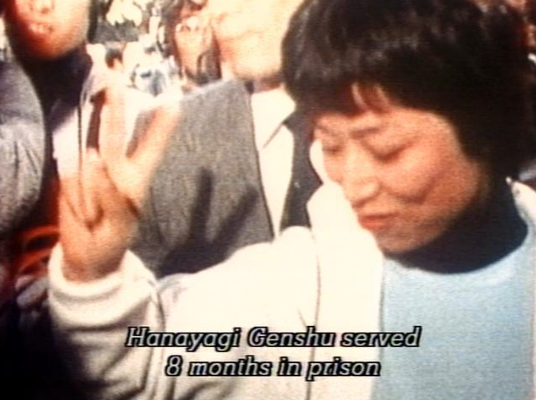
Though possibly slightly delusional, Genshu still manages to get her message across very clearly. Her methods seem to be very effective with her audience as they listen with rapt attention and appear to be very moved by her words. She may generalize a lot, but it's easy to understand how a crowd can be swayed by her pronouncements that "Weak people are getting stronger" and "If it's done to you, do it back". Of course, not everyone is a fan. When she makes statements that Emperor Hirohito has killed more people than Hitler and yet the country still celebrates his birthday, you take her word for it that the far right wing have threatened her. She's also not shy about bringing up other dark corners of Japan's history. She talks about Japan's treatment of Koreans - how many were enslaved and brought to Japan, denied care after Hiroshima (preferential treatment was given to Japanese people) and now get deported back to Korea. She focuses on the patriarchal society of the country as well by stating that men can't commit to love and always look down on women. Instead of always making the sacrifices, she encourages women to break free:

"The kimono comes from Japan's feudal past. It traps women. My art is expressing freedom, even though I'm restricted...You musn't be eaten by the kimono...You must eat the kimono, gobble it up."

Genshu uses the kimono a great deal in her lovely dances which fortunately are showcased several times in the film. There's an economy of movement that seems to capture many of her repeated themes of being restricted, struggling against the system and then fighting back via any means necessary. Longinotto and her frequent collaborator Clair Hunt have used a typical cinema verite approach to Gensu's story and managed a difficult feat - allowing a controversial person to clearly get across their message without it being obscured by the personality. Even with all her generalizations, self-serving speeches and questionable methods, the larger message about searching out enforced inequalities in society and helping to eradicate them is still conveyed. You don't have to like her to get her point.

Read more from Bob Turnbull at his blog.

Sadako to literally crawl off the screen in proposed 3D "Ringu" reboot

by Chris MaGee

Remember that iconic moment in Hideo Nakata's "Ringu" when the stringy-haired Sadako crawls out of a TV screen to scare Hiroyuki Sanada to death? Well, if Paramount has anything to do with it Sadako may literally be crawling out of the movie screen for a third "Ringu" remake. According to Slash Film Paramount, who took over the rights to the "Ringu" remakes after they split with Dreamworks, are looking to jump on the 3D bandwagon and produce a reinvention of the grandfather of all J-Horror movies that will jump off the screen and will be "teen-centric". Screenwriter David Louka, whose previosu credits include Evelyn Purcell's "Borderline" (I haven't heard of it either) and the 1996 Whoopi Goldberg vehicle "Eddie", has been tagged to pen the script. Thus far there's no sign of Naomi Watts reprising her role in the English-language remake series, and thankfully there's no word of Hideo Nakata being involved.

A "teen-centric" 3D version of "Ringu", huh? It was only last night that Popw-Wow writer Bob Turnbull and I were critiquing film bloggers for at times being less than eloquent with their frequent use of "dude!" and "this film owns!", but I can only think of one thing to counter a 3D "teen-centric" remake of "Ringu" - Crap-tastic!

Weekly Trailers


8,000 Miles 2: Girls Rapper - Yu Irie (2010)


"8000 Miles (Saitama's rapper)", Yu Irie's surprise winner of the top prize at the 2009 Yubari Fantastic International Film Festival, gets a sequel that focuses on a group of aspiring female rappers who go up against the boys from the first film. Fresh off its screening at this year's Nippon Connection Film Festival in Frankfurt "8000 Miles 2: Girls Rapper" is set to be released in Japan later this year.


Pussycat Great Mission! - Ryuichi Honda (2004)

Director Ryuichi Honda, the same man who brought us the retro rock comedy "GS Wonderland", staked his claim to revisionist 60's kitsch with his 2004 independent film "Pussycat Great Mission!" Three sexy and vicious go-go dancers plot to steal money from wheelchair bound yakuza boss, but end up getting much more than they bargained for. Also known by the title "Operation Pussycat!"

NIPPON CONNECTION '10 REVIEW: Autumn Adagio


不惑のアダージョ (Fuwaka no Adagio)

Released: 2010

Director:
Tsuki Inoue

Starring:
Rei Shibakusa

Peyton Chiba
Takuo Shibuya
Rumi Tachibana
Kazuhiro Nishijima

Running time: 70 min.

Reviewed by Marc Saint-Cyr


After her highly acclaimed 2007 short film “A Woman Who is Beating the Earth,” rising filmmaker Tsuki Inoue made the logical and eagerly anticipated leap into features with the 70-minute marvel “Autumn Adagio.” It is truly remarkable to see a film from so early in a director’s career that displays so much wisdom and maturity in virtually every aspect, from story (from an original screenplay by Inoue) to visual craftsmanship to performances.

All of the latter are quite strong, but the main event is clearly lead actress Rei Shibakusa, who provides a layered and commanding presence in the central role of the 40 year-old nun Sister Maria. From the very first moment she appears onscreen, it is clear that her character is a deeply unhappy person. She quietly sees to her duties at her church with cool detachment and great thoroughness, determinedly keeping herself at a distance from everyone around her, listening to them whenever she has to with only the slightest changes in her continually reserved expression. Essentially, she keeps her small world under tight control, ensuring that it remains neat and manageable to an intense degree. At the start of the film, she lives in a world where communication simply doesn’t work – mainly due to her own unwillingness to partake in it. An overly enthusiastic and, it is later revealed, desperate man repeatedly pesters her after her church gatherings to speak about his personal issues with little success. Another patron emphatically asks her to come play the piano for a ballet class, to which Maria initially replies with much reluctance. Yet Maria herself is confronted with the same negative attitude in a gardener who stubbornly ignores her when she tries to deliver to him a message from his estranged, ailing mother.

While Maria starts out maintaining an ironclad grip on her femininity and outer emotions, her façade gradually gives way. Certain moments when portions of herself are finally freed are wonderful to behold. One major agent in this transformation is music, with Maria leaving her church organ to express herself through other instruments like the ballet school’s piano and even an accordion. A particularly uplifting sequence floods the previously calm soundtrack with a quick-paced classical piece as Maria rides her bicycle. An even more powerful moment occurs when she sits down at her piano at the ballet school and plays while the class instructor dances in the otherwise empty room to her lovely, flowing notes. As the film progresses, Maria is challenged by more unsettling events that trigger further changes and force her to greatly reconsider her life and values.

Inoue’s confident cinematic style, noticeably ingrained with tranquility and precision, elevates “Autumn Adagio” into the realm of perfection. The digital cinematography by Yohei Ohmori is absolutely stunning, comprised of one eloquent visual composition after another. The film is dominated by painterly fixed shots while the occasional camera movements are smoothly executed. The titular season is taken proper advantage of through vibrant tones of red, orange and gold. Several memorable images neatly encapsulate story motifs and help establish mood: drifting dust motes in the calm ballet studio, the empty streets of a residential area damp with rain, the smooth keys of the organ Maria plays and polishes. Many viewers are likely to be reminded of Ingmar Bergman’s films (including, obviously, “Autumn Sonata”) by “Autumn Adagio”’s masterful control, deep ideas surrounding faith and human nature, autumn imagery and stirring classical score (provided by Shibakusa herself).

Rightfully championed by Tom Mes (who introduced the film at Nippon Connection), “Autumn Adagio” is certainly a great film by any measure. Yet it inspires on a number of select levels: it sets a high standard of quality for digital films to strive for, it firmly establishes the place of an exciting new female director and it showcases the brilliance that is possible when a talented actor is fitted with the right part. Those who make the effort of seeking out a screening of “Autumn Adagio” will be greatly rewarded.

Read more by Marc Saint-Cyr at his blog.

Longtime horror franchise "Kaidan Shin Mimibukuro" gets new feature film

by Chris MaGee

While this week brought us the unwelcome news of the 3D English-language reboot of Hideo Nakata's "Ringu" it also bought us word of the continuation of one of J-Horror's most lasting franchises. According to Tokyograph the latest film in the long-running "Kaidan Shin Mimibukuro" series will be making its world premiere at this year's Anime Expo taking place between July 1st and 4th in Los Angeles. No this new "Kaidan Shin Mimibukuro", also known by it's English title "Tales of Terror from Tokyo and All Over Japan", film isn't animated, it's live-action, but it looks as if the Anime Expo organizers see some pretty promising crossover appeal with the anime fans who will be flocking to the event.

"Kaidan Shin Mimibukuro" began as a TV series in 2003 and since then some big names have been involved in bringing its scary stories to life. Such J-Horror luminaries as Takashi Shimizu, Norio Tsuruta, Hiroshi Takahashi, as well as New Wave camp horror directors Yudai Yamaguchi and Nobuo Iguchi have contributed episodes and there have been a number of spin-off feature films. This latest "Kaidan Shin Mimibukuro" is being helmed by Makoto Shinozaki whose previous credits include 1995's critical favorite "Okaeri" and the upcoming Natsuo Kirino screen adaptation "Tokyo Island". His film will star 19-year-old pop singer Erina Mano and will cover not one, but two chilling tales. The first will be titled "Tsukimono" about a haunted college student and the second "Nozomi" (above) follows a young woman who is mourning her sister's death and experiencing terrifying visions.

After its premiere at Anime Expo "Kaidan Shin Mimibukuro" will get a theatrical release in Japan this fall. Thanks to Sankei Sports for the above promo still.

Nishikata Film Review points the way to the Kawamoto Kihachiro Puppet Museum

by Chris MaGee

Normally we only tend to link to news stories here on the Pow-Wow blog, but sometimes a fellow blogger points the way to something so interesting that,w ell, all we can do is point the way to the blog that pointed the way... if that makes sense. Case in point, Cathy Munroe Hotes over at Nishikata Film Review has posted a really interesting article on the Kawamoto Kihachiro Puppet Museum in Iida City, Nagano Prefecture. For those of you who may not be familiar with the name Kihachiro Kawamoto is an independent stop-motion animator who tells traditional Japanese folk tales using elaborate puppets. Now 85-years-old Kawamoto sits as the president of the Japanese Animation Association, and his last feature film "Book of the Dead" picked up a special mention award at the 2006 Sitges-Catalonian International Film Festival and the Grand Prix Award at the Chinese International Cartoon and Digital Art Festival that same year. To get an even better idea of Kawamoto's work check out his 1972 short film "The Demon" below.

According to Hotes' article Iida City has been a center for bunraku, the traditional Japanese puppet theatre, for 300 years and has hosted a an annual Puppetry Carnival since 1979. It was after he attended the Carnival in 1990 that Kawamoto donated 200 of his puppets to the Iida City Puppet Museum, which has now adopted the animator's name. I'd highly recommend that you head over to Nishikata Film Review to read Hotes' article about the museum here. You'll learn a lot. After that you can see more of the Museum's collection online at its official website. Enjoy!

NIPPON CONNECTION '10 REVIEW: Pyuupiru 2001-2008


Pyuupiru 2001 - 2008

Released: 2009

Director:
Daishi Matsunaga

Starring:
Pyuupiru


Running time: 91 min.


Reviewed by Chris MaGee


In the past few years there has been a global mania for both Japanese pop art and street fashion. Artists like Takashi Murakami and his Kaikai Kiki roster of talent, as well as painters Yoshitomo Nara and Junko Mizuno have had gallery shows around the world, while upscale malls to Paris runways have been the home to wacky Japanese inspired fashions epitomized by the fashion magazine Fruits. One artist who combines the gallery with couture is 35-year-old transgendered Tokyo artist Pyuupiru. Originally starting out in the club scene Pyuupiru (who got her/ his name from a fellow club kid) creates elaborate hand-knit, hand-sewn costumes inspired by planets, manga characters, and organic forms that go beyond fashion and into the realm of sculpture and installation art. Pyuupiru's various guises and disguises are a true revolution of beauty - strange, sometimes disturbing, often cartoon-like, but an arresting and revelatory beauty nonetheless. To capture the human being behind this art is hardly an easy task, but it's one that Pyuupiru's longtime friend and at one time fellow club kid Daishi Matsunaga took on in 2001. For seven years Matsunaga chronicled his friends creative and personal highs and lows, the result of which is the 2009 documentary "Pyuupiru 2001-2008", a loving portrait that goes well beyond the colourful knits, garish make-up, and surreal props that Pyuupiru adorns her/himself with.

When we first meet Pyuupiru in 2001 he's a tall, gawky gay man who, despite Matsunaga's insistence that he looks like a TV star, isn't particularly handsome or distinguished. Pyuupiru is also very lonely. Instead of just graciously taking Matsunaga's compliment he jokes with his friend, asking him if he wants to fool around. It turns out that Pyuupiru has never been in love, never dated anyone for an extended period of time, and isn't particularly happy in his own skin. He is possessed of an astounding imagination though, and fills notebooks with sketches for outrageous club kid costumes. It's obvious that these outfits function more than just fun Saturday night attire and as Matsunaga's documentary progresses we see Pyuupiru use costumes, make-up and eventually female hormone injections, plastic surgery and even elective castration to transform himself into an almost angelically beautiful asexual being. Throughout this seven year physical transformation Pyuupiru goes through dramatic emotional changes as well. (S)he must deal with her/ his parents who wish their son would just drop all the bizarre visuals, leave his job working in a manga cafe and get on with a normal life. Thankfully his brother becomes one of his biggest fans, supporters, and at times creative collaborators. Even this support can't protect Pyuupiru when (s)he finally falls in love with a straight man who is referred to only as "Papa". While things don't ultimately go as Pyuupiru had wished the heartbreaking fallout results in some truly jaw-dropping creations including a fiery installation piece made up of 15,000 origami cranes.

It's this last romantic arch in Pyuupiru's story that makes "Pyuupiru 2001-2008" so watchable. Instead of an artist caught up in the dry intellectual sexual and political dialectics of gender-treachery Pyuupiru's transformation seems to be motivated as much by his/ her desire to be a happy, loved and loving human being as it is by artistic ambition. We almost get a sense that even if (s)he had not been propelled into the international contemporary art scene that (s)he would have followed the same creative trajectory regardless. Yes her/ his attempts to transcend the duality of male and female puts him in the same context as such artists as former Throbbing Gristle and Psychic TV member Genesis P. Orridge and French plastic surgery performance artist Orlan, and Japanese drag artist Yasumasa Morimura. (It also makes writing this review a pitched battle against gender specific pronouns.) Again though, there is a vulnerability, a longing for personal and romantic acceptance, and a whimsical sense of humour that, when combined with her/ his ferocious talent, makes Pyuupiru stand out from these other artists. The climax of the film which shows Pyuupiru performing atop a giant gallery installation is so deeply moving because it nakedly conveys her/ his continuing struggles and triumphs with her/ his own body and identity.

I dearly hope that with Viz Pictures now releasing their New People artist documentaries DVDs that Daishi Matsunaga's "Pyuupiru 2001-2008" ends up finding a home amongst the series. Like Yayoi Kusama, Yoshitomo Nara and Hisashi Tenmyouya who are already inlcuded in the series Pyuupiru is an artist whose work encapsulates a truly unique Japanese pop culture aesthetic. More importantly, though, is that the concepts and message of personal transformation in Pyuupiru's work makes it totally universal.

The 6th annual Sky PerfecTV! Adult Broadcasting Awards bring sexy laughs to Shibuya

by Chris MaGee

Somehow I always feel like I have to apologize when I post a story about Japan's AV (Adult Video) industry. Maybe it's the puritan in me, or maybe its the film snob who somehow thinks porn isn't a part of valid film culture. That's not true, or at least I believe a couple centuries from now when there are only a handful of films and videos left from the late 20th and early 21st centuries historians will see any surviving document from this time as valid. Come the 23rd century AV star Maria Ozawa may very well be on equal footing with a classic actress like Machiko Kyo. You never know.

This past week Brett Bull, the Tokyo Reporter himself, brought us news that Maria Ozawa and her fellow Japanese porn starlets Saori Hara and Shelly Fujii were honoured with trophies at the 6th annual Sky PerfecTV! Adult Broadcasting Awards. he event took place in a meeting room at a Shibuya love hotel and featured Ozawa, Hara, Fujii and their fellow AV peers getting into som pretty hilarious (and of course naughty) game show inspired hijinks. The end result was broadcast on the SkyPerfecTV! satellite network, but Bull has posted a gallery of some pretty funny (although somewhat NSFW) photos from the event here. See you can't say the J-Film Pow-Wow doesn't get naughty from time to time!

May DVD Releases


Tokyo Sonata - Kiyoshi Kurosawa (2008)
E1 Entertainment/ Release Date: May 4th

Miyamoto Musashi: The Ultimate Samurai (5 Disc Set) - Tomu Uchida (1961-65)
AnimEigo/ Release Date: May 4th

Girl in Captivity: Psycho Torture Chamber - Daisuke Goto (2008)
Tokyo Erotique/ Release Date: May 4th

Girl In Captivity 2: Hitwoman in Chains - Kenichi Fujiwara (2009)
Tokyo Erotique/ Release Date: May 4th

Gamera: The Giant Monster - Noriaki Yuasa (1965)
Shout! Factory/ Release Date: May 18th

Oshima's Outlaw Sixties - Nagisa Oshima (5-Disc Set)
Criterion/ Eclipse/ Release Date: May 18th

Goth - Gen Takahashi (2008)
Well Go USA/ Release Date: March 25th

REVIEW: War of the Gargantuas

フランケンシュタインの怪獣 サンダ対ガイラ
(Furankenshutain no Kaijū: Sanda tai Gaira)

Released: 1966

Director:
Ishiro Honda

Starring:
Russ Tamblyn
Kumi Mizuno

Kenji Sahara
Kipp Hamilton

Running time: 87 min.

Reviewed by Matthew Hardstaff


A fishing vessel trawls the waters of the Pacific, a storm raging through the night sky. The lone pilot sits aloft his perch, guiding the ship through the treacherous waters. But something lurks in the depths. A tentacle slithers its way through a window and into the pilots quarters, sneaking its way towards him, getting closer and closer. It starts to wrap its tendrils around his leg, but he reacts with the precision of a leopard, hacking at it with a bladed weapon. The tentacle quickly retreats, and the pilot looks out the window to see his attacker face to face. Unfortunately, it’s a colossal squid named Oodako (retreating from its battle with King Kong in ‘King Kong versus Godzilla’?), and it’s several times larger than his vessel. It’s tentacles attack, grabbing the pilot and pulling him towards its maw. But before it can consume its tasty treat it releases its grip. But why? The pilot investigates, and out in the waters of the Pacific, a battle rages, between the giant squid and a large green skinned creature known as Frankenstein. Frankenstein makes short work of the squid, and then the vessel, leaving the pilot as the loan survivor.

Thus begins ‘War of the Gargantuas’ aka ‘Frankenstein’s Monsters: Sanda versus Gaira’, the semi-sequel to ‘Frankenstein Conquers the World’ aka’ Frankenstein versus Subterranean Monster Baragon’, both helmed by tokusatsu kaiju master Ishiro Honda. Though no direct references are made to the previous film, its fairly obvious they operate in the same universe. In this Frankenstein incarnation, the oceanic green skinned Frankenstein, named Gaira, lives to breed destruction, although he, much like a Gremlin, has an aversion to bright light. With the help of American scientist Dr. Paul Stewart (played by Russ Tamblyn from West Side Story!!), his sexy assistant Akemi (Kumi Mizuno) and his fellow scientist Dr. Yuzo Majida (kaiju regular Kenji Sahara), the Japanese Self Defense Force plots to protect Tokyo from this destructive force. They blame Stewart and his friends for this monster, as they, on one of the few references to the previous film, helped create it. But their Frankenstein was friendly, not violent. After a trip to the Japanese Alps, they discover that there are in fact two Frankensteins, the evil Gaira, and the loving Sanda. Soon the two beasts do battle, leveling everything in their wake!!

One of several kaiju films with American actors in the lead, its obvious from the get go that this is an Ishiro Honda film. Friend to Akira Kurosawa, even when making films with men in rubber suits, he’s able to emote enough sympathy for the giant Frankenstein creatures, even as they level Tokyo and its surrounding area, that the films take on a transcendent quality, and helps to make them the cross cultural hits they were. If you’ve seen ‘Crank 2’, you’ll find inspiration in this film for the kaiju-eque fight Jason Statham has in the electrical plant. You’ll also find American singer Kipp Hamilton singing her hit single ‘The Words got Stuck in my Throat’ as Gaira tramples through the city. This is the kind of film a good monster movie should be, and its part of the reason that Hollywood and its god-awful renderings always fail. Yes, there are giant monsters that do battle and trash lots of stuff, and the special effects are quite amazing, but when the evil monsters are vanquished there is no moment of glee and cheer. The attacks upon them are long, drawn-out and brutal. Honda always tried to put some kind of social commentary in his kaiju films; mostly dealing with humankind’s creation of weapons of mass destruction and how they negatively affect society. Here, the Frankensteins are obviously both manmade, so he never seeks pleasure, nor asks the audience to seek pleasure, in their destruction. He also manages to elude our expectations by having the scientists create a lot of plans and strategies that would be typical of a more crowd pleasing venture, and then having them fall apart or fail miserably. If there is anything to cheer about in this film, it’s Ishiro Honda and his classic and lost art of filmmaking.

Read more by Matthew Hardstaff at his blog.

Thursday, April 29, 2010

Exhibition Report: Beat Takeshi Kitano: Gosse de peintre

by Marc Saint-Cyr

Over the past few weeks, I have been out of Canada for both business and pleasure: firstly, to accompany my friend and Pow-Wow boss Chris MaGee to the 10th annual Nippon Connection film festival in Frankfurt, Germany (keep an eye open for more reviews of films from the festival that will continue to trickle onto the site in the weeks to come). After a brief delay from the Icelandic volcano, Chris made it back home safely, while I took a train to Paris, France, where I've been taking in the sights and art, both film-related and otherwise. However, I haven't taken a complete break from my Pow-Wow duties, as I have had the privilege of attending an art exhibit exclusive to Paris that should appeal to readers of this site: the first-ever showing of paintings and art pieces from acclaimed, multi-talented artist Takeshi Kitano.


Entitled "Beat Takeshi Kitano: Gosse de peintre" ("The Painter's Kid"), the Fondation Cartier-programmed exhibition reveals the ever-prominent playful side of Kitano in an open, inviting environment filled with wonderful inventions and delights for the eye. Upon entering the glass-walled Fondation Cartier building, visitors are greeted by a statue of the man himself as he holds his own brain - an indicator of the personal yet playful tone of the exhibition. The main level of the building holds a number of installation pieces, many of which inviting hands-on exploration. One of my favorites is a row of fans that people can activate with the push of a button, but with surprising results. Two of the biggest objects are a brightly colored dinosaur with signs set up around it explaining Kitano's own off-beat theory regarding the creatures' extinction and a massive steam engine-like contraption with feet - Kitano's uniquely-designed sewing machine! On the opposite side of the main level, there is a multi-level marionette stage that comes to life every so often and is most reminiscent of (if not directly modeled on) the famous musical finale of "Zatoichi: The Blind Swordsman." Another personal favorite display shows several figures of animals merged with machines and weapons, an incredibly cool collection that certainly spoke to the kid I used to be who would play with Lego for hours on end.


The lower level of the exhibit is primarily dedicated to paintings by Kitano, many of which created solely for the event. Stylistically simplistic, they continue to show Kitano's childlike perspective through bright, pleasing patches of color and thick brush strokes. Also on display in the darkened area is a collection of paintings of animals with flowers for heads - works Kitano made in 1996 following his motorcycle accident and channelled in similar paintings in "Hana-bi" ("Fireworks"). Venetian vases made specifically for the exhibition accompany the paintings. A theatre-like area shows a collection of clips from Kitano's television show "World Great TV," highlighting the performer at some of his outright wackiest moments. Another room holds a giant paint gun that visitors can apparently get to use via lottery numbers on blank dinosaur-shaped canvases (though it was inactive and unattended when I visited it).


There are other pieces within the exhibit (including some outside of the building), but really, the best way to experience it is to, of course, visit and explore it yourself. Kitano gives a generous and openly playful approach to art and the art world, nicely illustrating his personal views on such matters while continuing to solidify his status as a legitimately noteworthy artist. Anyone who is in Paris and a fan of him, his films or art in general would very much benefit from an afternoon spent at the Fondation Cartier.

Along with this art exhibit, there is also a major retrospective of Kitano's films at Paris' Pompidou Centre, which will run until June 26th and includes films by him, about him and featuring him as an actor. You can check out the schedule here, while the main web site for the Fondation Cartier can be found here.


Exhibition information:

Running from March 11th-Sept. 12th, 2010
Fondation Cartier
261, boulevard Raspail 75014 Paris
Telephone: +33 (0)1 42 18 56 50
Fax: +33 (0)1 42 18 56 52

Metro: Raspail or Denfert-Rochereau (lines 4 & 6)
Bus: 38, 68, 88, 91
RER Denfert-Rochereau (line B)
Velib' 2, rue Victor Schoelcher
Disabled parking: 2, rue Victor Schoelcher

Hours of operation:
Tuesday: 11am-1opm
Wednesday-Sunday: 11am-8pm
Closed Monday

Admission: 7.50 €
Reduced rate: 5 € (for students, under 25, "carte Senior" holders, "Amis des Musees," unemployed)
Free: "Laissez-passer," children under 10, ICOM members, visitors under 18 on Wednesday from 2pm-6pm

Tuesday, April 27, 2010

Tadanobu Asano stars as alcoholic photojournalist in upcoming film

by Chris MaGee

I remember many years ago seeing a film called "Village of Dreams". I remember at the time thinking that the film adaptation of the boyhood memoir of childrens' book illustrator Seizo Tashima and his twin brother Yukihiko felt a lot to me like a live-action take on Hayao Miyazaki's iconic animatd film "My Neighbour Totoro". No, it didn't have any giant Lord of the Forest, but it did have a variety of rural yokai spirits, some beautiful cinematography, and the whole experience stuck with me. That's why when I saw this news item at Nippon Cinema I was pleasantly surprised.

The director of "Village of Dreams", Yoichi Higashi, who hadn't directed a feature film since 2004, has returned with a new film starring Tadanobu Asano. Titled "Yoi ga Sametara, Uchi ni Kaero (When I sober up, I’ll go home)" the film is inspired by the troubled marriage of alcoholic journalist Yutaka Kamoshida and manga artist Reiko Saibara. Asano plays Tsukahara, a photojournalist who returns home to Japan after covering some of the world's most dangerous war zones and marries a manga artist named Yuki, portrayed by Hiromi Nagasaku. True love can't conquer all though, especially when Tsukahara endulges his raging drinking problem. The booze nearly destroys the couple's marriage and it takes a stint in rehab for Tsukahara to realize what he's got with Yuki and his children and that booze could take it all away. Sounds a little like Asano's boozing character in the critically acclaimed Osamu Dazai adaptation "Villion's Wife".

"Yoi ga Sametara, Uchi ni Kaero" is due out in Japanese theatres this fall, just in time to see if it can get the same kind of awards accolades as "Villon's Wife".

Miike continues adapting manga to the big screen with "Nintama Rantaro"

by Chris MaGee

Okay, here's something that will have some people getting a bit hot under the collar in the comments... While I was in Frankfurt for Nippon Connection I was talking to a few people (who shall remain nameless) about Takashi Miike. One thing that we all seemed to agree on was that while Miike had made some truly brilliant films ("Audition", "Dead or Alive", "Gozu", and "Happiness of the Katakuris" to name a few) he's also made a lot of crappy films. Hey, when you're making seven or so films a year they can't all be brilliant. We all came to the conclusion that lately it seems that Miike has been churning out high profile manga and anime adaptations that just don't have the edge that his film once possessed. Case in point the latest project with Miike's name attached to it.

Anime News Network is reporting that the 49-year-old director has been tagged to helm a live-action adaptation of the popular anime TV series "Nintama Rantaro" (above). The series, which is based on the Sōbē Amako manga, has been running on NHK for the past 17 years. It follows the adventures of a young apprentice ninja, or nintama, named Rantarou and his fellow classmates as they attempt to master the ninja arts. While Miike will be directing the wackiness behind the camera 8-year-old actor Seishirō Katō will be playing Rantarou in front of the camera. When exactly did Miike go from edgy to wacky anyway?

No official release date for "Nintama Rantaro" has been announced yet, but with Miike attached to the project you know that that will change very soon.

Godzilla invades San Francisco and New People's Viz Cinema next month

by Chris MaGee

Here is a treat for anyone living in the San Francisco Bay Area. First off, you lucky folks get to live near New People, the Japanese art, culture and of course film center located in San Francisco's Japan Town district. Secondly, next month you will be able to enjoy four classic Godzilla films at New People's Viz Cinema next month!

Between May 8th and 13th Viz Cinema will be screening Yoshimitsu Banno's "Godzilla vs. Hedorah" (1971), and three Godzilla films directed by Jun Fukuda - 1972's "Godzilla vs. Gigan", 1973's "Godzilla vs. Megalon" (above), and 1974's "Godzilla vs. Mechagodzilla" - all in glorious 35mm. Plus audiences will be taken through all things Godzilla and kaiju with Japanese pop culture expert Patrick Macias who will be introducing the films.

Not to be missed if you're on the West Coast! New People is located at 1746 Post Street in San Francisco. For more details on these four Godzilla screenings check out Patrick Macias' blog here. For all of you who don't live near San Francisco check out this classic trailer for "Godzilla vs. Mechagodzilla" below.

Studio 4°C throws its hat into the 3D ring with "Ambient Love"

by Chris MaGee

"Avatar" quickly spawned other 3D films like "Clash of the Titans", "Alice in Wonderland" and "How to Train Your Dragon", amongst others. The only thing I wonder, though, is if these films are all spectacle above substance. The ability to create a truly immersive film experience is intriguing to me, but only if the story and ideas are just as thrilling as the visuals. Have we seen that combination yet? I don't think we have. but when I saw the news that Japan's Studio 4°C is working on a new 3D film titled "Ambient Love". Directed by Koji Morimoto this film is being described as being a "3D version of Disney’s 'Fantasia'" by the folks at Wildgrounds, and yes, I know... "Fantasia" isn't known for its narrative innovations, but a film that combines 3D imagery with music created by the same studio that brought us "Ming Game" and "Genius Party"? That's a 3D film I want to see!

There's no release date for "Ambient Love" at this point, but with Studio 4°C's attention to animation detail I'm sure this project will be worth whatever wait we have to endure.

Sabu takes his trouble to the small screen with "Troubleman"

by Chris MaGee

Director Sabu (a.k.a. Hiroyuki Tanaka) didn't enjoy the kind of huge success in Japan with his "Kanikosen (The Cannery Boat)" as the original novel that his feature film was based on. That hasn't stopped the 45-year-old director from doing his cinematic thing though. As we reported last August Sabu had his 6-minute short chase film "Dash & Cash" streaming on the Japanese website for Tony Scott's "The Taking of Pelham 1 2 3". Now news comes from Jason Gray that Sabu is bringing his eccentric style to television with the TV Tokyo series "Troubleman".

"Troubleman", which is currently airing on TV Tokyo on Friday nights just after midnight, stars NEWS member Shigeaki Kato as an average guy who can't avoid getting involved in the troubles of his neighbours and friends... thus "Troubleman". A search through YouTube didn't result in any clips from "Troubleman", but I would put good money on the fact that there'd be at least one chase scene in the series.

For more info on "Troubleman" (in Japanese) check out its official TV Tokyo page here.

Japanese Weekend Box Office, April 24th to April 25th


1. Alice in Wonderland (Disney)
2. Detective Conan The Lost Ship In The Sky * (Toho)
3. Nodame Cantabile The Movie II* (Toho)
4. Gintama* (Warner)
5. Clash of the Titans (Warner)
6. Crayon Shin Chan 2010* (Toho)
7. Shutter Island (Paramount)
8. Sunshine Ahead* (Showgate)
9. District 9 (Warner/ GAGA)
10. My Darling Is A Foreigner* (Toho)
* Japanese film

Courtesy of Box Ofiice Japan.

Friday, April 23, 2010

HOT DOCS '10 REVIEW: Shinjuku Boys


Shinjuku Boys

Released: 1995

Director(s):

Kim Longinotto &
Jano Williams

Starring:
Gaish

Tatsu
Kazuki


Running time: 53 min.


Reviewed by Bob Turnbull


"We're living honestly"

It's 7AM and as the streets of Tokyo start to come alive, a group of Onnabes leave the New Marilyn Club to head back home. After a long night of entertaining customers at the club and singing Karaoke, they're pretty tired, but their suits are still sharp as ever (if a little baggy) and their hair looks freshly coiffed. Apart from the hour, they don't look much different than any other style conscious young man looking to make an impression - except for the fact that they are all women. After all, the term Onnabe refers to a woman who lives as a man and dates other women. "Shinjuku Boys", a documentary from 1995 by Kim Longinotto and Jano Williams, not only introduces us to three of them, but provides three very intimate portraits.

This year's Hot Docs Canadian International Documentary Festival has, as one of its many programs, an Outstanding Achievement retrospective on filmmaker Longinotto. She's won numerous awards for a variety of documentaries (such as "Rough Aunties", "Divorce Iranian Style" and "Sisters In Law") and many of them focus on women in extraordinary circumstances and provide some understanding as to how they survive. Given that and a quick reading of the topic of "Shinjuku Boys", one might be led to think these women are reacting to a very patriarchal society and looking for their own roles within it. That's not the case. These women (or "boys" as they tend to be referred to - even by each other) have far more personal reasons for choosing to adopt these more masculine roles.

The film splices in scenes from within the club (where the Onnabes work as hosts to female clientele) with individual interviews and glimpses of their personal lives outside the club. Of the three, Gaish is the only one who seems to extend the contacts from within the club to outside. She seems to attract several clients who want to keep her to themselves and are very eager to have a monogamous relationship. Gaish also seems to relish being slightly cruel to these women - purposely ignoring their calls, hanging up on them and being a bit too brutally honest. Of course, it only pulls these women in deeper. Whatever it is they aren't getting from the men of Tokyo, Gaish seems to have it. Tatsu, on the other hand, lives with a lovely young 19 year old girl in what seems to be a very caring relationship. The hormone injections seem to be helping bring out further masculine traits in Tatsu (and more hair), but it won't help in ever allowing them to conceive a child together - something they seem to accept well enough, though there are certainly pangs of sadness in their words. Kazuki also seems to have found a partner outside the club. She lives with Kumi, a man who lives as a woman, and though their relationship is "sexless", there appears to be a strong, comfortable and completely loving rapport between them.

The film works so well because Longinotto and Williams have found some amazing subjects who are willing to share their lives and talk openly about them. And yet, Kazuki has not even told her own mother about being an Onnabe. One of the best scenes in the film actually shows Kazuki calling her Mom, delicately broaching the subject and finally telling her about how she really lives. She shares with the camera how terrified she is, but her chain-smoking through the call is enough to let us know that. The only issue I have with the film is that it's too short - at 53 minutes, we simply don't get to spend enough time with these three fascinating people who are so much more than just their chosen lifestyles. I wanted to hear more about Tatsu's plans for the future, Kazuki and Kumi's little spats and Gaish's underlying sadness. There's likely even an entire separate film to be made about the women who frequent the New Marilyn Club - are they truly disillusioned with the men they know or do they find something special in the Onnabes? There are many angles with which you could follow up and maybe that's why the film is so short - after hooking us with these intriguing characters, they want us to do the rest on our own.

Read more from Bob Turnbull at his blog.

Shinya Tsukamoto makes it to New York City to discuss "Tetsuo: The Bullet Man"

by Chris MaGee

A couple weeks ago we reported on how there was going to be a 2-week retrospective of the films of Shinya Tsukamoto held in Shibuya. Not to be felt left out New Yorkers are going to get their won Tsukamoto event this Saturday, April 24th, courtesy of the Tribeca Film Festival. Tsukamoto's latest film "Tetsuo: The Bullet Man" will be having its American premiere at the fest and to mark the occasion Shinya Tsukamoto will be on hand for a panel discussion being held at the Apple Retail Store in SoHo (103 Prince Street). Moderated by Japanese film blogger and Midnight Eye contributor Nicholas Rucka the panel dicussion will be a huge treat for fans of Tsukamoto and his "Tetsuo" trilogy of films.

You can get more details on the screening times of "Tetsuo: The Bullet Man" and this panel discussion at the Apple Retail Store site and Nicholas Rucka's blog. The Tribeca Film Festival runs from April 23rd to May 1st.

NIPPON CONNECTION '10 REVIEW: Lost Girl


ロストガール (Rosuto gâru)

Released: 2009

Director:
Daisuke Yamaoka

Starring:
Makiko Watanabe

Hiroshi Yamamoto
Ken Ishikawa
Manami Tanabe
Shiori Ebara

Running time: 63 min.


Reviewed by Chris MaGee


Ryoko (Makiko Watanabe) is depressed and bulimic, spending her days sitting on the floor of her walk-in closeting gorging herself with junk food and vomiting it into a plastic bucket. Her husband Daichi (Hiroshi Yamamoto) wants nothing but to see his wife pull herself out of her downward spiral, but the problem is that food is the key to her recovery. You see, Ryoko was a celebrity chef, one of the many who people Japan's airwaves witrh cooking shows, and was a part owner of a French bistro-style restaurant with Daichi and their friend Sakai (Ken Ishikawa). Was is the operative word here, as one afternoon a woman, an eccentric manga artist named Yuka (Manami Tanabe) contracts food poisoning after eating a dish of mussels prepared by Ryoko. While it seems that this single event shakes Ryoko's faith in herself and her talents to their very core Daisuke Yamaoka's film "Lost Girl" quickly shows us that this incident is just the tip of the problems in Ryoko's life and marriage.

Yamaoka, a Kanagawa University graduate and self-professed cinematic disciple of Rainer Werner Fassbinder and Yasuzo Masumura, has had great success with his particular brand of down-beat social realism. His 2004 lesbian-themed short "Mika And Seijun" toured a number of Gay and Lesbian film festivals worldwide, while his 2009 short film "Wonderful Lives At Asahigaoka” won the 2010 Sundance Film Festival NHK Award. He has even had such high profile admirers as filmmaker Naomi Kawase whio has said of "Lost Girl" that it, "will make viewers reaffirm their idea of 'Love'." This isn't a heart-throbbing and lusty love though. While Ryoko has herself set on self-destruct her husband is cooking her gourmet meals with the dual purpose of getting her to eat something (anything) nutritious, and also to somehow reignite Ryoko's passion for cooking. He also uses a gentle and absurd sense of humour to try and return a smile to Ryoko's face. This is love as self-sacrifice, beautiful when it can succeed, and horrible when the one doing the saving gets pulled under by the person who refuses to be saved. Yes, Ryoko does constantly say she wants to go to work at the restaurant again, but it seems like a return to work is more of a self-expectation that an real drive to get back in the kitchen. Besides, Sakai wants nothing to do with Ryoko as long as she is such a physical and emotional mess. Ryoko even has Yuka, whom she has formed an odd friendship, tie her up to prevent her from binging and purging, but Yuka, tired of her strange friendship with Ryoko, doesn't even tie the ropes that tightly. The problem is that Yuka has forgiven Ryoko a long time ago, in fact it seems she barely thinks of the poisoned plate of mussels she once ate. Yuka's forgiveness isn't what Ryoko needs though. Before she can get better she needs to forgive herself, and not just for serving a plate of mussels that were past their sell-by date.

It's obvious that despite the obvious affection that Daichi has for her that Ryoko's marriage has simple run out of gas. The complex performances delivered by Makiko Watanabe and Hiroshi Yamamoto make this crystal clear. Ryoko slowly punishes herself not only for accidentally poisoning one of her patrons, but for realizing she no longer loves her husband, and Watanabe, whose previous roles have included Naomi Kawase's "The Mourning Forest" and Sion Sono's "Love Exposure", imbues her character with with a crippling sadness. For me, though, the pillar of "Lost Girl" is Yamamoto's Daichi who brings a natural humour to the film that otherwise could become unbearably bleak. The thin line that Yamamoto walks with Daichi is fascinating to observe - on the one hand his warmth and inside jokes that he shares with Ryoko speak of his deep love for her, but he simmers with pent up frustration and rage. He is doing his part in trying to help his wife, but he simply can't comprehend why she won't meet him half way. Their fights, both in private and, in one scene, in public are both heartbreaking and hilarious.

So many Japanese relationship films end up slipping into misty pastel romance, chest-beating melodrama, or in many cases both. It also doesn't help that they usually star various pop stars or models turned actors/ actresses with some pretty dubious acting skills. Thankfully in amongst these churned out dramas Japan has given us such gems as Ryuichi Hiroki's "Vibrator" and Ryosuke Hashiguchi's "All Around Us" that not only feature top-notch acting talent like Shinobu Terajima and Tae Kimura, but that give an honest, but never easy view of the trials and tribulations of love, relationships and marriage. Yamaoka's "Lost Girl" falls perfectly into this category. Despite the final shot that takes its subtle humour into decidedly unsubtle territory "Lost Girl" wonderfully avoids the obvious. Here's hoping that it will find a wider audience who will be able to appreciate its subtle yet deeply insightful story.

Hideo Nakata's 2nd film of 2010, "Incite Mill", gets a teaser trailer

by Chris MaGee

Earlier this week a whole bunch of us Japanese film bloggers were jumping up and down with excitement after the first stills from "Ringu" director Hideo Nakata's upcoming thriller "Chatroom" apeared online. I'm a big fan of Nakata's "Ringu" and Dark Water", but I'm a huge fan of his 1999 mystery "Chaos", so the prospect of a non-horror film from him is more than welcome. Nakata has been a very busy man lately though, as "Chatroom" isn't the only film he'll be releasing this year. The other film is also a thriller, this time Japanese-language as opposed to English-language, titled "Incite Mill". Starring Tatsuya Fujiwara and Haruka Ayase (amongst many others) "Incite Mill" follows a group of strangers who answer a help wanted ad, come to an abandoned house and one by one get killed off by a mysterious murderer. A simple premise, yes, but one that I had faith that Nakata could pull off... that is until I saw the rather limp teaser trailer that hit the net this week. Granted it is a teaser trailer, but it just comes across as a little over the top as opposed to atmospheric. Maybe seeing Tatsuya Fujiwara so soon after catching the abysmal "Kaiji" has coloured my judgment. Maybe it's the ventriloquist doll head that's reminiscent of that creepy doll from the "Saw" films. It's hard to say. As I always say, you be the judge. Check out the trailer below and have your say in the comments.

Hideo Nakata's "Incite Mill" is due to hit Japanese theatres on October 16th. Thanks to Twitch for pointing the way to this.

Jo Odagiri reteams with Satoshi Miki for police detective TV series

by Chris MaGee

Jo Odagiri is a superstar in Japan, across Asia and around the world, but it was the release of his film "Adrift in Tokyo" on DVD by Montreal-based distributor Evokative Films that has kept the 34-year-old actor alive in the minds of Canadian film fans. That quirky comedy was directed by Satoshi Miki, and now according to Tokyograph this actor and director pairing will be reuniting for a TV series on Japan's TV Asahi network. Titled "Atami no Sousakan" the series will feature Odagiri as a federal investigator who is called in to crack an 3-year-old cold case involving four missing high school girls, a case that goes red hot after one of the girls miraculously reappears.

This is the second time that Odagiri has collaborated with Satoshi Miki on a TV series. In 2006 Odagiri starred in the TV Asahi, Staoshi Miki directed series "Jikou Keisatsu (Time Limit Detective)" as Kiriyama Shuichiro, a low-level police desk worker who investigates cold cases that have gone past the statute of limitations.

No word yet on when "Atami no Sousakan" will be airing, but we can assume it will be in the next couple coming months.

REVIEW: High Kick Girl!


ハイキック・ガール! (Hai kikku gâru!)

Released: 2009

Director:
Fuyuhiko Nishi

Starring:
Rina Takeda
Tatsuya Naka
Sayaka Akimoto

Kyôji Amano
Mayu Gamou

Running time: 81 min.

Reviewed by Matthew Hardstaff


Is there a growing trend in martial arts films these days, to bombard the audience with a female protagonist capable of tearing most mere mortals limb from limb? Thailand has JeeJa Yanin in ‘Chocolate’ and ‘Raging Phoenix’, China has Jiang Luxia in ‘Coweb’ and ‘Bad Blood’, but whom does Japan have? Producer, director and martial arts co-ordinator Fuyuhiko Nishi is on a mission to bring about a revival in traditional Japanese martial arts and budo type films. To help spread the good word of Karate, he discovered Rina Takeda, a teenage Karate extraordinaire, fully capable of kicking people who stand a good foot taller than her in the face. ‘High Kick Girl’ is her first film, and like ‘Chocolate’, it’s definitely a vehicle to showcase her mad kicking skills. She’s also become what is now dubbed as a ‘Karate Idol’, a cute and adorable teenage star who can take a punch to the face and then knock you flat out with a spinning hook kick to the head.

‘High Kick Girl’s’ set-up is rather easy. Kei Tsuchiya, played by the deceptively cute Rina Takeda, is a Karate student and brown belt. She’s hell bent on receiving her black belt, but her sensei Yoshiaki Matsumoto, played by Tatsuya Naka, is a very patient man, and views the learning and practicing of kata, the arranged forms and movements practiced to ingrain techniques into ones subconscious, as the key to Karate mastery. Fighting, Kei’s preferred method of practice, is just an after thought. Without the perfection of the kata, one cannot function properly in combat. Kei is too impatient however, and goes on a black belt hunt, finding any black belt she can, challenging them to a fight. Upon the conclusion of her swift kick to the head, she takes her prize, the opponents black belt. This form of ‘training’ draws the eye of The Destroyers, a group of rogue martial arts experts who use their skills for criminal gain. The want Kei to join. She wants to battle the best. Soon she becomes mixed up with the wrong people, and she can’t handle them on her own.

‘High Kick Girl’ has a lot of great things going for it. One, Rina Takeda is pretty frickin’ fantastic. She has some crazy long and flexible legs, and does some fantastic kicking flurries to smite down her enemies. She’s also pretty charismatic, and plays a ubertough teenage girl quite well. Two, the choreography its pretty impressive. Fuyuhiko Nishi, who also produced and choreographed ‘Blackbelt’, uses a similar formula here, hiring real Karate experts for all the fighting roles, and therefore using some real contact within each fight scene. Even the seventeen year old Rina takes a wholloping, but she also deals out some pretty vicious moves. Fuyuhiko is apparently well versed in several forms of Karate, but it most definitely seems theres a lot of Kyokushin Kaikan (a full contact for of Karate, practiced by UFC champion and Quebecois Canadian Georges St. Pierre) going round with the films performers. Some of the behind the scenes footage has Rina sparring with a fellow student who also happens to be one of her opponents in the film, and they give each other a good smacking. Three, the film is actually sort of funny, the best humorous moments coming when intertwined with Karate mayhem. It does some short comings however. The biggest one is that they use a nifty motif of showing the ensuing fight mayhem several times, once at your average 24ps, so you can see the action in one, long, unedited take, just as it should be, and then again at much slower frame rate, letting you see the intricacy and precision of the technique. However, they use the motif a lot, and I mean a lot. The running time would probably be under an hour if they didn’t. And sometimes the techniques they are showing aren’t really daring or intricate enough to require a slow motion breakdown. Sometimes its breathtaking, sometimes its quite monotonous.

Regardless of some of its cinematic shortcomings, and there are a few, its still a breath of fresh air in the martial arts film world. There aren’t a lot of films that depict Karate in its true form, and this one tries its hardest to do so, distilling some of its philosophies down to a fine point. And that’s usually followed up by a swift kick to the head.

Read more by Matthew Hardstaff at his blog.

A new gallery of stills from the new "Chusingura" shows up at Twitch

by Chris MaGee

At the beginning of November word came out about a new screen adaptation of Japan's national epic, "Chushingura" or "The Loyal 47 Ronin". The story of 47 samurai who plot the elaborate revenge of their master who was ordered to commit seppuku after he defied court etiquette aqnd attempted to kill his superior has been adapted to the screen numerous times (just search "Chushingura" on IMDb and you'll see what I mean). This new adaptation, titled "Saigo no Chushingura (The Last Chushingura)" is being directed by Shigemichi Sugita and stars Koji Yakusho and Koichi Sato. It's being promoted by its producers at Warner Brothers as the studios
"first true Japanese film".

"Saigo no Chushingura" isn't due out in Japan until next year, but Twitch has already snagged a gallery of stills that give us a taste of what to expect from this new version. Is there any other Japanese actors right now who can bring the screen gravitas that Koji Yaksuho can? Wearing a kimono or no? I'm hard pressed to think of another one, and these stills drive that point home. You can get a look at all the stills by visiting Twitch here.

Weekly Trailers


Kyôfu - Hiroshi Takahashi (2010)


The sixth film in super producer Taka Ichise's J-Horror series that began with Masayuki Ochiai’s “Infection”, "Kyôfu" has screenwriter Hiroshi Takahashi (Ringu, Crows Zero II) step behind the camera to bring us a chilling story of brain experiments and one sister's search for her missing sibling. "Kyôfu" is due out in Japanese theatres in July.


Prisoner/ Terrorist - Masao Adachi (2006)

Groundbreaking filmmaker Masao Adachi explores his personal history as a leftist working with Palestinian groups in Jordan through the fictional story of a terrorist named "M" (Tomorowo Taguchi) who is imprisoned after a botched grenade attack. Reality and fantasy mix as "M" is interrogated and tortured by his captors.

REVIEW: Shaolin Girl


少林少女 (Shōrin shōjo)

Released: 2008

Director:
Katsuyuki Motohiro

Starring:
Ko Shibasaki
Toru Nakamura

Yosuke Eguchi
Chi Chung Lam
Takashi Okamura

Running time: 107 min.


Reviewed by Eric Evans


As a huge fan of both Japanese and Hong Kong cinema, I saw "Shaolin Girl" as an opportunity for two of my film-fanboy worlds to collide in a glorious border-busting orgy of sports laughs, J-humor, and kung fu action. The premise was alive with possibility: Take the globally proven formula of special effects and laughs Stephen Chow created in "Shaolin Soccer" and apply it to a Japanese sports film; Cast comely, proven talent Ko Shibasaki as your titular heroine and surround her with comedians and actors (Takashi Okamura, Yosuke Eguchi, Chow film vets Chi Chung Lam and Zhang "Kitty" Yuqi, all wasted) who can bring their parts to life; Get the creative team behind the massively popular "Bayside Shakedown" films to produce (with Stephen Chow, no less) and direct. So how did director Motohiro Katsuyuki assemble all these parts, then create a joyless muddle of a film?

For those unfamiliar with "Shaolin Soccer," the HK smash to which "Shaolin Girl" is a sort-of sequel, here's the plot in a nutshell: A lovable loser with amazing kung fu prowess convinces his brothers--also Shaolin-trained--to play on a losing soccer team. They apply their kung-fu skills to the sport, hijinx ensue, and a good time is had by all. "Shaolin Girl" gets this half right, and in an alternate universe of cinematic common sense would have been called "Shaolin Lacrosse" and followed the losers-become-winners trajectory of so many other Japanese school sports films. (Yes they are formulaic, but when executed well they can be amazing fun, just like kung-fu movies.) Unfortunately "Shaolin Girl" combines this basic sports team plot with a wrong-headed attempt at creating genuine menace in the form of an evil martial arts mastermind who is… a university president. Toru Nakamura does what he can with a one-note non-role, literally glowering down from his tower at the University's campus, but really: Has there ever been a less intimidating evil genius occupation? This entire side of the film feels tacked on, even when—especially when!—it becomes the main story and the kung-fu-trained girls' lacrosse team becomes the forgotten subplot. How forgotten? That story, ostensibly THE story, is only resolved during the end credit scroll.

The concept of using kung fu to play soccer demanded a heavy comedic bent punctuated with special effects that placed the film squarely in fantasy territory, and one would think that a girls' lacrosse team utilizing Shaolin would up the ante, but no. It's played straight and sincere, a decision that sucks the life out of the film. I imagine that the film's producers didn't want to just mimic "Soccer"'s tone, but really, this isn't a 'recreate the wheel' type of enterprise. What should have been a fun, breezy movie that zips by and is over before you know it becomes a slog of what seems like 3 hours, and fails as either comedy or action film.

You can't blame Ko Shibasaki, who radiates a painful sincerity in most every scene but is essentially trying to push custard up a hill as Rin, the Shaolin-trained girl who wants to teach everyone kung fu. The idea must have been for Shibasaki to split the difference between her cute/hammy turn in "Dororo" and her serious action-heroine role in "The Sinking of Japan", but there's little room for laughter here. It's evident from the tai chi and dojo scenes that she did some training for the role, but her fight scenes lack the speed and conviction that they need given the film's grave tone. A "Come Drink With Me"/"Kill Bill"-style scene where she fights 100 bad guys in a huge room with an open staircase should have been an action showpiece, but instead reveals every limitation of both the cast and the director. Ko-chan seems a beat slow at every turn, and the editing and camera angles do nothing to mask her lack of fight authenticity. Perhaps it would have worked as a spoof if Katsuyuki had adjusted the tone accordingly and cast, say, Juri Ueno as the Shaolin shojo. But played straight it fails to generate the excitement of a well-made action film, especially in light of other estrogen-driven martial arts films like "Chocolate", "Coweb", or even "High-Kick Girl". If you're going to play it straight actionwise you've got to walk the walk, and Shibasaki just can't.

What to say? It's strangely watchable as a train wreck of confused intentions, but unsuccessful on every level. The Will Ferrell movie "Anchorman" was famously half way through production when the creative principals realized they had gone down the wrong road, scrapped almost all the footage they'd shot, and started fresh with a simpler, funnier concept. (These edited sections became "Wake Up, Ron Burgundy", a near-complete film tacked on as a bonus feature on some editions of the "Anchorman" DVD.) If only Katsuyuki and company had the same epiphany partway through their film, something genuine and fun might have been salvaged. As it stands, "Shaolin Girl" is a cautionary tale for filmmakers. Its lesson is painfully simple: Know whether you're making a comedy or a drama, then script, cast, and direct accordingly.

Akihabara gets its own Mobile Suit Gundam themed restaurant

by Chris MaGee

This past year we've had the life-sized RX-78-2 Gundam towering over Odaiba, and then we had "Battle Royale" and "Kill Bill, Vol. 1" starlet Chiaki Kuriyama making her singing debut for the "Mobile Suit Gundam Unicorn" OVA series. That's a decent amount of news for Mitsuteru Yokoyama's "Mobile Suit Gundam". If the giant Gundam and the pop songs (and the cosplay, and the models...) aren't enough for you though you can always sate your appetite for all things Gundam by heading to the newly opened Gundam Café in Akihabara.

Yes, Bandai Entertainment has thrown their hat into the food service ring by opening the 60-seat café that has Gundam-themed decor and of course waitresses. Bandai president Kazunori Ueno was on hand at a press conference on Thursday and said that the Gundam Café "has the capability to entertain core and lighter Gundam fans, children, and female customers as well as customers from overseas.’‘ You can check out more shots of the waitresses and interior of the restaurant here, but I'm more curious to take a look at a menu, aren't you? And I'd like to know whether or not the cooks in back are 4-storey tall robots because if they aren't I'm not going.

Wednesday, April 21, 2010

New York Asian Film Festival!!!

by Matthew Hardstaff

The gang at Subway cinema have blessed us today with their first announcements concerning the splendorific New York Asian Film Festival. This will be the first time the festival is co-presented by the prestigious Film Society of Lincoln Centre, and they do issue a warning/note stating that 'we may be in a new location, seemingly more refined in nature, but the NYAFF will still be all about what the fans love from Asian cinema; these movies are as raw and potent as moonshine'. Let me say, the festival is shaping up to be quite spectacular.

Whilst I'm excited that Simon Yam and Sammo Hung will both be in attendance as they are recieving Star Awards for their fantastic careers, I'm also ludicrously excited that the NYAFF will be screening 'a rich vein of low budget Japanese independent movies that offer the kind of unhinged insanity that audiences are used to getting'. Director Yu Irie will be in attendence with '8000 Miles' and '8000 Miles 2' and Tetsuaki Matsue will be screening the Korean/Japanese documentary 'Annyong Yumika' about an Japanese porn star working in Korea, as well as 'Live Tape', noted as being one of the most ambitious concert films ever made! Sound good to you! Enjoy the trailers in the mean time!!


Tuesday, April 20, 2010

Chris MaGee stranded in Germany

by Chris MaGee

As many of you already know Marc and I have been in Frankfurt for Nippon Connection 2010. It was a great fest, but the plume of ash sent up by the Icelandic volcano has stranded me here in Germany. Marc's been lucky because he was heading over to Paris for some R&R after the fest. That being said we may be experiencing some delays here on the blog as I move from couch to couch in and around Frankfurt (on Nishikata Eiga's Cathy Munroe Hotes' couch at the moment) as I try and make it home. Keep your fingers crossed for me and for Marc next week. Either we'll get home or we'll change the name of the blog to the Frankfurt J-Film Pow-Wow!

Oh, and it seems I`ve been quoted here in Germany by Gary Siemund, the IT wizard behind Nippon Connection. I really do think blogging is the punk rock of the 21st-century!

Full gallery of stills from Hideo Nakata's "Chatroom" hit the net

by Chris MaGee

Another much anticipated film coming out this year is Hideo Nakata's "Chatroom", a screen adaptation of Irish playwright Enda Walsh's 2005 stage play "Chatroom". The play, and now Nakata's upcoming film , tells the story of a manipulative young man named William who befriends four young men and women online. William takes special interest in Jim, a depressive University student who he weans off his meds and sets on a path of destruction. With "Chatroom" gearing up for its premiere at Cannes next month the promotional machine is starting to grind out material. The first of this are a series of stills from the film featuring Nakata behind the camera and stars Aaron Johnson, Imogen Poots, Matthew Beard, Hannah Murray, and Daniel Kaluuya. Some very atmospheric and creepy looking images, but with the director of "Ringu" and "Dark Water" at the helm what else could we expect.

You can check out stills and the new plot synopsis for "Chatroom" from Twitch and to get even higher res versions of the same images head to Dread Central. We can only assume that we'll be seeing a full theatrical trailer soon.

Akira Ogata's "Shikeidai no Elevator" finally gets a theatrical trailer

by Chris MaGee

Back in October we first reported on how "Boy's Choir" and "The Milkwoman" director Akira Ogata was going to be making a Japanese-language remake of Louis Malle's 1958 noir film "Ascenseur pour l'échafaud (Elevator to the Gallows)". At that point we told you how the original film starred screen legend Jeanne Moreau as a woman who plots the murder of her husband with her lover, played by Maurice Ronet. All seems to go as planned by small overlooked details and clues threaten to upset their new life together. Now Kadokawa Pictures is finally giving us a look at Ogata's reworking of this classic film with a brand new trailer.

"Shikeidai no Elevator" is obviously set in present day Tokyo instead of mid-20th-century France, and stars Michiko Yochise as Meiko who along with her lover Tokito (Hiroshi Abe) are planning the murder of Meiko's husband, a top executive at a medical company. Things go bad though and Tokito is trapped in an elevator while another criminal couple takes off with his car. The trailer is pretty darn stylish, and with my already great love for Akira Ogata I can't wait to get a look at "Shikeidai no Elevator". Japanese audiences will get the first chance when the film is released in Japanese theatres on October 9th.

Check out the trailer for "Shikeidai no Elevator" at Nippon Cinema here.

Japanese Weekend Box Office, April 17th to April 18th


1. Alice in Wonderland (Disney)
2. Detective Conan The Lost Ship In The Sky* (Toho)
3. Nodame Cantabile The Movie II* (Toho)
4. Crayon Shin Chan 2010* (Toho)
5. Shutter Island (Paramount)
6. District 9 (Warner/ GAGA)
7. My Darling Is A Foreigner* (Toho)
8. Solanin* (Asmik Ace)
9. Pretty Cure All Stars DX 2 Ray of Hope Save the Rainbow Jewel* (Toei)
10. Doraemon The Movie: Nobita's Mermaid Legend* (Toho)

* Japanese film

Courtesy of Box Office Japan.

Monday, April 19, 2010

Nippon Connection Days 3 & 4

by Chris MaGee

The last half of this year's Nippon Connection was a busy one with Japanese film lovers packing the student residence building at Johann Wolfgang Goethe-University in Frankfurt. Special events that visitors to the fest could take part in were everything from a Saturday night concert by Kenta Maeno the subject of Tetsuaki Miura's "Live Tape", guest curator Tom Mes presenting Tsuki Inoue's feature film directorial debut "Autumn Adagio", and a lecture by John Berra, editor of Intellect Books "The Director of World Cinema: Japan", on seishun eiga, or "youth films" from "Crazed Fruit" to "Crows Zero". Both Marc and I had the honour of meeting the bloggers behind German film website Schöner Denken who were blogging the festival guerrilla-style putting all us other bloggers to shame by uploading their coverage in minutes!

The big news of this last part of the festival was, though, the announcement of the fest winners, both the Audience Award and the newly created Digital Award. The latter was judged by Midnight Eye's Jasper Sharp, Prof. Roland Domenig of Vienna University and film expert Bernd Brehmer and the trio granted the award to Matsue's "Live Tape" (above), shot in one take in one day and one one single DV tape - total cost $15 USD. How's that for D.I.Y. filmmaking? The jury gave a special mention to Kota Yoshida's film "Yuriko's Aroma", a black comedy about about sweat and sex. In terms of the Audience Award ended up going to the CGI-animated "Oblivion Island: Haruka and the Magic Mirror", the story of a 16-year-old girl who travels to a fantastic realm where all the forgotten things form our childhood end up.

You can check the full trailer for "Oblivion Island: Haruka and the Magic Mirror" below. While you all do that I will try and contact Air Canada one more time to see if I can ever get home to Toronto... Before I get caught up in all that both Marc and I would like to thank Petra Palmer, Gary Siegmund, Lukas Brehm, Alex Zahlten, Marion Klomfass, and all the Nippon Connection crew for making this year's fest such a huge success and for making attending the fest so much fun! Congrats!